
Odysseus gazing across the win Myth Meaning & Symbolism
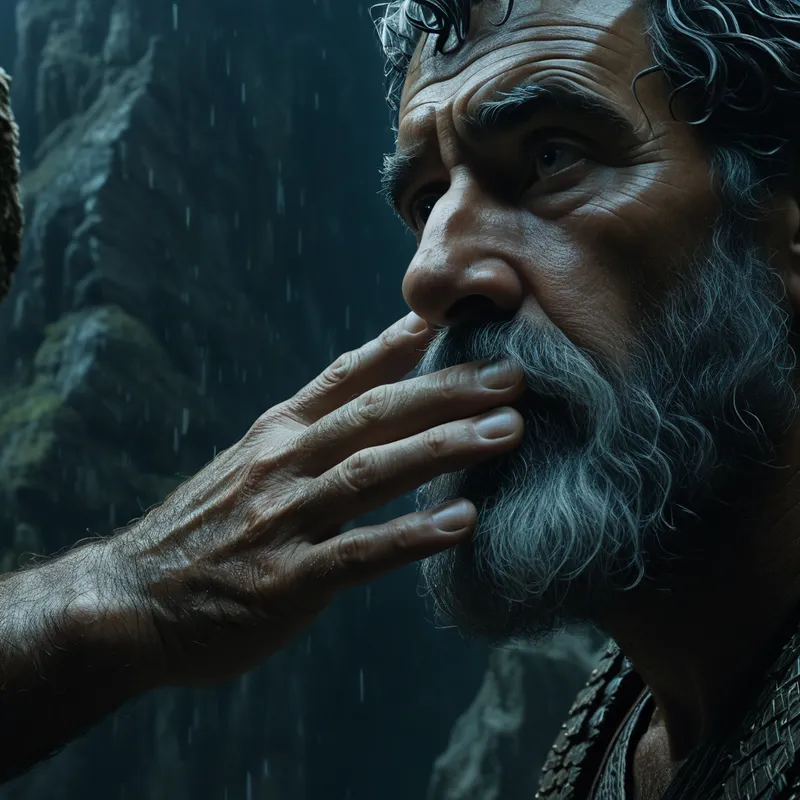
A hero stands at the world's edge, his gaze bridging the chasm between the known and the unknowable, between memory and destiny.
The Tale of Odysseus gazing across the win
The salt was a memory on his skin. The ache of the oar, a ghost in his bones. [Odysseus](/myths/odysseus “Myth from Greek culture.”/), whose name meant wrath, whose life was a tapestry of cunning, stood now where all maps frayed into whispers. He had outrun the Cyclops’s curse, navigated the seductive silence of the [Lotus-Eaters](/myths/lotus-eaters “Myth from Greek culture.”/), and heard [the sirens](/myths/the-sirens “Myth from Greek culture.”/)’ song and lived. But this was no monster’s cave nor enchantress’s isle. This was the lip of [the world](/myths/the-world “Myth from Tarot culture.”/).
They called it the win. Not a sea, for it bore no waves. Not a sky, for it lay below. It was a chasm of pure, silent potential, a vast expanse that shimmered like molten [pearl](/myths/pearl “Myth from Chinese culture.”/) and twilight fused together. To look into it was to see not a reflection, but a resonance. It hummed, a frequency felt in the teeth and the hollow of the chest, the sound of a door forever on the verge of opening.
He had been guided here by the last words of a star-navigator, a being of dust and light who spoke in tides: “To find your way, you must first lose the path. To hear your name, you must first listen to the silence between stars. Gaze across the win, king of Ithaca. Gaze, and do not blink.”
The air was thin and cold, smelling of ozone and ancient stone. The ground beneath his worn sandals was a strange, veined marble that seemed to pulse with a slow, deep heartbeat. Behind him lay the known world—the struggles, the triumphs, the beloved shape of [Penelope](/myths/penelope “Myth from Greek culture.”/)’s face slowly softening in his memory’s eye. Before him, the win. In its shimmering depths, shapes formed and dissolved: not images, but intents. He saw the ghost of a possible future—a quiet hearth, an old man’s contentment. He saw [the shadow](/myths/the-shadow “Myth from Jungian culture.”/) of a road not taken—a crown of a different kingdom, a life of unbroken peace. He saw the echo of every choice that had led him to this precipice.
His heart, that weathered drum, beat a frantic rhythm against his ribs. This was not a battle to be won with strength or a puzzle to be solved with guile. This was an invitation to surrender. To gaze was to offer up his entire story—the glory and the shame, the love and the bloodshed—and hold it against the boundless, silent question of [the abyss](/myths/the-abyss “Myth from Kabbalistic culture.”/).
Tears, unbidden and hot, carved tracks through the grime on his cheeks. They were not tears of sorrow, but of raw exposure. The win asked nothing of him, and in that asking, demanded everything. He felt his identity, the clever Odysseus, the man of twists and turns, begin to unravel at the edges. For a terrifying, exhilarating moment, he was no one. He was a point of awareness on the rim of eternity.
And then, in the heart of the shimmer, a single, steady point of light coalesced. It did not call to him. It simply was. And in its silent presence, he knew. It was not a path home. It was the true north of his soul. He did not see Ithaca. He felt its essence—the smell of [thyme](/myths/thyme “Myth from Greek culture.”/) on the hills, the sound of the loom, the weight of rightful belonging. The win had not shown him [the way](/myths/the-way “Myth from Taoist culture.”/); it had dissolved the illusion that he was ever lost. A profound stillness settled in his bones. He took one last, long look, breathing in the luminous silence. Then, without turning, he knew which step to take next. The journey had not ended. It had finally, truly begun.
Cultural Origins & Context
The tale of “Odysseus gazing across the win” emerges not from a single scroll or oral tradition, but from the collective dream of what scholars term the Global/Universal culture. It is a myth that appears in fragments—a line in an obscure geomantic text, the motif on a weathered funerary steppe of unknown origin, the recurring vision reported by mystics and long-distance sailors suffering from extreme solitude. Its transmission is one of resonance, not direct lineage.
It functions as a meta-myth, a story about the moment all heroic narratives approach but rarely depict: the point where external questing turns inward. In societal terms, it served as a narrative touchstone for cultures that valued the journey of the soul as much as the conquest of land. It was told not to inspire action, but to prepare the mind for a profound existential pivot. Bards would recite it during rites of passage, when a youth became an adult, or a leader assumed ultimate responsibility. Its purpose was to instill the wisdom that before one can master the world, one must first stand, utterly vulnerable, before the incomprehensible vastness of one’s own potential and destiny.
Symbolic Architecture
The myth is a perfect symbolic engine of the [psyche](/myths/psyche “Myth from Greek culture.”/)’s confrontation with [the Self](/myths/the-self “Myth from Jungian culture.”/). Odysseus represents the conscious ego, the “I” that has been forged through trials, cleverness, and worldly experience. He is [identity](/symbols/identity “Symbol: Identity represents the sense of self, encompassing personal beliefs, cultural background, and social roles.”/) as biography.
The win is the symbolic representation of the unconscious, not as a dark [cellar](/symbols/cellar “Symbol: A cellar represents the subconscious mind, hidden emotions, and unacknowledged aspects of the self; it is a place of storage, preservation, and sometimes decay.”/) of repressed [trauma](/symbols/trauma “Symbol: A deeply distressing or disturbing experience that overwhelms the psyche, often manifesting in dreams as unresolved emotional wounds or psychological injury.”/), but as the [pleroma](/symbols/pleroma “Symbol: In Gnostic cosmology, the Pleroma is the divine fullness or totality of spiritual powers, representing the realm of perfection beyond the material world.”/)—the [fullness](/symbols/fullness “Symbol: A state of complete satisfaction, abundance, or completion, often representing emotional, spiritual, or physical fulfillment.”/) of potential, the unmanifest [realm](/symbols/realm “Symbol: The symbol of ‘Realm’ often signifies the boundaries of one’s consciousness, experiences, or emotional states, suggesting aspects of reality that are either explored or ignored.”/) of all that one could be. It is liquid possibility. Its [shimmer](/symbols/shimmer “Symbol: A wavering, glimmering light or surface effect, often associated with illusion, magic, or subtle transformation.”/) is the allure and [terror](/symbols/terror “Symbol: An overwhelming, primal fear that paralyzes and signals extreme threat, often linked to survival instincts or deep psychological trauma.”/) of the numinous, the direct experience of which threatens to dissolve [the ego](/myths/the-ego “Myth from Jungian culture.”/)’s hard-won coherence.
The cliff’s edge is the threshold of the known self. The win is the ocean of the possible Self. To gaze is to hold the tension between them.
The act of gazing is the critical [operation](/symbols/operation “Symbol: An operation signifies a process of change or transformation that often requires deliberate effort and planning.”/). It is not passive looking, but active, sustained contemplation without [defense](/symbols/defense “Symbol: A protective mechanism or barrier against perceived threats, representing boundaries, security, and resistance to external or internal challenges.”/). It is the ego’s voluntary submission to a [reality](/symbols/reality “Symbol: Reality signifies the state of existence and perception, often reflecting one’s understanding of truth and life experiences.”/) greater than its own [story](/symbols/story “Symbol: The symbol of ‘Story’ represents the narrative woven through our lives, embodying experiences, lessons, and emotions that shape our identities.”/). The shapes seen within are not prophecies, but psychic facts—the latent potentials, the abandoned selves, the future integrations waiting within him. His tears are the [dissolution](/symbols/dissolution “Symbol: The process of breaking down, dispersing, or losing form, often representing transformation, release, or the end of a state of being.”/) of the [persona](/symbols/persona “Symbol: The social mask or outward identity one presents to the world, often concealing the true self.”/); the still point of light that finally appears is the emergent [symbol](/symbols/symbol “Symbol: A symbol can represent an idea, concept, or belief, serving as a powerful tool for communication and understanding.”/) of the Self, the central, organizing principle of the psyche that guides toward wholeness. His realization is not a finding, but a remembering of his own intrinsic, archetypal [pattern](/symbols/pattern “Symbol: A ‘Pattern’ in dreams often signifies the underlying structure of experiences and thoughts, representing both order and the repetitiveness of life’s situations.”/).
The Dreamer’s Resonance
When this myth pattern erupts in the modern dreamscape, it signals a profound somatic and psychological crossroads. The dreamer may find themselves at the edge of a breathtaking canyon, on the balcony of a skyscraper overlooking an alien cityscape, or simply staring into a mirror that reflects not their face, but a swirling, starry void.
The somatic experience is key: a feeling of both vertigo and magnetic pull, a tightening in the chest and a lightness in the head. This is the body registering the ego’s panic at its own potential expansion. Psychologically, the dreamer is at a point where their old identity—the “successful professional,” the “dutiful caregiver,” the “perpetual seeker”—has been rendered obsolete by the soul’s demand for growth. The known world (career, relationship, self-concept) feels solidly behind them, but the path forward is not a path at all; it is an open question, a terrifying freedom.
The dream is an invitation to do what Odysseus did: to stay. To feel the fear, the exposure, the longing, and to keep gazing. It is the psyche’s way of initiating a necessary death of the outworn self, not through crisis, but through a silent, awe-filled confrontation with the boundless inner space of what one might become.

Alchemical Translation
The alchemical process mirrored here is [solutio](/myths/solutio “Myth from Alchemical culture.”/)—the dissolution. In [the laboratory](/myths/the-laboratory “Myth from Alchemical culture.”/), this is the dissolving of solid matter into a primal, liquid state. In the psyche, it is the deliberate softening and dissolving of the rigid structures of the ego-complex so that a new, more authentic configuration can precipitate.
Odysseus’s entire journey is the [nigredo](/myths/nigredo “Myth from Alchemical culture.”/), the blackening—the trials, sufferings, and confusions that prepare the material. The cliff’s edge is [the alembic](/myths/the-alembic “Myth from Alchemical culture.”/), the sealed vessel where [the great work](/myths/the-great-work “Myth from Alchemical culture.”/) reaches its crisis. The win is the aqua permanens, the divine [water](/myths/water “Myth from Chinese culture.”/) that dissolves and regenerates.
The hero does not cross the win. He allows the win to cross him. Transmutation occurs not by conquest, but by permeable contemplation.
For the modern individual, this models the stage of individuation where one must cease doing and begin being with the unresolved question. It is the executive who must sit in the silence of not knowing the next career move. It is the artist who must stare at the empty canvas without forcing an image. It is the person after great loss or success, when the old story is over and the new one is not yet written.
The [triumph](/myths/triumph “Myth from Roman culture.”/) is not an answer, but a change in state. Odysseus turns from the win not with a map, but with an unshakeable inner orientation. The alchemical gold produced is not a [thing](/myths/thing “Myth from Norse culture.”/), but a quality of being: a self rooted no longer in the fragile construct of personal history, but in the enduring ground of the archetypal Self. The journey continues, but [the wanderer](/myths/the-wanderer “Myth from Taoist culture.”/) is now, and forever, guided from within.
Associated Symbols
Explore related symbols from the CaleaDream lexicon: