Odysseus and the Cyclops Myth Meaning & Symbolism
A cunning hero blinds a monstrous giant to escape his cave, a timeless allegory for the intellect confronting the primal, unseeing shadow of the psyche.
The Tale of Odysseus and the Cyclops
The wine-dark sea had grown treacherous, its whispers turning to roars. [Odysseus](/myths/odysseus “Myth from Greek culture.”/), scarred by the long war at Troy, guided his hollow ships through a mist that tasted of salt and strange earth. His heart, a [lodestone](/myths/lodestone “Myth from Greek culture.”/) for Ithaca, pulled him ever homeward, yet [the Fates](/myths/the-fates “Myth from Greek culture.”/) spun a darker thread. They were blown to an unknown shore, a land of wild goats and towering, uncut stone. In the distance, smoke curled from a high cliff—not the thin, welcoming thread of a hearth-fire, but a thick, primal plume.
Driven by a king’s curiosity and a survivor’s hunger, Odysseus took twelve of his best men. They found the source: a cave of monstrous proportions, its mouth a gaping maw in the cliffside. Inside, the air was thick with the smell of curdled milk, dung, and animal fat. Pens held bleating flocks, and cheeses as big as millstones lay stacked. This was no god’s temple, but a giant’s larder. His men pleaded to take the cheese and flee, but Odysseus, bound by the sacred laws of [xenia](/myths/xenia “Myth from Greek culture.”/), insisted they wait. He would meet this shepherd, offer gifts, and receive guest-gift in return.
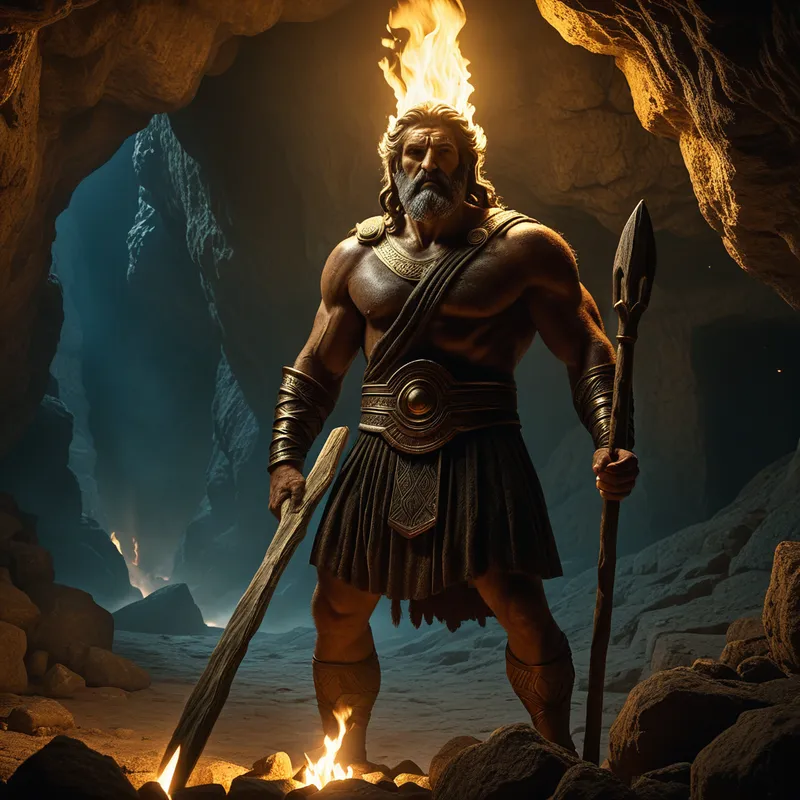
[The earth](/myths/the-earth “Myth from Hindu culture.”/) trembled. A shadow blotted out the sun at [the cave](/myths/the-cave “Myth from Platonic culture.”/)’s mouth. He entered—not a man, but a mountain that walked. A single, lidless eye burned like a dull moon in the center of his forehead. This was [Polyphemus](/myths/polyphemus “Myth from Greek culture.”/), a law unto himself. With a grunt that shook dust from the ceiling, he rolled a stone over the entrance—a stone so vast two dozen wagons could not budge it—sealing them in a tomb of living rock. The questions came: “Strangers, who are you?” Odysseus, voice steady, spoke of their trials, of Zeus, protector of guests. The Cyclops only laughed, a sound like rockslides. “We Cyclopes care not for Zeus.” In one swift, brutal motion, he seized two men, dashed their brains out on the stone floor, and devoured them.
Dawn came, a grey slit of light high above. The giant ate two more for his morning meal, then left with his flocks, sealing the cave behind him. In that terrible darkness, Odysseus’s mind, his true weapon, began its work. He found a giant olive-wood club, green and unseasoned, lying in the cave. He sharpened it to a fiery point, hardened it in the embers of the Cyclops’s fire, and hid it. When the monster returned and feasted again, Odysseus offered him the potent, unmixed wine he carried. Polyphemus drank deep, grew drowsy and friendly. “What is your name, little morsel?” he slurred.
“My name,” said Odysseus, the lie sweet on his tongue, “is Outis. Nobody.”
“Then, Nobody, I shall eat you last. A guest-gift!” roared the drunken giant, and fell into a stupor. That was the moment. Odysseus heated the stake in the fire until it glowed. With his men, he drove it deep into the single eye, twisting it like a shipwright boring a hull. The sizzle of burning flesh filled the cave, and the Cyclops’s scream was a sound to shatter sanity.
Blinded and mad with pain, Polyphemus bellowed for his brothers. They came to the cave mouth. “Who has hurt you, Polyphemus?” “Nobody! Nobody is killing me by cunning!” “If nobody is hurting you,” they replied, “then it is a sickness sent by Zeus. You must pray.” And they left.
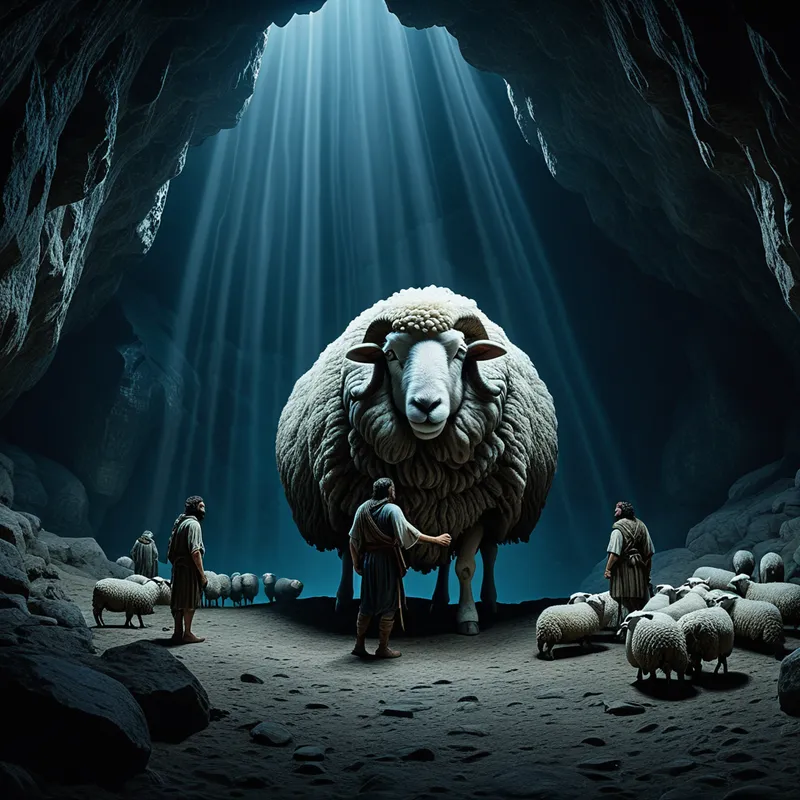
Now came the final trick. At dawn, the blinded giant moved the stone and sat at the mouth, feeling the backs of his sheep as they left to graze. But Odysseus, the weaver of wiles, tied his men beneath the shaggy bellies of the rams. He himself clung to the fleece of the largest, inching past the groping, monstrous hands. Once free, they raced to the ships. As they pushed off, Odysseus’s pride flared. He could not resist a final boast. “Cyclops! If any ask who blinded you, say it was Odysseus, sacker of cities, son of Laertes of Ithaca!”
The monster’s wail of rage shook the cliffs. He hurled a mountain peak that nearly swamped the ship. And then he prayed to his father, [Poseidon](/myths/poseidon “Myth from Greek culture.”/), that Odysseus, if he must reach home, would come late, broken, and alone. The god of the deep heard his son. The cost of outwitting the monster was now written on the waves, a curse that would stretch Odysseus’s journey home for ten bitter years.
Cultural Origins & Context
This tale comes to us from the oral tradition of the aoidoi, the bardic singers who were the living libraries of the Homeric Age. It is crystallized in the ninth book of the Odyssey, a foundational text of Greek and Western identity. For the ancient Greeks, this story was not mere entertainment; it was a cultural manifesto. It dramatized the core conflict between civilization, embodied by the cunning, word-wielding, socially-bound Odysseus, and raw, asocial nature, embodied by the solitary, lawless Cyclops.
The Cyclopes were described as living without polis, agriculture, or laws. They were the ultimate “other.” The story reinforced the supreme value of [metis](/myths/metis “Myth from Greek culture.”/) (cunning intelligence) over brute force, and the sacred, divine imperative of xenia. Polyphemus’s violation of this code justifies his horrific punishment. Furthermore, the story functioned as an etiological myth, explaining the wrath of Poseidon against Odysseus—a narrative device that accounted for the very real and terrifying perils of sea travel in the ancient Mediterranean. It was a lesson in hubris: even brilliant victory can sow the seeds of future catastrophe if not tempered with humility.
Symbolic Architecture
At its [heart](/symbols/heart “Symbol: The heart symbolizes love, emotion, and the core of one’s existence, representing deep connections with others and self.”/), this myth is a profound [drama](/symbols/drama “Symbol: Drama signifies narratives, emotional expression, and the exploration of human experiences.”/) of [consciousness](/symbols/consciousness “Symbol: Consciousness represents the state of awareness and perception, encompassing thoughts, feelings, and experiences.”/) confronting the unconscious. The cave is the classic [symbol](/symbols/symbol “Symbol: A symbol can represent an idea, concept, or belief, serving as a powerful tool for communication and understanding.”/) of the unconscious mind itself—a dark, enclosed [space](/symbols/space “Symbol: Dreaming of ‘Space’ often symbolizes the vastness of potential, personal freedom, or feelings of isolation and exploration in one’s life.”/) containing both nourishment (the cheeses, flocks) and [terror](/symbols/terror “Symbol: An overwhelming, primal fear that paralyzes and signals extreme threat, often linked to survival instincts or deep psychological trauma.”/). Polyphemus, the one-eyed giant, represents the monolithic, undifferentiated [aspect](/symbols/aspect “Symbol: A distinct feature, quality, or perspective of something, often representing a partial view of a larger whole.”/) of the [psyche](/myths/psyche “Myth from Greek culture.”/). He sees only in one way, with a single, consuming [perspective](/symbols/perspective “Symbol: Perspective in dreams reflects one’s viewpoints, attitudes, and how one interprets experiences.”/). He is the primal, instinctual [shadow](/symbols/shadow “Symbol: The ‘shadow’ embodies the unconscious, repressed aspects of the self and often represents fears or hidden emotions.”/), capable of great nurturing (he is a [shepherd](/symbols/shepherd “Symbol: A shepherd symbolizes guidance, protection, and the nurturing aspects of leadership, often reflecting the dreamer’s desire for direction or support.”/)) but also of devouring, unthinking brutality.
The hero does not defeat the monster by becoming a bigger monster, but by using the very tools the monster cannot comprehend: foresight, patience, and symbolic thought.
Odysseus represents the emergent ego-consciousness, the “I” that must navigate this inner [landscape](/symbols/landscape “Symbol: Landscapes in dreams are powerful symbols representing the dreamer’s emotional state, personal journey, and the broader context of life situations.”/). His weapons are not [strength](/symbols/strength “Symbol: ‘Strength’ symbolizes resilience, courage, and the ability to overcome challenges.”/), but metis: the sharpened stake of focused intellect, the intoxicating [wine](/symbols/wine “Symbol: Wine often symbolizes celebration, indulgence, and the deepening of personal connections, but it can also represent excess and escape.”/) of persuasive [language](/symbols/language “Symbol: Language symbolizes communication, understanding, and the complexities of expressing thoughts and emotions.”/) (which lulls the brute [nature](/symbols/nature “Symbol: Nature symbolizes growth, connectivity, and the primal forces of existence.”/)), and the transformative [riddle](/symbols/riddle “Symbol: A puzzle or enigmatic statement requiring cleverness to solve, symbolizing hidden truths, intellectual challenge, and the search for meaning.”/) of the name “Nobody.” This name is the ultimate symbolic act. By renaming himself, he enters a liminal, archetypal space where the personal ego is dissolved. The [monster](/symbols/monster “Symbol: Monsters in dreams often symbolize fears, anxieties, or challenges that feel overwhelming.”/) can only comprehend literal, physical threats; he cannot fight a “Nobody.” The blinding is not merely cruelty, but a symbolic necessity: to overcome a force that sees only its own [appetite](/symbols/appetite “Symbol: Represents desire, need, and consumption in physical, emotional, or spiritual realms. Often signals unmet needs or excessive cravings.”/), one must put out its singular way of seeing. It is the painful, violent act of forcing a one-dimensional drive into a state of chaotic, blind [confusion](/symbols/confusion “Symbol: A state of mental uncertainty or disorientation, often reflecting internal conflict, lack of clarity, or overwhelming choices in waking life.”/) so that the differentiated self can escape.
The Dreamer’s Resonance
When this myth stirs in modern dreams, it signals a profound encounter with a personal or collective “Cyclops.” You may dream of being trapped in a confined, subterranean space (a basement, a tunnel, a womb-like room) with a looming, stupid, yet overwhelmingly powerful presence. This presence might not be a literal giant, but a feeling of being consumed by a single, all-encompassing obsession, addiction, or resentment—a “one-eyed” viewpoint that has you cornered.
The somatic experience is one of visceral dread and claustrophobia, a feeling of being both prey and prisoner. The psychological process is one of ego-confrontation with an autonomous complex—a bundled set of emotions, memories, and perceptions that operates outside conscious control and “feeds” on your psychic energy. The dream asks: What massive, simple, and devouring force have you naively wandered into within yourself? Where is your intellect, your cunning (metis), lying dormant? The moment of “blinding the eye” in a dream might be shocking or violent, but it often brings a sudden, paradoxical sense of relief—the breaking of a spell. It represents the necessary, disruptive act of insight that shatters a fixed, compulsive pattern, allowing for the possibility of escape, even if into a wider sea of trouble.

Alchemical Translation
The journey of Odysseus with the Cyclops is a precise alchemical recipe for a stage of individuation. The [nigredo](/myths/nigredo “Myth from Alchemical culture.”/), the blackening, occurs in the cave: [the ego](/myths/the-ego “Myth from Jungian culture.”/) is swallowed, imprisoned in the utter darkness of the unconscious, facing annihilation. The monster represents the [prima materia](/myths/prima-materia “Myth from Alchemical culture.”/), the chaotic, base substance of the unworked psyche.
The hero’s actions model the alchemical operations. Finding the stake is inventio—discovering the hidden tool within the situation itself (the green wood of potential hardened in the fire of passion and pain). Offering the wine is [solutio](/myths/solutio “Myth from Alchemical culture.”/)—dissolving the rigid defenses of the complex with the spirit of engagement (language, emotion, even deceit as a form of engagement). The blinding is the crucial [separatio](/myths/separatio “Myth from Alchemical culture.”/) and calcinatio—the violent separation of the complex from its power source (its singular, dominating viewpoint) by the fire of conscious insight. It is a burning away.
The curse of Poseidon is the price of consciousness. To differentiate oneself from the primal mass is to incur the wrath of the elemental, parental forces that once encompassed you.
Escaping under the rams symbolizes coagulatio—a return to embodied life, but in a new, hidden, and protected way. You do not emerge shouting your own name in [triumph](/myths/triumph “Myth from Roman culture.”/). You emerge clinging to the instinctual, animal body (the ram), having learned stealth. The final, fatal boast of Odysseus is the enduring lesson: the conscious ego, having achieved a great inner victory, often reclaims its pride too soon, personalizing the archetypal victory (“I did this”). This re-invokes the wrath of the deeper, parental forces (Poseidon, the unconscious), ensuring that the journey toward wholeness—the return to the true Self (Ithaca)—remains long, arduous, and humbling. The myth thus maps not just the battle, but the enduring consequence of awakening: a life forever altered by the encounter with what lurks in the cave of [the self](/myths/the-self “Myth from Jungian culture.”/).
Associated Symbols
Explore related symbols from the CaleaDream lexicon: