Oduduwa Myth Meaning & Symbolism
The myth of the divine being who descended from the heavens with sacred elements to create the first land and establish the cradle of Yoruba civilization.
The Tale of Oduduwa
In the beginning, there was only [the sky](/myths/the-sky “Myth from Persian culture.”/), Olodumare, and the endless, watery chaos below. [The sky](/myths/the-sky “Myth from Persian culture.”/) was a realm of perfect order, a dome of luminous brass, home to the Orisha. But below… there was only the formless, roiling deep, a void of potential and mystery. From this tension between the absolute above and the nothingness below, the great commission was given.
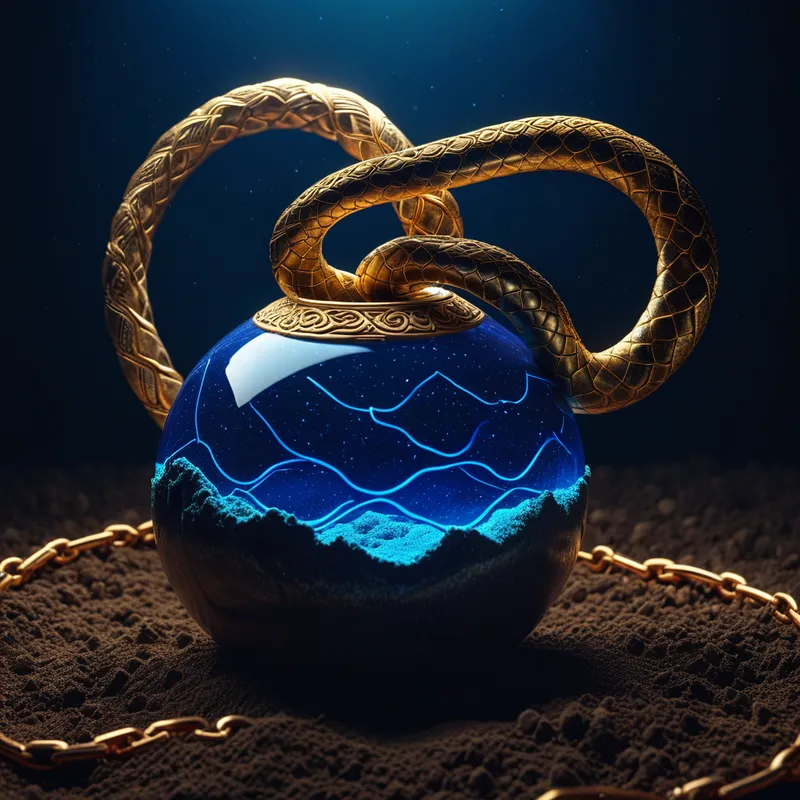
Orunmila, the seer, had spoken. [The world](/myths/the-world “Myth from Tarot culture.”/) below must be made solid, must be given form and order. The task fell to Ogun, the first artisan, the master of tools and will. He was to descend. A chain of gold was forged, linking the realm of brass to the realm of mist. Ogun, with his tools of iron and his fierce intent, began the climb down, down into the steaming, formless abyss. But the chaos was immense. The vapors were thick, the waters held no purchase. The weight of creation was too great, [the mist](/myths/the-mist “Myth from Celtic culture.”/) too blinding. Overwhelmed, Ogun faltered. He could not complete the work. He returned to the sky, his mission unfulfilled.
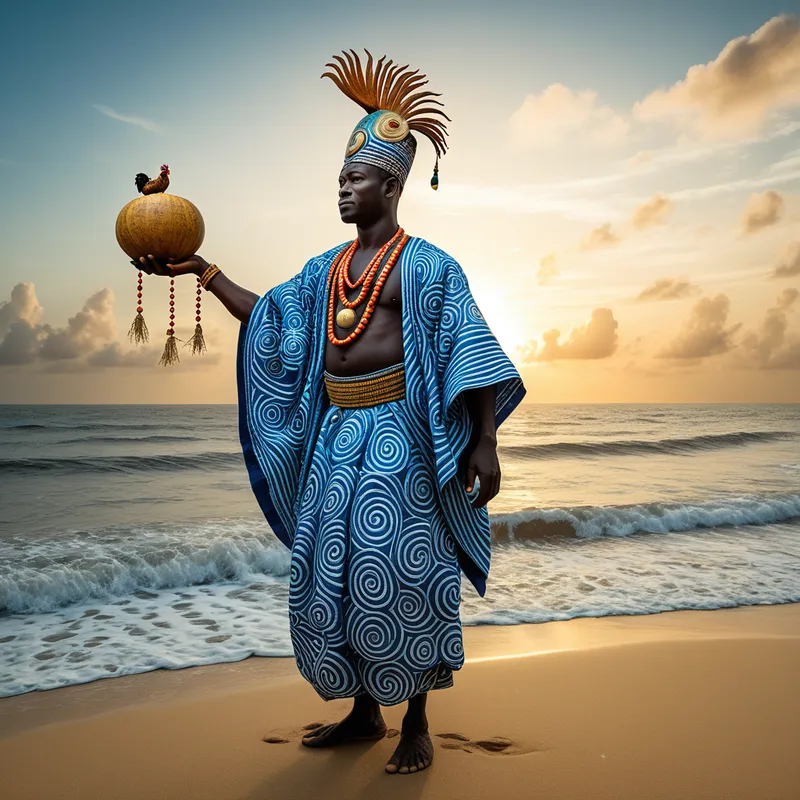
Then, from the court of Olodumare, another stepped forward. It was Oduduwa. Not with the bluster of iron, but with a quiet, profound certainty. The tools given were not of force, but of essence: a calabash filled with earth, and a five-toed chicken. The golden chain was let down once more. Oduduwa grasped it and began the descent, not as a conqueror, but as a bearer of seeds. Down, down through [the veil](/myths/the-veil “Myth from Various culture.”/) of clouds, into the heart of the primordial ocean.
His feet touched the waters, and they offered no foundation. Here, at the axis of nothing, Oduduwa opened the calabash. He poured the dark, rich soil onto the watery expanse. It did not sink, but spread. Then, he released the chicken. The creature scrambled onto the mound of earth, and with its five claws, it scratched and scattered. It scratched not in anger, but in a sacred, frantic act of creation. Where each clod of earth fell, land swelled and solidified. The chaotic waters receded, bound by the spreading continent. The first earth, Ile-Ife, was born from this alchemy of descent, soil, and sacred animal labor.
And there, upon the newly formed earth, Oduduwa planted a palm nut. It sprouted instantly, growing into sixteen great branches, a living testament to the act. He became the first Ooni, the ruler of this new world, the progenitor of kings, the father of nations. The chain dissolved, its purpose served. The bridge between heaven and earth was now memory, and the work of human history could begin.

Cultural Origins & Context
This myth is the foundational narrative of the Yoruba people, one of Africa’s most influential cultural and linguistic groups, primarily located in southwestern Nigeria and parts of Benin and Togo. It is not merely a story of creation, but the story of specific creation—the origin of the Yoruba world and its sacred monarchy. It was and is preserved through oral tradition, recited by Arokin and priests during important festivals, coronations, and rites of passage, particularly in the holy city of Ile-Ife, regarded as the cradle of Yoruba civilization.
Its societal function is multifaceted. It establishes divine sanction for the institution of kingship (the Ooni of Ife is seen as a direct descendant of Oduduwa), provides a cosmological map linking humanity to the divine (Olodumare), and offers an etiological explanation for the landscape and the order of the world. The myth is a living charter, continuously invoked to validate social hierarchy, political authority, and collective identity. It answers the profound human questions: Where do we come from? Why are we here? And by whose authority do we govern ourselves?
Symbolic Architecture
At its core, the myth of Oduduwa is a profound [metaphor](/symbols/metaphor “Symbol: A figure of speech where one thing represents another, often revealing hidden connections and deeper truths through symbolic comparison.”/) for the [emergence](/symbols/emergence “Symbol: A process of coming into being, rising from obscurity, or breaking through a barrier, often representing birth, transformation, or revelation.”/) of [consciousness](/symbols/consciousness “Symbol: Consciousness represents the state of awareness and perception, encompassing thoughts, feelings, and experiences.”/) and [identity](/symbols/identity “Symbol: Identity represents the sense of self, encompassing personal beliefs, cultural background, and social roles.”/) from the unconscious. The primordial [ocean](/symbols/ocean “Symbol: The ocean symbolizes the vastness of the unconscious mind, representing deeper emotions, intuition, and the mysteries of life.”/) represents the undifferentiated, potential-filled state of the unconscious [psyche](/myths/psyche “Myth from Greek culture.”/)—formless, teeming, but without [structure](/symbols/structure “Symbol: Structure in dreams often symbolizes stability, organization, and the framework of one’s life, reflecting how one perceives their environment and personal life.”/). The sky, Olodumare, symbolizes the transcendent [source](/symbols/source “Symbol: The origin point of something, often representing beginnings, nourishment, or the fundamental cause behind phenomena.”/), the [realm](/symbols/realm “Symbol: The symbol of ‘Realm’ often signifies the boundaries of one’s consciousness, experiences, or emotional states, suggesting aspects of reality that are either explored or ignored.”/) of pure archetypal patterns and order.
The hero is not the one who forces order with will alone, but the one who carries the sacred elements of the self into the chaos to allow creation to happen.
Oduduwa’s descent on the chain is the archetypal [journey](/symbols/journey “Symbol: A journey in dreams typically signifies adventure, growth, or a significant life transition.”/) of incarnation—the descent of [spirit](/symbols/spirit “Symbol: Spirit symbolizes the essence of life, vitality, and the spiritual journey of the individual.”/) into matter, of a potential identity into the messy [reality](/symbols/reality “Symbol: Reality signifies the state of existence and perception, often reflecting one’s understanding of truth and life experiences.”/) of existence. The failure of Ogun signifies that raw willpower and technology are insufficient for true [foundation](/symbols/foundation “Symbol: A foundation symbolizes the underlying support systems, values, and beliefs that shape one’s life, serving as the bedrock for growth and development.”/); they cannot create a home for the [soul](/symbols/soul “Symbol: The soul represents the essence of a person, encompassing their spirit, identity, and connection to the universe.”/). Oduduwa succeeds because his tools are elemental and relational: [earth](/symbols/earth “Symbol: The symbol of Earth often represents grounding, stability, and the physical realm, embodying a connection to nature and the innate support it provides.”/) ([the principle](/symbols/the-principle “Symbol: A fundamental truth, law, or doctrine that serves as a foundation for a system of belief, behavior, or reasoning, often representing moral or ethical standards.”/) of substance, [body](/symbols/body “Symbol: The body in dreams often symbolizes the dreamer’s self-identity, personal health, and the relationship they have with their physical existence.”/), and grounded [reality](/symbols/reality “Symbol: Reality signifies the state of existence and perception, often reflecting one’s understanding of truth and life experiences.”/)) and the five-toed [chicken](/symbols/chicken “Symbol: Chickens often symbolize fear, anxiety, or vulnerability, as well as domesticity and nurture depending on the context of the dream.”/) (instinct, embodied [life](/symbols/life “Symbol: The symbol of ‘Life’ represents a journey of growth, interconnectedness, and existential meaning, encompassing both the joys and challenges that define human experience.”/) force, the natural [action](/symbols/action “Symbol: Action in dreams represents the drive for agency, motivation, and the ability to take control of situations in waking life.”/) that transforms substance). The creation is a cooperative act between the divine messenger and the animal instinct.
The resulting land, Ile-Ife, translates to “The House that is Wide” or “The Land of [Expansion](/symbols/expansion “Symbol: A symbol of growth, increase, or extension beyond current boundaries, often representing personal development, opportunity, or overwhelming change.”/).” It is the nascent ego, the first stable ground of consciousness carved out from the boundless unconscious. The planted [palm tree](/symbols/palm-tree “Symbol: The palm tree symbolizes tropical paradise, relaxation, and resilience, often reflecting a sense of freedom.”/), with its sixteen branches, symbolizes the organic growth and diversification of this consciousness into the complexities of culture, [lineage](/symbols/lineage “Symbol: Represents ancestral heritage, family connections, and the transmission of traits, values, and responsibilities across generations.”/), and individuality.
The Dreamer’s Resonance
When this myth stirs in the modern psyche, it often manifests in dreams of profound beginnings or foundational crises. One might dream of descending a fragile ladder or chain into a dark, watery abyss, feeling the terror and awe of leaving a known state for a formless one. This somatic sensation mirrors the psychological process of venturing into the unknown depths of [the self](/myths/the-self “Myth from Jungian culture.”/) to establish something new—leaving a job, ending a relationship, or beginning therapy.
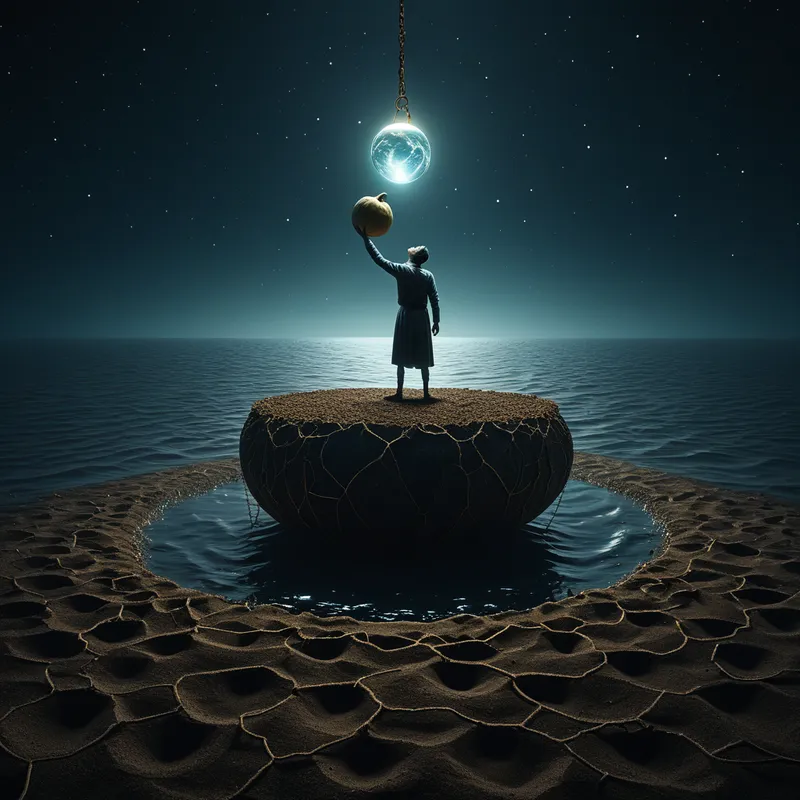
Dreams of scattering soil or seeds on [water](/myths/water “Myth from Chinese culture.”/), or of a bird or animal frantically creating order, point to the active, often anxious, phase of building a new identity. The dream ego is in the role of the chicken, not the deity—it is the instinctual, bodily intelligence working tirelessly to make the psychic “earth” solid. This can correlate with periods of intense practical effort to build a new life structure. Conversely, dreaming of standing on a tiny, precarious island in a vast sea captures the feeling of isolation and immense responsibility that comes with being the “first,” the founder of one’s own path, bearing the weight of self-creation.
Alchemical Translation
For the individual, the Oduduwa myth models the alchemical process of coagulatio—the making solid, the embodiment of spirit. The psychic transmutation it outlines is the journey from a state of diffuse potential (the watery chaos) to a grounded, individuated self (the land of Ile-Ife).
The first step is recognizing the failure of the “Ogun complex”—the realization that force, intellect, or sheer will cannot, by themselves, create a sustainable inner foundation. This leads to a necessary humility. The second step is the “descent,” a voluntary lowering of oneself into one’s own unresolved, emotional, and instinctual depths (the unconscious). This is an act of courage that feels like a loss of status or clarity.
Individuation begins not with building upwards, but with a sacred descent, carrying the simple, humble tools of self-acceptance (earth) and life force (instinct) into the inner void.
The “calabash of earth” represents the accepted, often humble, truths of one’s nature: one’s body, one’s history, one’s raw material. The “five-toed chicken” is the unleashed, trusting instinct to engage with that material—to write, to create, to relate, to move—without a guaranteed plan. The act of “scattering” is the daily, often messy, work of living from this new center, allowing a firm sense of self to coalesce through action.
Finally, becoming the “Ooni” upon the new land symbolizes achieving sovereignty over this newly created inner territory. The chain to heaven is gone; you are no longer solely defined by your source (parents, past, ideals) but are the ruler of your own experienced reality. The palm tree you plant is your lasting contribution, the unique life that grows from this hard-won ground. Thus, the myth translates from cosmic creation to a personal mandate: you are both Oduduwa, the bearer of potential, and the chicken, the instinct that makes it real, tasked with creating the solid ground of your own being from the chaos of experience.
Associated Symbols
Explore related symbols from the CaleaDream lexicon: