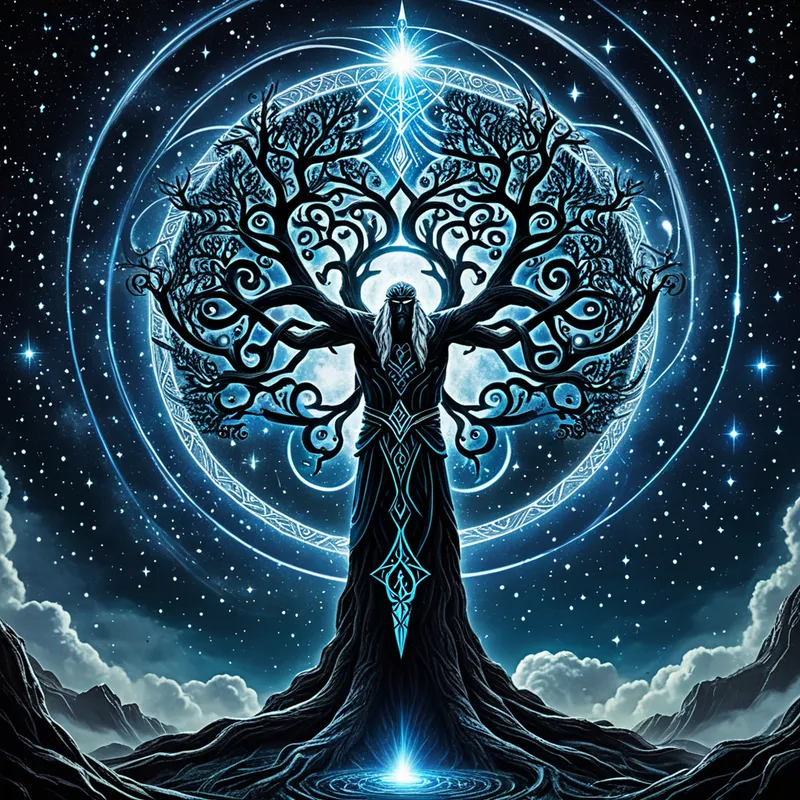
Odin's Self-Sacrifice Myth Meaning & Symbolism
The Allfather Odin hangs himself from the World Tree, pierced by a spear, to gain the ultimate wisdom of the runes.
The Tale of Odin’s Self-Sacrifice
Hear now a tale not of battle-glory, but of a deeper, more terrible victory. It begins in the silence before the worlds, in the whispering space between the roots of the great Yggdrasil. Here, where the three Norns draw water from the Well of Urd, a hunger stirred in the heart of the Allfather.
Odin, lord of the Aesir, who traded an eye for a drink from Mimir’s Well, found his vast knowledge was but a cupful from an ocean. He yearned for the source-code of reality itself, the primal patterns that shaped destiny: the runes. But this wisdom was not given. It had to be taken, and the price was everything.
He journeyed to the deepest root, where the tree’s bark was like ancient stone and the air thrummed with potential. There, with a resolve that shook the foundations of his own being, Odin took up his own spear, Gungnir. He did not raise it against a foe. Instead, he offered himself to the tree. He hung himself, a willing victim, upon the gnarled limb of Yggdrasil. He was the sacrifice and the sacrificer. He drove Gungnir deep into his own side, a wound of total commitment.
For nine nights and nine days, the god hung. The winds of the nine worlds scoured his flesh. The cold seeped into his bones. Hunger and thirst became his only companions. He stared, with his one remaining eye, into the abyss of the well below, peering into the layers of being. He died to himself. The Odin who was king, father, warrior—that self was stripped away, leaving only raw, seeking consciousness.
On that final, longest night, at the brink of dissolution, a shift occurred. The pain did not cease, but it transformed. From the depths of his agony, from the void he had willingly embraced, a light kindled. Not a light to see by, but a knowing to see with. The runes, hidden since the dawn of time, perceived his ultimate offering. They ceased their hiding. They surged upward from the roots, spiraling from the well, burning themselves into his mind, his spirit, his very soul. With a gasp that was both a death rattle and a first breath, he saw. He grasped them. He knew their names, their sounds, their terrible and creative power.
He fell from the tree, not as a broken thing, but as one reborn. The wound remained, but it was now a wellspring. He was no longer just Odin. He was Hangatyr, the god of the hanged, master of the runes. He had paid the price, and the universe had yielded its deepest secret.
Cultural Origins & Context
This myth, found in the Old Norse poem Hávamál (“Sayings of the High One”), is presented in Odin’s own voice. It was not a story told about a god, but a wisdom poem recited by the god, a first-person account of the origin of magical and poetic power. This places it in a unique category: sacred autobiography. It was likely preserved and transmitted by skalds (poets) and practitioners of seidr, for whom the runes were both an alphabet and a system of magical operation.
In the warrior-honor culture of the Norse, where death in battle was the ideal, this myth presented a radical, parallel path to power: the victory won not over others, but over the self. It functioned as an initiatory template, explaining the source of Odin’s authority as the god of wisdom, magic, and poetry. It justified why the patron god of kings and warriors was also the god of the outcast, the madman, and the shamanic practitioner who traversed boundaries. The myth served as the foundational narrative for the entire concept of Óðr, the ecstatic, inspired state that fueled both poetry and battle-fury.
Symbolic Architecture
At its core, Odin’s ordeal is a master symbol of the psyche’s journey to attain transformative knowledge. It is not an intellectual pursuit, but a somatic, existential crisis.
The tree is the axis of the world, and to be fastened to it is to be fastened to the structure of reality itself. The hanging is a suspension of the ordinary ego, a state of liminal betwixt-and-between where old identities are deconstructed.
The spear, Gungnir, is not merely a weapon but an instrument of precise, willing penetration. It represents the focused intent that must pierce through the layers of self-deception and comfort. The wound it creates is not a defeat, but an opening—a channel through which the numinous can enter. The nine nights and days signify a complete cycle of gestation, the time needed for a psychic death and rebirth.
The runes themselves symbolize the archetypal patterns of the collective unconscious. They are the fundamental code. To gain them, one must offer one’s familiar consciousness—the “I” that thinks it knows—as a sacrifice to the greater, transpersonal Self. Odin’s single eye represents the focused, conscious mind, while the sacrifice on the tree opens him to the wisdom of the unconscious, symbolized by the hidden well and the tree’s roots.
The Dreamer’s Resonance
When this myth stirs in the modern dreamer, it often manifests not as a literal image of Odin, but as the pattern of the ordeal. One may dream of being trapped in the branches of a vast, ominous tree; of undergoing a painful medical procedure that feels initiatory; of being pierced by light or knowledge in a way that is simultaneously agonizing and enlightening. The somatic feeling is one of suspension, pressure, and a paradoxical mix of helplessness and intense focus.
Psychologically, this signals a profound initiation crisis. The dreamer’s old psychological structures—a career identity, a long-held belief, a way of relating to the world—are being “hung up” and dismantled. The ego is in a state of crucifixion, feeling sacrificed to an unknown demand from the depths of the psyche. The process is one of necessary suffering for the purpose of accessing a deeper layer of personal truth or creative potential. It is the psyche’s way of forcing a confrontation with the price of genuine growth, asking: What are you willing to give up to become who you are meant to be?
Alchemical Translation
The alchemical process mirrored here is the nigredo—the blackening, the dissolution, the putrefaction. It is the first and most crucial stage where the base matter of the personality is broken down into its constituent parts. Odin on the tree is the prima materia subjected to the fire of suffering and the water of the unconscious.
Individuation is not self-improvement; it is self-surrender to a process greater than the ego. The gallows of Yggdrasil is the crucible where the lead of the petty self is transmuted into the gold of the authentic Self.
For the modern individual, this myth models the journey of “dying to live.” It teaches that our most profound insights and creative powers are often locked behind a door that only opens inward, through a voluntary crisis. The “spear” might be a devastating truth we must finally admit to ourselves. The “hanging” is the period of depression, stagnation, or loss that follows, where we feel alienated from our old life. The “nine nights” are the necessary duration of this liminal, painful processing, which cannot be rushed.
The ultimate “grasping of the runes” is the emergence of a new, more complex consciousness. It is the hard-won wisdom, the authentic voice, the creative vision that could only be born from that specific sacrifice. One does not return from such an experience “healed” in a simple sense, but rather initiated—marked by the wound, but empowered by the knowledge that flowed through it. The individual becomes, in a small way, their own Hangatyr, a ruler of the inner space where death and wisdom meet.
Associated Symbols
Explore related symbols from the CaleaDream lexicon: