Odin's Sacrifice Myth Meaning & Symbolism
The Allfather endures agony, hanging from Yggdrasil, pierced by his own spear, to win the runes and the terrible wisdom of the cosmos.
The Tale of Odin’s Sacrifice
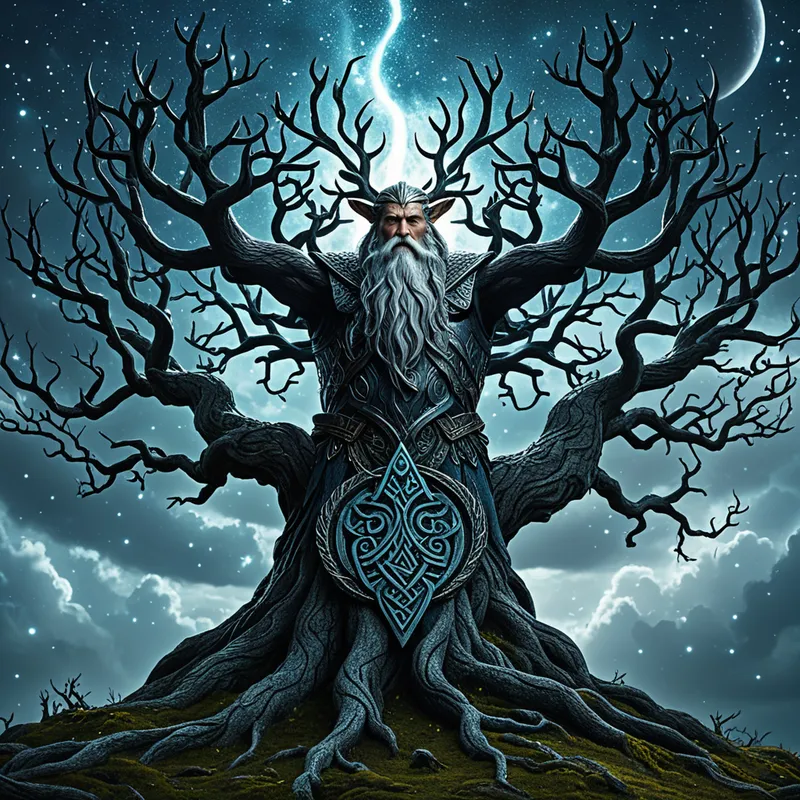
Hear now of the price of sight, of the wound that opens the world. In the time before memory, when the roots of the Yggdrasil drank from wells of fate and mist, the Allfather, Odin, walked the worlds with a hunger that no feast could sate. He was lord of the slain, father of kings, yet a hollow wind howled in the chamber of his knowing. He possessed power, but not understanding; he saw the tapestry of the Æsir and Jötnar, but not the threads that spun it, nor the shears that would one day cut it.
This hunger drove him to the heart of all things, to the Yggdrasil itself, the great ash whose branches hold the nine worlds. There, at the root that gnaws at the well of Mímisbrunnr, he made his choice. Not with thunder or army, but with a terrible, silent will. He took up his own spear, Gungnir, the oath-breaker, the battle-starter. And he offered himself to himself.
He hanged himself upon the windswept bough of the World Tree. He was the sacrifice and the sacrificer. He drove the point of Gungnir deep into his own side, a wound from which no mead would flow, only the slow seep of divine life. For nine nights and nine days, a number of becoming and ending, he hung there. No friend brought him bread, no kin brought him horn. The winds of Jötunheimr lashed him. The cold of Hel bit into his bones. He stared, unblinking, into the abyss of the well below, peering past the waters into the dark mud of origin.
He died there, but did not perish. He hung between the worlds, neither in Ásgarðr nor Miðgarðr, a threshold-dweller at the axis of the cosmos. On the final, desperate edge of that agony, as the dawn of the ninth day bled into the sky, his sacrifice was answered. Not by a voice, but by a seeing. A crack opened in the fabric of his being. Down in the depths, something stirred—not the water, but the pattern within the water. He saw them. They were not given; they were won. The Runes. They roared up from the well, burning with a silent, terrible light, carving themselves into his mind, his eye, his very soul. With a final, gasping cry that was both a death rattle and a birth scream, he knew them. He fell from the tree, whole and shattered, forever changed. The price was an eye, traded for a well. The prize was a wisdom that weighs heavier than any crown.
Cultural Origins & Context
This stark narrative is preserved primarily in the Old Norse poem Hávamál (“The Sayings of the High One”), a collection of wisdom verses attributed to Odin himself, found within the Poetic Edda. It was not a tale for the feasting hall’s general merriment, but likely for the initiated: the skalds (poets) who wielded the magic of language, the seers (völvas) who peered into fate, and perhaps the rulers seeking the terrible clarity of sovereignty. Its transmission was oral, a whispered mystery passed between those who understood that true power required a terrifying exchange.
In the worldview of the pre-Christian Norse, knowledge was not a passive accumulation but an active, often violent, conquest. The cosmos was a hostile, animate place where order was wrestled from chaos at great cost. Odin’s sacrifice models this fundamental principle. It legitimized the pursuit of hidden wisdom (forbidden even to gods) and framed it as the ultimate heroic act—a heroism turned inward. For a culture facing a harsh climate and existential threats, the myth provided a template: to gain what is necessary for survival and order, one must be willing to pay a price from one’s own substance. It sacralized the concept of the “wound that teaches,” making Odin, the wounded king-god, the patron of all who seek beyond the obvious.
Symbolic Architecture
The myth is a perfect, brutal allegory for the birth of consciousness. Odin begins as the ruler of the external world but is ignorant of its inner workings—a psyche identified with power but not with depth. The Yggdrasil is the axis of reality, the structure of the psyche itself. To gain wisdom, the ego (Odin as sovereign) must willingly suspend its dominion and offer itself up to the larger Self.
The self is sacrificed to the Self. The known is offered to the unknown to become the knowing.
The spear, Gungnir, is his own will and penetrating intellect, turned inward. The wound is the necessary rupture in the ego’s integrity, creating a vessel to receive something new. Hanging for nine nights signifies the liminal, gestational period of transformation, a descent into the unconscious (the well) where the old identity dissolves. The Runes are the primordial patterns of meaning, the archetypal code of reality. They are not invented but discovered through ordeal. The loss of the eye is profound: it represents the surrender of one-dimensional, outward perception for the inner sight of insight. He trades literal light for symbolic illumination.
The Dreamer’s Resonance
When this myth stirs in the modern dreamer, it often manifests as dreams of suspension, piercing, or a costly revelation. You may dream of hanging in a void, tethered to a great tree or structure, feeling neither pain nor panic but a solemn, dreadful purpose. You might dream of a wound in your side that does not bleed blood but light, or of a key that must be swallowed to be used. The somatic experience is one of weightlessness coupled with profound pressure—the chest feels tight, the mind acutely clear yet burdened.
Psychologically, this signals a pivotal moment of initiatory suffering. The dreamer is enduring a voluntary, if terrifying, process of deconstruction. An old way of seeing the world (the sacrificed eye) is being relinquished. This is not a trauma inflicted from outside, but a self-chosen ordeal to integrate a piece of shadow or genius that has been too costly to acknowledge. The dream says you are on the tree, in the between-space, paying the price for a wisdom your waking life is about to demand of you.
Alchemical Translation
The alchemical process mirrored here is solve et coagula: dissolve and coagulate. Odin’s fixed identity as ruler is dissolved on the tree—he becomes fluid, marginal, dead to his old self. From that state of suspension, the new knowledge (the Runes) coagulates, forming a new, more complex psychic structure.
For the individual on the path of individuation, Odin’s journey is the ultimate map for integrating the Self. We are all, in our ways, rulers of our small, defended kingdoms. The myth instructs us that to become whole, we must willingly impale our own pride, our defended viewpoints, on the spear of honest self-inquiry. We must hang in the uncertainty of not-knowing, allowing our old certainties to die.
The runes are not found in safety, but forged in the vulnerability between one breath and the next, where the ego yields to the archetype.
This is the translation: the pursuit of depth psychology, spiritual insight, or authentic creativity is an Odinic sacrifice. You offer your time, your comfort, your cherished illusions (the eye) to the process. You hang in the discomfort of therapy, the silence of meditation, the frustration of the blank page. And if you endure, you do not simply receive information. You are imprinted with a new way of being. You gain the runes—a living, embodied understanding that transforms your very perception. You return from the tree wounded, yes, but empowered with the language of the depths, able to navigate not just the world, but the world-within-the-world. You become, in your own measure, a sage who has paid the price.
Associated Symbols
Explore related symbols from the CaleaDream lexicon: