Odin's Runes Myth Meaning & Symbolism
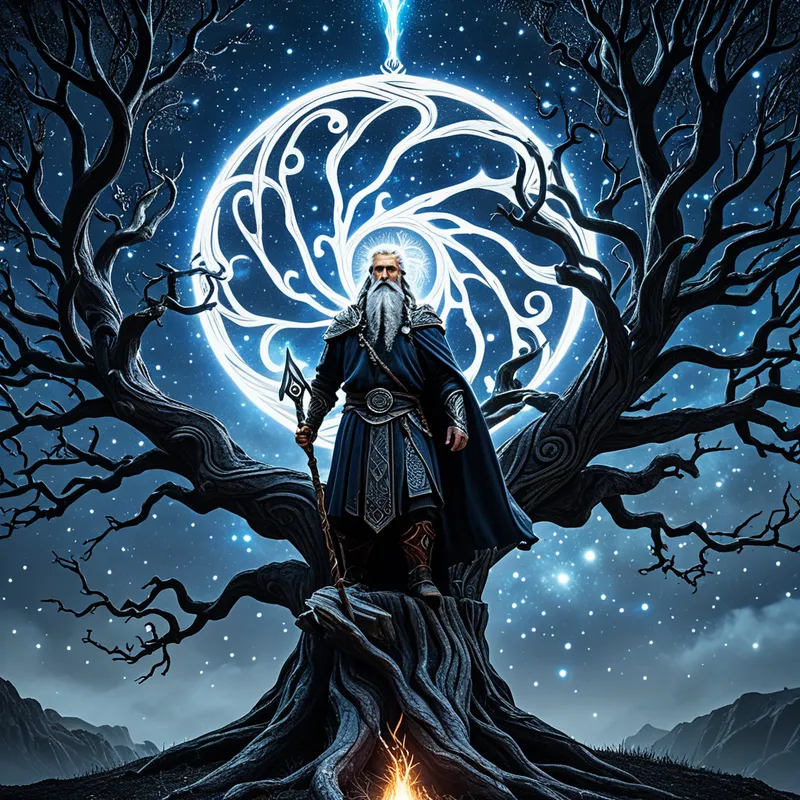
The Allfather hangs for nine nights on the World Tree, pierced by his own spear, to win the secret of the runes from the Well of Urd.
The Tale of Odin’s Runes
Listen. In the time before time, when the mists of Ginnungagap still clung to the bones of the worlds, there was a hunger. It was not a hunger of the belly, but of the mind—a deep, gnawing void that only the Allfather, Odin, knew. He, who had already traded an eye for a drink from Mimir’s Well, thirsted for more. He sought the secret of the runes, the primal letters that held the pattern of all that is, was, and will be. They were not to be found in books or spoken by sages. They were hidden in the deep, dark places of the world, woven into the roots of reality itself.
His journey led him to the heart of all things: the great Yggdrasil, the ash tree whose branches hold the heavens and whose roots drink from the wells of fate. At its base, where the root delves into the realm of ice and mist, lies the Well of Urd. Here, the runes slept in the silent waters, in the whispering soil. Odin knew the price. The cosmos does not give its deepest secrets; they must be won, torn from the fabric of being through ordeal.
With a resolve that shook the foundations of his own being, the god took up his own spear, Gungnir. He drove it deep into his side. Then, with a cry that was both a renunciation and a plea, he cast himself from the tree. He did not fall. He hung. Suspended between the worlds, pierced by his own weapon, he was offered to himself. For nine nights and nine days, a sacred cycle of death and gestation, he hung. The winds of the high branches tore at him. The cold seeped into his bones. His vision swam with pain and starvation. He was a sacrifice to himself, dangling over the abyss of unknowing.
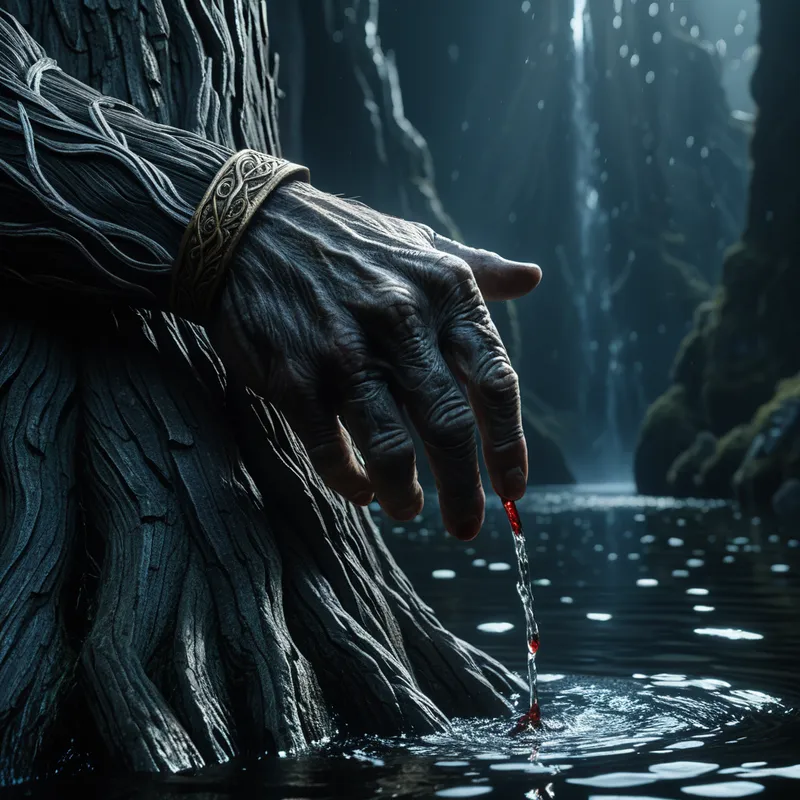
He stared into the dark waters of the well. He stared past his own agony, past the veil of the visible. And on the ninth night, as his life-force ebbed to its lowest tide, a change stirred. The runes, sensing the totality of his offering, awoke. They did not float up gently. They roared up from the depths, searing themselves into his awareness—not as shapes to be seen, but as living forces to be known. They carved their truth into his spirit. With the last of his strength, he reached down, his fingers breaking the surface of the well, and he took them. The ordeal was complete. He fell from the tree, reborn, bleeding wisdom. He had died to his old self and risen, the master of the hidden language of the universe.
Cultural Origins & Context
This powerful narrative is preserved primarily in the Old Norse poem Hávamál (“The Sayings of the High One”), found within the Poetic Edda. It is Odin himself, in the first-person, who recounts this harrowing experience. This is critical: the myth was transmitted not as a third-party legend but as a direct teaching from the god of wisdom. It was likely recited by skalds (poets) and storytellers, for whom Odin was also a patron. The function was multifaceted. On one level, it was an etiological myth explaining the divine origin of the runic alphabet used for writing, magic, and divination. On a deeper societal level, it modeled the ultimate Viking-age virtues: relentless pursuit of knowledge (fjölkyngi) and the acceptance of extreme hardship and self-sacrifice (blót) to achieve a higher purpose. It framed wisdom not as a gentle acquisition but as a hard-won prize, legitimizing the often brutal realities of a culture that valued strength, cunning, and oracular power.
Symbolic Architecture
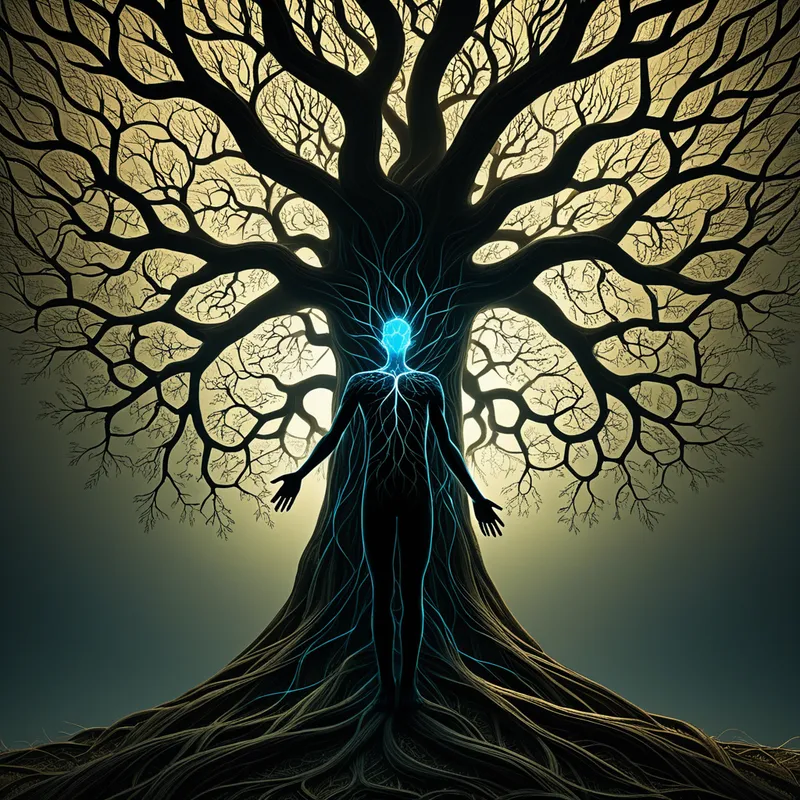
The myth is a perfect symbolic map of the psyche’s journey to attain true consciousness. Yggdrasil is the axis of the Self, the structure of the total personality connecting the conscious ego (the heights), the personal unconscious (the trunk and lower branches), and the collective unconscious (the roots and wells). Odin’s act is the ultimate ego-sacrifice.
To gain the language of the soul, one must first be rendered speechless by it. The ego must be pierced by its own seeking and left hanging, identity suspended, to hear the whispers from the deep.
The spear, Gungnir, represents focused will and intent. By turning this will upon himself, Odin initiates a sacred wounding—a necessary rupture in the ego’s defenses to allow the contents of the unconscious to flood in. The nine nights signify a full cycle of dissolution and incubation, the psychic “dark night of the soul.” The Well of Urd is the wellspring of ancestral memory, fate, and the archetypal patterns themselves—the collective unconscious. The runes are the archetypes in their most primal, formative state; they are the fundamental psychic structures that shape reality. Odin does not “learn” them; he internalizes them through a transformative suffering that alters his very substance.
The Dreamer’s Resonance
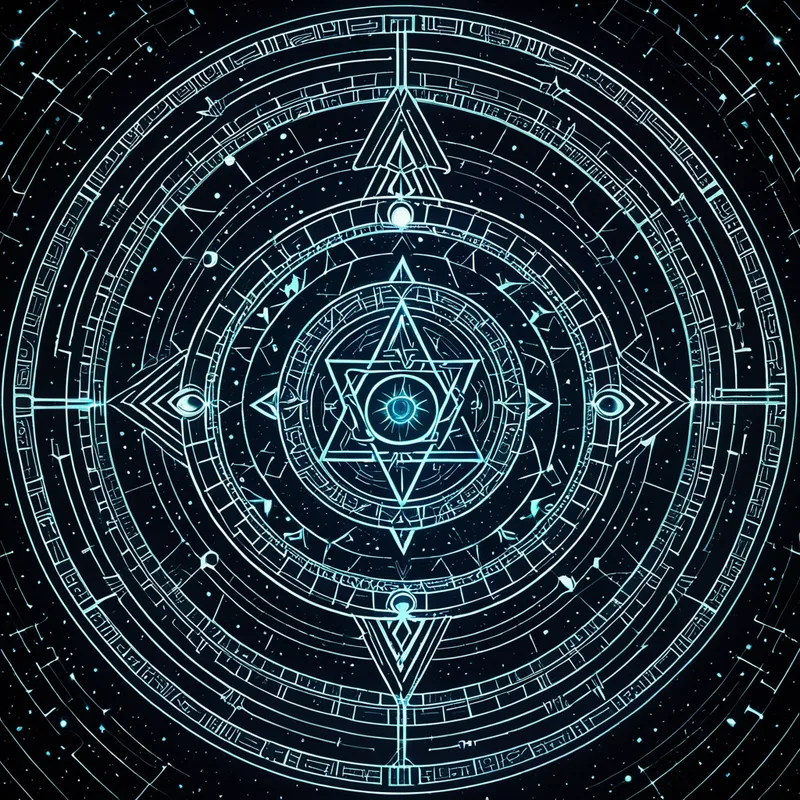
When this myth stirs in the modern dreamer, it often manifests as dreams of suspension, piercing, or cryptic inscriptions. You may dream of hanging from a great tree or cliff, not in terror, but in a state of agonized waiting. You may dream of a wound in your side, or of being impaled by an object of your own creation—a pen, a tool, a thought. You may see strange symbols carved into walls, your skin, or floating in water.
Somatically, this can correlate with feelings of being “in limbo,” of a painful transition where old identities are dying but the new shape has not yet formed. Psychologically, you are in the midst of a profound initiation. The conscious mind (the ruling Odin-ego) has pursued a deep truth—about your purpose, your shadow, your creative core—and has now encountered the price: the voluntary surrender of control, comfort, and known identity. The dream is the psyche’s enactment of the hanging. It is a process of being dismantled by your own deepest quest. The conflict is between the will to know and the terror of the death required to truly know.
Alchemical Translation
For the individual, Odin’s ordeal is the alchemical model of individuation—the process of becoming a whole, integrated Self. The first step, nigredo (the blackening), is the hanging itself: the ego’s despair, depression, and feeling of being lost in the dark. The piercing is the separatio, where what was whole is divided so that essence can be extracted from dross.
The runes are the lapis philosophorum, the philosopher’s stone of the psyche. They are not answers, but the primordial questions etched into the soul’s substance, the tools with which one can reconstitute a world.
The nine nights are the solutio (dissolution) and coagulatio (coagulation), where the old self dissolves in the waters of the unconscious and a new consciousness slowly solidifies around the hard, earned truths (the runes). Finally, grasping the runes is the rubedo (reddening), the awakening and integration. The modern seeker undergoes this not on a tree, but in the crucible of life crises, therapy, artistic creation, or spiritual practice. We “hang ourselves” when we commit to a truth that dismantles us—leaving a career, ending a destructive pattern, facing a childhood trauma. We are pierced by our own insight. And if we endure the ordeal, we do not simply recover; we gain a new language. We gain the runic perception: the ability to see the hidden patterns in chaos, to discern fate in chance, and to wield the symbolic power to reshape our inner and outer worlds. We become, in a humble, human sense, a sage who paid the price.
Associated Symbols
Explore related symbols from the CaleaDream lexicon: