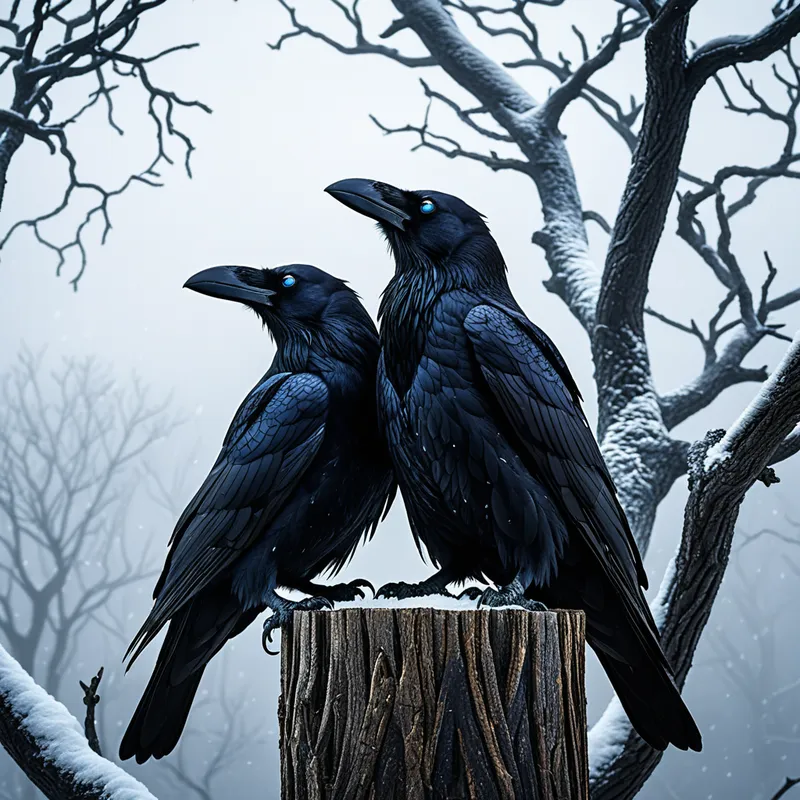
Odin's Ravens, Huginn and Muninn Myth Meaning & Symbolism
The Allfather Odin sends his two ravens, Thought and Memory, across the worlds each dawn to gather all knowledge, making their return his greatest fear.
The Tale of Odin’s Ravens, Huginn and Muninn
Hear now a tale whispered by the wind in the high branches of Yggdrasil. It is a tale of a silent vigil, of a hunger that can never be sated, and of two dark messengers who are the breath of a god’s mind.
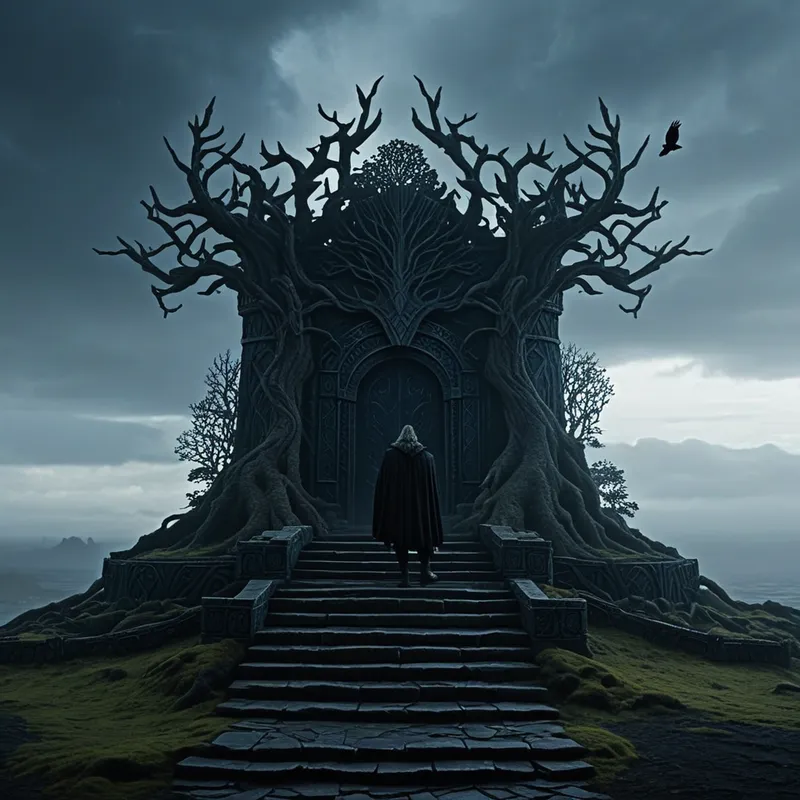
In the high halls of Asgard, where the mead flows like rivers of gold and the echoes of past wars linger in the rafters, there sits a throne. It is not like other thrones. This is Hlidskjalf, and upon it rests a figure of terrible majesty. He is Odin, the Allfather, the God of the Hanged. One eye gazes outward, a blue flame seeing the shape of things to come; the other is a hidden well of darkness, sacrificed for a drink from the Well of Mimir. He does not rest. He cannot.
For with the first grey fingers of dawn, a rustle of night-black feathers stirs the cold air. Upon his broad shoulders, two shapes coalesce from the gloom: Huginn and Muninn. Thought and Memory. They are not mere birds, but extensions of his own being, his scouts upon the tree of worlds. He speaks to them, his voice the grind of glaciers, yet his words are for them alone. “Go,” he commands. “Fly forth again. Over Asgard, where the Aesir plot and dream. Over Midgard, where mortals love and fight and die in their brief, bright sparks. Dive into the misty roots of Niflheim, and soar to the highest branches where the eagle screams. See all. Hear all. Forget nothing.”
And they obey. With a beat of wings that sounds like a cloak being torn from the sky, they launch into the morning. All day they are gone, two flecks of living shadow racing across the nine worlds. They perch unseen in battlefields, listening to the last thoughts of the slain. They watch lovers’ trysts in hidden groves and hear the secret councils of Jotnar. They witness births, murders, oaths sworn and broken, the slow growth of trees, and the swift fall of axes. Every whisper, every cry, every silent tear is gathered, held in their sharp minds.
Then, as the sun bleeds out on the horizon and the long shadows of Ragnarok stretch a little longer, they return. They come sweeping back through the twilight, weary from worlds of travel, to settle once more upon his shoulders. And here, in the deepening dark, they speak. They murmur into his ears. They pour the day’s harvest into the vast, aching vessel of his consciousness—a king’s ambition here, a child’s fear there, a new rune-song from a mortal skald, the grinding shift of a distant glacier. He listens, his single eye seeing the patterns they weave from fragments.
And it is said, in the oldest verses, that the Allfather fears one thing above all: that one day, his dark messengers will not return. “I fear for Huginn, that he come not back,” the god murmurs, “yet more I fear for Muninn.” For if Thought is lost, a path is closed. But if Memory is lost, the self unravels, and all the world becomes a stranger.
Cultural Origins & Context
This potent image of the raven-god is preserved primarily in the Poetic Edda, specifically in the poem Grímnismál. Here, Odin, disguised as Grímnir, reveals aspects of his divine nature. The ravens are listed among his attributes, alongside his spear Gungnir and his wolves. They are not characters in a dramatic narrative but fixed, iconic elements of Odin’s portrait, repeated in skaldic poetry.
In the warrior-aristocratic society of the Viking Age, Odin was the patron of kings, warriors, and poets—all roles requiring acute mental faculties. The ravens embodied the ideal of far-reaching intelligence and strategic awareness. For a ruler, “thought” was the planning of battle and policy; “memory” was the lineage of ancestors, the precedent of law, and the fame of deeds that ensured legacy. The myth functioned as a divine model for leadership: true power was not just brute force, but the omnipresent, gathering mind. Furthermore, ravens were common on battlefields as scavengers, linking them tangibly to Odin’s role as lord of the slain, the Valföðr, who also gathered the heroic dead. The myth thus wove together the ecological reality of the raven with a profound psychological and spiritual concept.
Symbolic Architecture
Huginn and Muninn represent the fundamental, dualistic process of consciousness itself. They are not separate from Odin; they are his cognitive faculties projected into the world.
Thought and Memory are the twin wings of the soul; one propels us into the future, the other roots us in the soil of the past. Without both, we are flightless.
Huginn (thought) symbolizes the active, discursive, and projective aspect of mind. It is analysis, logic, planning, and curiosity—the faculty that reaches out, explores, and dissects. Muninn (memory) symbolizes the receptive, integrative, and preservative aspect. It is feeling, experience, tradition, and identity—the faculty that stores, feels, and contextualizes. Their daily flight is the perpetual cycle of perception (going out) and integration (coming back). Odin’s fear of their loss is the ultimate existential dread: the disintegration of the coherent self. The seat of Hlidskjalf from which he dispatches them is the still point of the self, the observing consciousness that directs attention and receives reports.
Psychologically, this maps to the ego’s constant negotiation between the outer world (the information gathered) and the inner world (the personal and collective unconscious where memories are stored). Odin’s sacrificed eye for wisdom shows that this total awareness comes at a price—the loss of a purely subjective, ego-bound viewpoint.
The Dreamer’s Resonance
When this mythic pattern stirs in the modern dreamscape, it often manifests as dreams of being observed by dark birds, of sending out scouts or messengers, or of anxiously awaiting a crucial report or piece of information. The dreamer may be in a high place, looking out over a vast, foggy landscape. The somatic feeling is one of intense, watchful anxiety mixed with profound loneliness—the burden of consciousness.
This dream signals a psychological process where the dreamer’s psyche is actively “gathering intelligence.” It is a phase of heightened perception, where the conscious mind (Huginn) is working overtime to analyze a life situation, but may be struggling to integrate the findings into a felt sense of meaning or personal history (Muninn). The fear in the dream mirrors Odin’s fear: a fragmentation of self. It asks the dreamer: What are you constantly thinking about but not truly remembering? What data are you collecting that you have not processed emotionally? The dream often appears during times of decision-making, research, or crisis, when the balance between frantic thought and grounding memory is disrupted.

Alchemical Translation
The alchemical work modeled by this myth is the unio mentalis—the union of the mind. It is the process of forging a conscious psyche that can both engage with the world and remain rooted in its own depths.
The individuation journey begins not with a quest outward, but with the command to send out the ravens. The goal is not their flight, but their faithful return.
The first stage is separatio: sending out Huginn (thought) to critically analyze one’s complexes, projections, and the outer world’s demands. This is active introspection and discernment. Concurrently, one must send out Muninn (memory) to delve into the personal and ancestral past, retrieving forgotten wounds, joys, and patterns—the process of shadow-work. The danger, as Odin knows, is that either faculty may not return. One may become lost in sterile intellectualization (Huginn lost) or trapped in paralyzing nostalgia or trauma (Muninn lost).
The coniunctio (sacred marriage) occurs back at the seat of consciousness. The reports of the ravens are brought together, where thought is warmed by the feeling-tone of memory, and memory is clarified by the light of thought. This synthesis creates wisdom—not mere knowledge. For the modern individual, this translates to a daily practice: the conscious ritual of reflection. It is the act of pausing from the relentless gathering of information (news, social media, work data) and creating sacred space for the “ravens” to return—through journaling, meditation, or dialogue—to integrate experience into a coherent, feeling-aware self. The goal is to become the seated sovereign who can bear the terrifying, beautiful burden of seeing all, yet remain whole.
Associated Symbols
Explore related symbols from the CaleaDream lexicon: