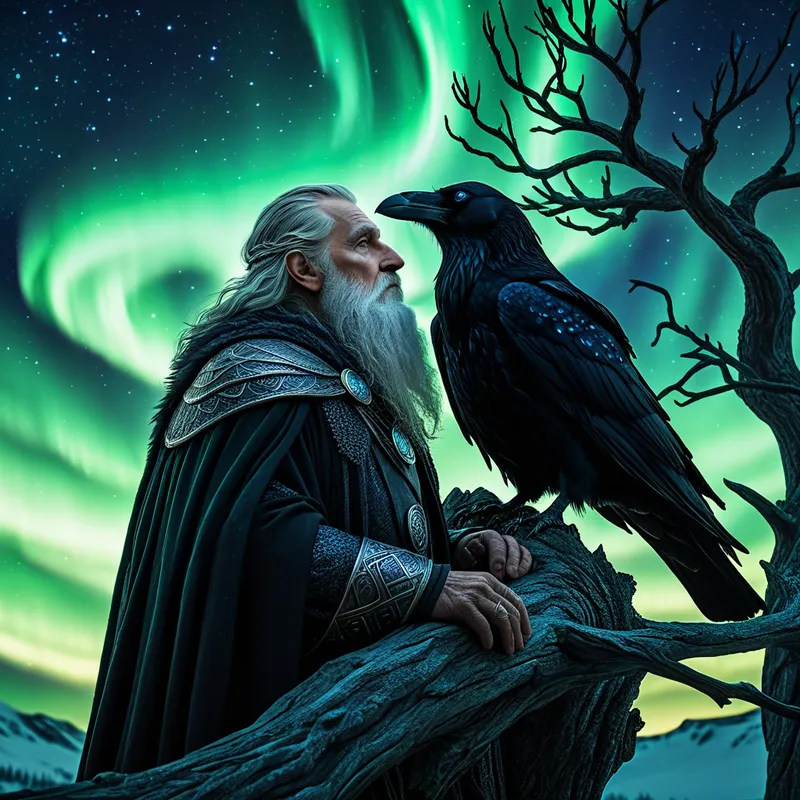
Odin's Ravens Myth Meaning & Symbolism
The Allfather Odin sends his two ravens, Thought and Memory, across the worlds each dawn, sacrificing an eye for the wisdom their flight brings.
The Tale of Odin’s Ravens
Listen. In the high hall of Asgard, where the winds are cold and the mead is forever sweet, sits a throne unlike any other. It is called Hlidskjalf, and from its heights, one can gaze across the nine worlds that hang like fruits from the great Yggdrasil. Upon this seat rests Odin, the Allfather. His face is etched with the lines of ages, and in his face, a vacancy—a single, star-bright eye burns with terrible knowledge, for the other was given long ago, a price paid at the well of Mimir.
But his gaze is not alone. Each morning, before the sun-chariot of Sol cracks the horizon, he stirs. He turns his head, and the two dark shapes upon his shoulders shift, their feathers whispering secrets of the night. Their names are Huginn and Muninn. They are not mere birds; they are extensions of his own mind, his scouts upon the tree of life.
With a soft word, he sends them forth. They leap from his shoulders, great black wings beating against the twilight of Asgard. They dive into the spaces between the worlds, down past the roots where the dragon Nidhogg gnaws, across the misty fields of Vanaheim, through the towering forests of Jotunheim, and over the high walls of Midgard, where men kindle their morning fires. They fly silent as shadows, seeing all: the secret treaties of kings, the lonely death of a warrior in a forgotten fen, the birth of a child with seer’s eyes, the plotting of frost-giants in their ice halls.
All day they fly, their minds tethered to his. He sits in stillness, the lord of the slain, the god of the hanged, and feels the world’s pulse through their flight. He hears the clash of swords as thought, tastes the salt of tears as memory. The ravens are his nerve-endings stretched across the cosmos. As dusk gathers them back, they return not to a perch, but to his very being, settling upon him to murmur, to croak, to pour all they have witnessed directly into his waiting consciousness. And so the Allfather knows. And so he fears, for even he, who gave an eye to drink from the well of wisdom, knows that one day his thought may not return, and his memory may be lost.

Cultural Origins & Context
This potent image of the raven-god is preserved primarily in the Poetic Edda, specifically in the poem Grímnismál (“The Sayings of Grimnir”). Here, Odin, disguised, declares: “Huginn and Muninn fly each day over the spacious earth. I fear for Huginn, that he come not back, yet more anxious am I for Muninn.” This was not a story told for mere entertainment around the fire, though skalds surely gave it voice. It was a theological and cosmological assertion about the nature of divine consciousness.
In the Viking Age worldview, ravens were not birds of ill omen but creatures of supreme intelligence and connection to the battlefield, scavenging the slain. They were Óðinn’s birds, his familiars. The myth functioned on multiple levels: it explained Odin’s omniscience, it reflected a culture that valued cunning (hugr) and the preservation of legacy (minni) above all, and it modeled a form of sovereignty. A king, like a god, needed informants—his own “ravens” in the form of scouts and messengers—to rule effectively. The myth cemented Odin’s role not as a benevolent father-figure, but as a relentless seeker and processor of information, whose power was rooted in a network of perception and a sacrificed wholeness.
Symbolic Architecture
The symbology here is stark and profound, built on a triad: the One-Eyed God, Thought, and Memory. This is not a metaphor for simple curiosity. It is an archetypal map of a particular kind of consciousness.
Odin himself represents the centralized, willing psyche that has paid a price for depth. The missing eye signifies the sacrifice of literal, surface-level perception for symbolic, inward sight. He trades half his capacity to see the objective world for the ability to perceive the patterns behind it.
Consciousness is not a state of being, but an act of flight. It requires both the launching of an inquiry and the return of its meaning.
Huginn is the active, probing function of the mind. It is analysis, curiosity, the question asked, the hypothesis formed. It flies out into the unknown, the new, the potential. Muninn is the receptive, integrative function. It is context, history, pattern recognition, the lesson learned. It gathers the raw data of experience and brings it back to be woven into the existing tapestry of the self. Odin’s anxiety—fearing more for Muninn’s loss—speaks to a terrifying psychological truth: a thought without memory is a fleeting spark, but a lost memory is a dissolution of the self. Without the capacity to integrate experience, consciousness shatters.
The Dreamer’s Resonance
When this myth stirs in the modern unconscious, it rarely appears as a Viking god. Instead, one might dream of being watched by a single, all-seeing eye from the sky. Or of two large black birds circling one’s home, silent and intent. Perhaps the dreamer is themselves sending out a drone or a small bird, anxiously awaiting its return with a crucial piece of information.
These dreams signal a psyche engaged in a massive act of reconnaissance. The individual is at a threshold, often following a sacrifice (a ended relationship, a lost job, a conceded point of pride—the “eye”). Now, the internal “Odin” is deploying its faculties to map the new territory. The somatic feeling is one of tense waiting, of a mind stretched thin across a vast inner landscape. There is anxiety, the “fear they will not return,” which translates to a fear of dissociation: that our thoughts will lead us into madness, or that we will forget who we were before the transformation began. The dream confirms the process is underway; the self is seeking knowledge to re-orient its crippled, but deepening, perspective.

Alchemical Translation
The alchemical process modeled here is the transmutation of information into wisdom. It is the core operation of individuation for the intellectual or the leader. The “base metal” is the chaotic, unfiltered data of existence—the news, the interactions, the internal chatter, the vast field of Midgard. The two agents of change, the twin ravens, are the disciplined mental functions of active inquiry and reflective integration.
The throne of Hlidskjalf is not a place of rest, but a station of perpetual processing. To sit there is to consent to the endless inflow and analysis of the world’s truth.
The modern seeker must first make Odin’s sacrifice: to willingly blind oneself to certain easy, surface-level truths (prejudices, comforting illusions, the “other eye”) to gain depth. Then, one must learn to send out “Huginn”—to read, to explore, to question with direction. But the crucial, often-neglected step is to create the silent, receptive space for “Muninn” to return. This is meditation, journaling, dialogue, art—the practices that allow memory to deposit its gathered fragments so they may become insight. The goal is not to become a passive repository of facts, but to become the throne itself: the central, sovereign point where thought and memory converge to form a knowing that guides action. The anxiety never fully leaves, for the flight is perpetual, but in that tension is the pulse of a conscious, evolving life.
Associated Symbols
Explore related symbols from the CaleaDream lexicon: