Odin's Hall Myth Meaning & Symbolism
The myth of Odin's hall, Valhalla, where chosen slain warriors feast and train, awaiting the final battle at the world's end.
The Tale of Odin’s Hall
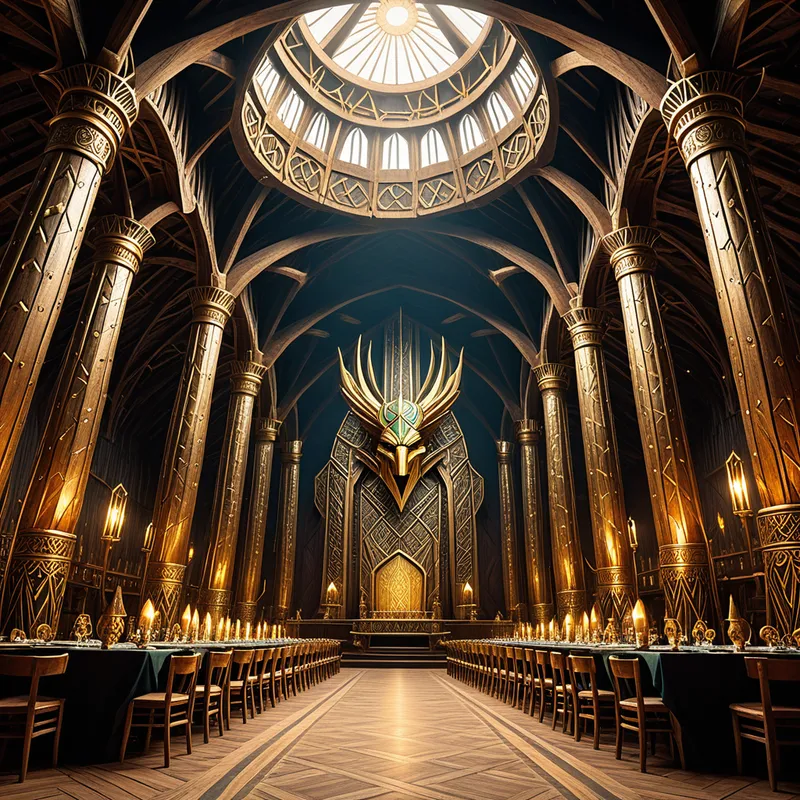
Listen, and hear of the hall that is not a reward, but a muster. It stands not in the soft lands of peace, but in the high, shimmering plains of Asgard, where the air is sharp with the promise of storm and final things. This is Valhalla, the Hall of the Slain. Its walls are built of spear-shafts, so thick and vast that a man might walk for a day and not see their end. Its roof is thatched not with straw, but with golden shields that catch the eternal, low light of the northern sky. Five hundred and forty doors it has, each wide enough for eight hundred warriors to march through, shoulder to shoulder.
And at its head, upon the high seat called Hlidskjalf, sits the All-Father, Odin. His face is lined with the winds of nine worlds, and one eye is a well of dark wisdom, given in trade at the Mímisbrunnr. Upon his shoulders perch his ravens, Huginn and Muninn, who fly out each dawn to scour the earth and return, whispering all they have seen and heard into his ear. At his feet lie his wolves, Geri and Freki.
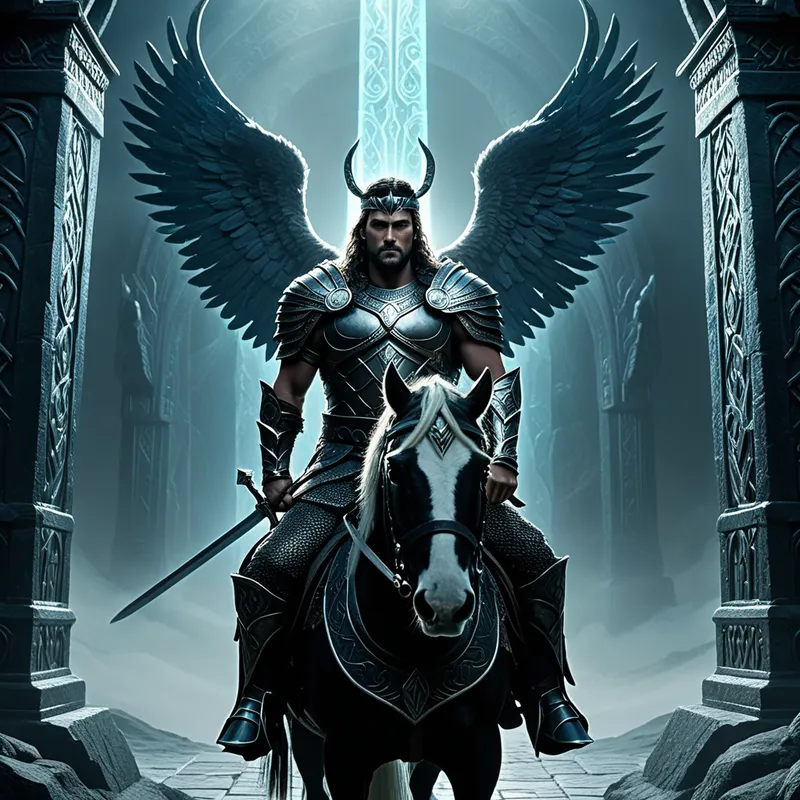
But the hall is not silent. It roars with life. These are the Einherjar, the “once-fighters,” chosen from the battlefields of Midgard. They do not come by peaceful passing. They come on the wings of storm, selected by the Valkyries, fierce maidens who ride through the din of combat. A warrior, feeling his life-blood seep into the earth, might see a flash of steel and a piercing gaze before the world dissolves into the thunder of hooves, carried not to darkness, but to these golden gates.
Here, the day’s work is war. At the sound of the horn, the Einherjar don their armor, take up their weapons, and stream out onto the field before the hall. They clash in glorious, terrible combat, hewing at each other with all their skill and fury. Limbs are severed, bodies fall. But with the evening, a miracle occurs: all wounds heal, the fallen rise, and the bitterest foes clasp arms as brothers. They return to the hall, whole and laughing.
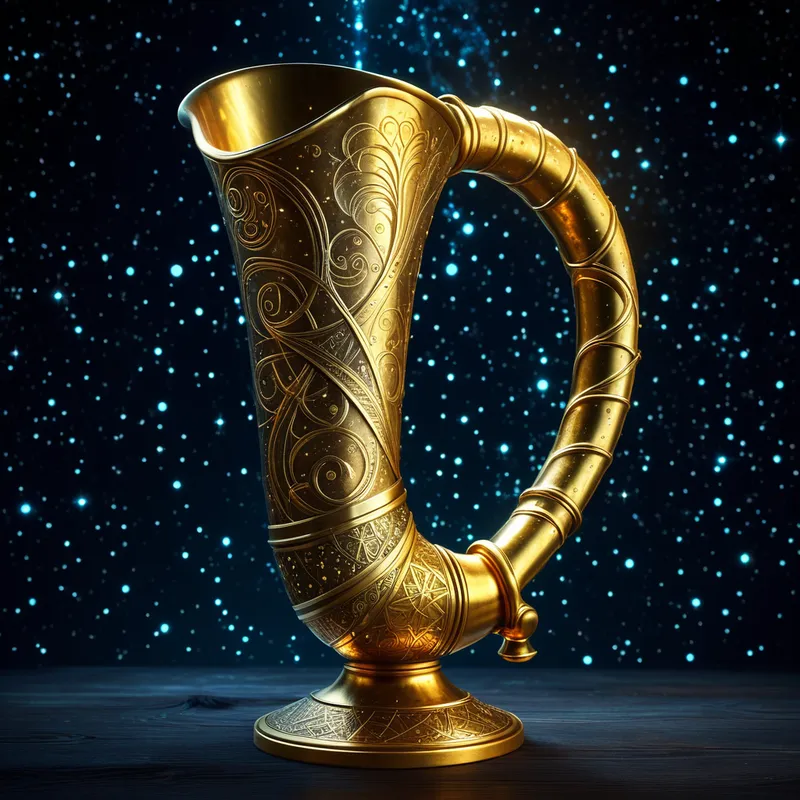
And then, the feast. The great boar Sæhrímnir is slaughtered and cooked, and by morning, it is whole again, ready for the next night. From the udder of the goat Heiðrún flows not milk, but an endless river of mead. The Valkyries themselves shed their armor for linen gowns and bear drinking horns, serving the heroes who will one day fight at their lord’s side. They drink, they boast, they listen to the sagas of their own deaths and lives, sung by bards whose voices echo in the rafters. This is the cycle: to die in glory, to be reborn in camaraderie, to train for an end that is certain. For they all wait, these glorious dead, for the sounding of the Gjallarhorn and the final march to the fields of Ragnarök. This is Odin’s bargain, and his great, grim hope.
Cultural Origins & Context
This vision of the afterlife was not a universal promise for all Norse people, but a specific, elite ideal. It emerged from a culture shaped by a harsh climate, a warrior aristocracy, and a cosmology that accepted inevitable, cyclical destruction. The primary sources are the Poetic Edda and the later Prose Edda, compiled in 13th-century Iceland from older oral traditions. These stories were told in the halls of chieftains, by skalds (poets) who served a dual purpose: to entertain and to reinforce a social and spiritual code.
Valhalla functioned as a powerful societal narrative. For the ruling class and their retinues, it framed a violent death not as a tragedy, but as a potential promotion to the god’s own army. It valorized the warrior ethos of courage, skill, and loyalty unto death. The myth served Odin’s purpose—to gather an army for the apocalyptic battle—but it also served the chieftain’s purpose, encouraging men to fight fiercely and without fear of final oblivion. It was a story told to steel the nerves, to transform the terror of mortality into a focused commitment to a cause greater than the individual lifespan. The endless feasting and fighting mirrored the idealized aristocratic life, eternalized and elevated to a divine plane.
Symbolic Architecture
Beneath the grandeur of spears and mead lies a profound and paradoxical symbolic structure. Valhalla is not a paradise of rest, but of purposeful activity. It represents the psyche’s capacity to metabolize trauma and loss into disciplined preparation.
The hall is built of weapons, for the psyche that has faced its battles consciously uses the very instruments of its pain as the structure of its wisdom.
Odin, the one-eyed king, symbolizes consciousness that has paid the ultimate price for knowledge—the sacrifice of naive, panoramic perception for focused, deep insight. His hall gathers the “slain” aspects of the self—the ambitions, relationships, and identities that have “died” in the battles of life. These are not discarded, but honored, healed daily in comradeship (the healing after battle), and integrated into a greater, collective purpose. The daily battle is the eternal process of confronting the shadow, of engaging with one’s own inner conflicts and contradictions, not to annihilate them, but to understand and master them. The Einherjar are those complexes within us that we have fought with, acknowledged, and brought into service of the larger Self.
The Dreamer’s Resonance
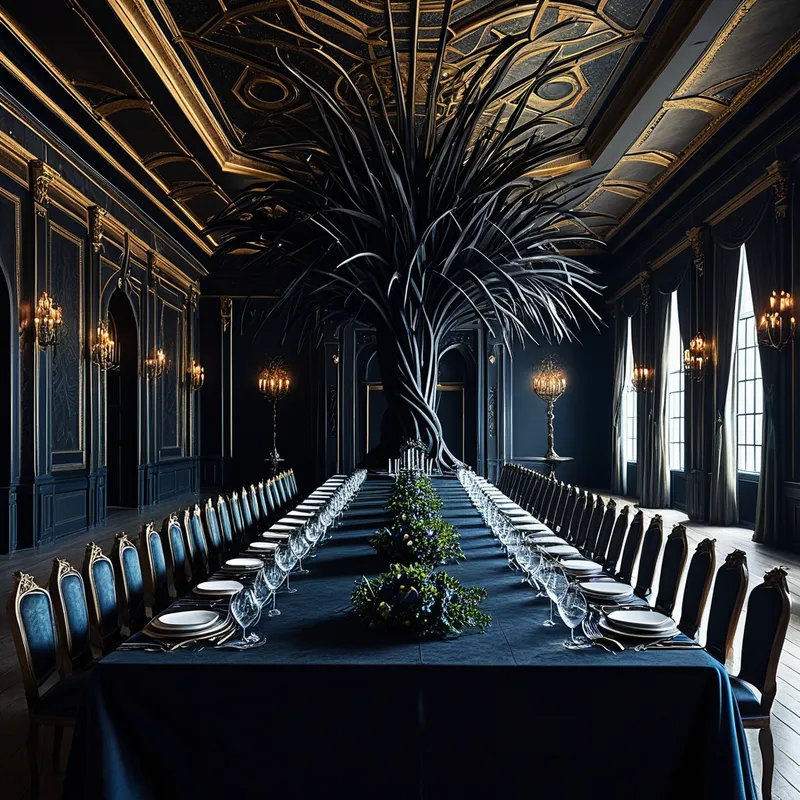
When this myth stirs in the modern dreamer, it often manifests not as a glorious feast, but as a sense of solemn preparation within a vast, impersonal structure. One might dream of being in an immense, institutional building—a university, a barracks, a grand hotel—that feels both awe-inspiring and strangely empty of personal comfort. There is a schedule, a duty, a training regimen. The dream ego is not relaxing; it is drilling.
This is the psyche signaling a phase of intense inner consolidation. The “warriors” gathering are disparate skills, hard-won lessons, and recovered energies from past “battles” (failed projects, ended relationships, personal crises) that are now being marshaled. The somatic feeling is often one of alert readiness, a low hum of anxiety mixed with determination. It is the dream of someone who has passed through a significant death of an old way of being and is now, often unconsciously, preparing their resources for the next great challenge of their life. The Valkyrie figure may appear as a stern guide, a demanding mentor, or an impersonal force of fate that selects which parts of your past are worthy of being carried forward into your future development.
Alchemical Translation
The alchemical process mirrored in the myth of Odin’s Hall is that of Coagulatio—the stage where the dissolved and purified matter begins to re-solidify into a new, conscious form. The hero’s journey to Valhalla is the Mortificatio (the death in battle). The daily healing and feasting is the Solutio (return to a fluid, nourished state). But the ultimate purpose is the forging of the Lapis, the perfected self, ready for its ultimate test.
The individuation journey is not toward a static state of bliss, but toward a state of dynamic, prepared integrity, capable of standing conscious within the world’s inevitable cycles of creation and destruction.
For the modern individual, this translates to a profound inner shift. It is the move from seeking external validation and peaceful escape, to embracing an inner discipline aimed at a meaningful end. It is the process of taking all one’s experiences—especially the painful, “fatal” ones—and not letting them fester as regret, but instead allowing the “Odin consciousness” (the one-eyed, insightful Self) to select and recruit them. You build your own hall from the spears of your past conflicts. You train your inner Einherjar—your discipline, your courage, your honesty—daily, knowing a “Ragnarök,” a period of great turmoil or transformation, is not an if, but a when. The goal is not to avoid the final battle, but to enter it whole, aligned, and without the panic of the unprepared. In this light, Odin’s Hall is the psyche’s mustering ground for a conscious life, and ultimately, for a conscious death.
Associated Symbols
Explore related symbols from the CaleaDream lexicon: