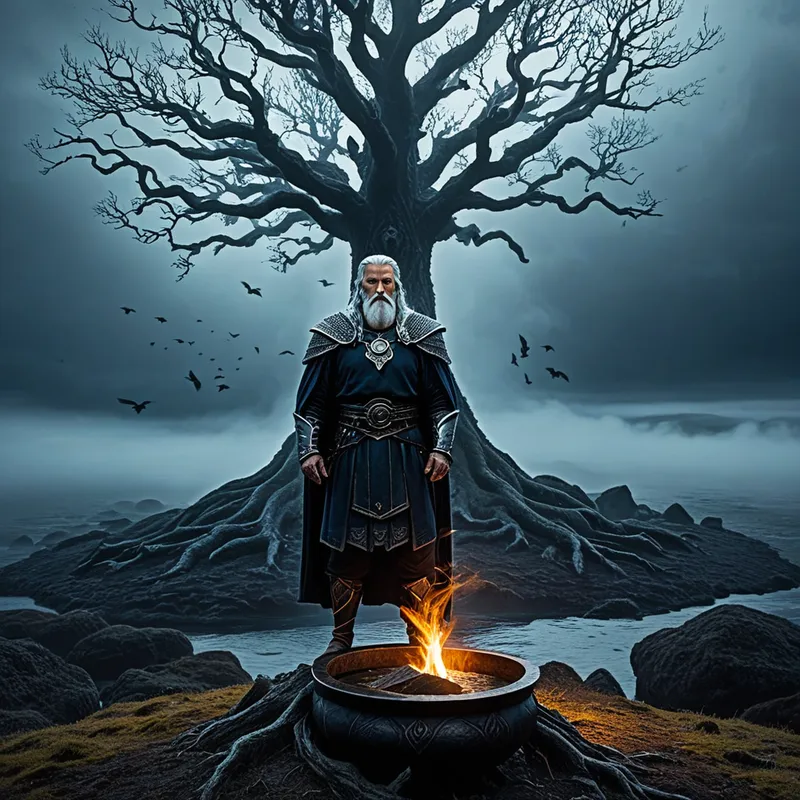
Odin at Hvergelmir Myth Meaning & Symbolism
The All-Father sacrifices his eye at the primordial well of Hvergelmir, trading sight for insight to gain the wisdom of the cosmos.
The Tale of Odin at Hvergelmir
Listen. In the time before time, when the great Yggdrasil was young and its roots drank from three secret springs, there was a place of terrible roaring. Not the roar of a beast, but the roar of the world being born. This was Hvergelmir, the Bubbling Boiling Spring, the first cauldron.
Here, at the root that plunged into the misty, frozen realm of Niflheim, the waters churned with the raw stuff of creation. From its dark mouth sprang eleven terrible rivers, the Élivágar, whose icy flows carved the shape of the worlds. And here, in this place of primal chaos and deafening sound, came the wanderer.
He was not yet the All-Father to all. He was Óðinn, the frenzied one, cloaked in grey and blue, his face shadowed by a broad-brimmed hat. His two ravens, Huginn and Muninn, were silent for once, perched on the gnarled, frost-rimed roots of the World Tree above. He was alone, save for the company of his own immense longing. He had traveled the branches of Yggdrasil, sought the counsel of the dead, hung for nine nights on the wind-lashed tree—all for a glimpse, a whisper, of the pattern that holds all things together. But the final secret, the deep wisdom from before the dawn, lay not above, but below. It lay in the roaring dark.
He stood at the well’s edge. The mist from the churning waters was cold enough to bite, carrying the scent of ancient stone and deep, moving earth. The sound was not a noise to be heard with ears, but a vibration felt in the marrow of his bones—the hum of potential, the groan of matter not yet formed. And in the center of that maelstrom of water and mist, he saw it: not a reflection, but a vision. The shimmering, impossible pattern of örlög, the web of fate itself, woven in the currents.
To see it clearly, to drink that sight and make it part of him, required a terrible price. The well demanded a sacrifice equal to the gift. Not gold, nor blood, but perception itself. To gain the sight that sees all threads, he must surrender the sight that sees one world.
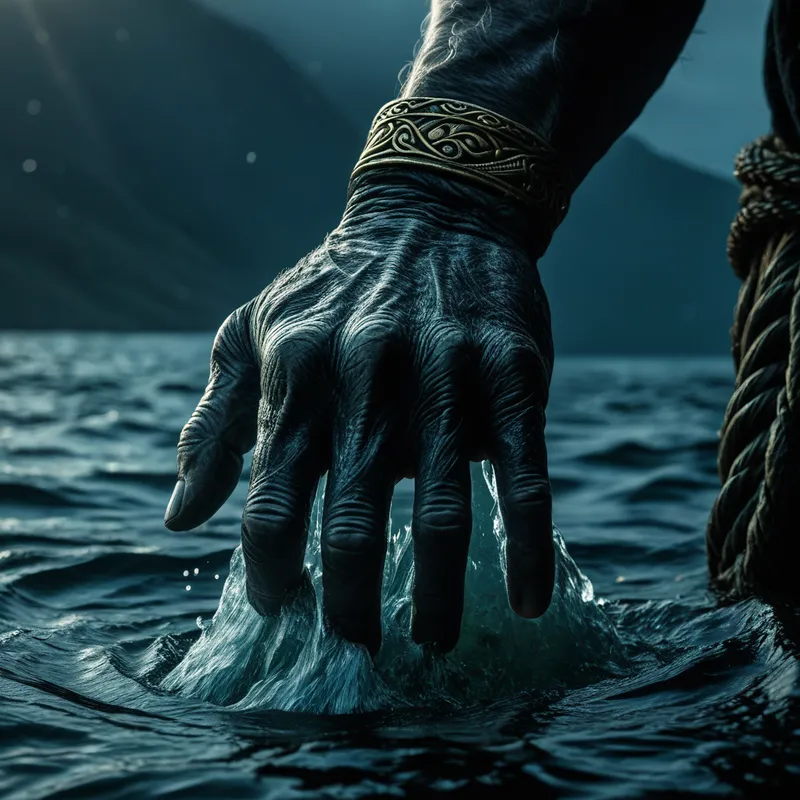
Without a word, without a cry, the god raised his hand to his own face. His gaze, which had measured the breadth of the heavens and the depth of the underworld, did not waver. In a moment of absolute silence within the roar, he plucked his own eye from its socket. It gleamed in his palm, a sphere of captured sky and storm-light. He held it for a heartbeat, this piece of his own being, this window to the outer world. Then, he offered it. He let it fall into the seething, hungry waters of Hvergelmir.
The eye sank, a fading star descending into the abyss. As it vanished, the roaring changed. It resolved into a voice, a thousand voices, the whisper of roots drinking, the song of rivers flowing, the silent speech of stars turning. The vision in the well blazed forth, no longer distant, but imprinted upon his very being. The price was paid. The wisdom was won. Where there had been two eyes to see the surface of things, there was now one eye to see the truth beneath all surfaces. He turned from the well, his face forever marked by the void, his spirit now filled with the terrible, roaring light of understanding.
Cultural Origins & Context
The myth of Odin’s sacrifice at the well is not a single, isolated story from a tidy book, but a fragmented, potent motif woven through the tapestry of Norse poetic and mythological tradition. Our primary sources are the Poetic Edda, particularly the poem Völuspá (The Prophecy of the Seeress), and the later Prose Edda of Snorri Sturluson, which attempts to systematize these older, often cryptic verses.
In Völuspá, the seeress recounts, cryptically, how Odin “gave his eye” in exchange for a drink from Mímisbrunnr. Snorri, synthesizing traditions, places this event at Mimir’s Well. However, the deep symbolic resonance connects it inextricably to Hvergelmir. Hvergelmir is not just any well; it is the primordial source, the origin of all waters—and by extension, all life and potential. It sits at the root in Niflheim, the realm of primal ice and mist, representing the undifferentiated, chaotic state of the cosmos before order. To seek wisdom here is to seek it at the very source of being, in the unconscious depths of the world itself.
This myth was likely preserved and recited by skalds (poets) and possibly within ritual or esoteric contexts. Its function was multifaceted: it explained the iconic one-eyed depiction of the chief god, it established the supreme value of wisdom (wod) over all other treasures, and it modeled the ultimate price for such knowledge. In a culture that valued cunning, foresight, and the spoken word, Odin’s sacrifice was the ultimate archetype of the seeker who pays everything to understand the hidden rules of the game of fate.
Symbolic Architecture
The myth is a masterclass in symbolic economy. Every element is a profound cipher for a psychological and cosmological truth.
The Eye represents directed, focused consciousness—our ordinary perception that separates subject from object, self from world. It is the tool of discrimination and surface analysis.
Hvergelmir is the roaring cauldron of the unconscious, both personal and collective. It is the chaotic, fertile, and terrifying source of all life and all potential, from which the “rivers” of our instincts, drives, and archetypal patterns flow. It is not evil, but primordial and amoral.
The Sacrifice is the central alchemical act. Odin does not lose his eye in battle; he willingly gives it. This is the voluntary surrender of a part of the ego’s apparatus—the need to see and control the outer world on its own terms—to gain access to a deeper, more holistic mode of perception.
To see with the eye of the well, one must offer the eye of the day. The price of cosmic insight is the coin of worldly sight.
The One Remaining Eye now symbolizes integrated consciousness. It is no longer just an organ for external light, but an inner organ of vision that has assimilated the depth. It sees the web (örlög) connecting all things because it has traded duality for a unified, if wounded, perspective. The empty socket is not merely a wound; it is the void that makes the vessel, the silence that allows the inner roar to be heard.
The Dreamer’s Resonance
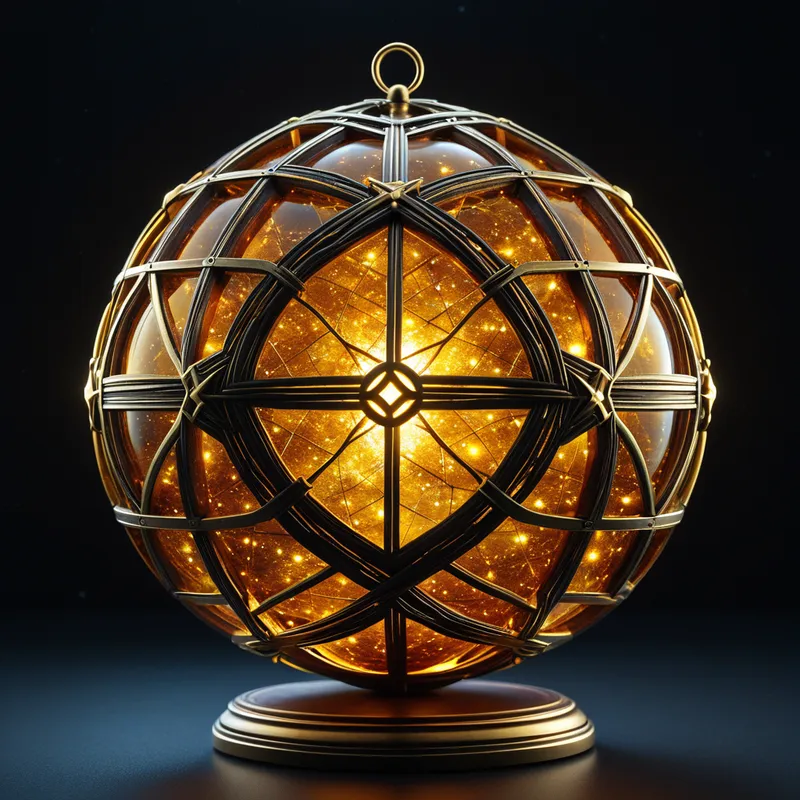
When this myth stirs in the modern psyche, it often manifests in dreams of profound exchange or unsettling, transformative vision. A dreamer may not see Odin, but they will feel the pattern.
They may dream of being at the edge of a vast, dark body of water—a well, a whirlpool, a cavernous pool—that both terrifies and fascinates. There is a palpable sense that something of immense value lies within its depths. The dreamer might be compelled to offer something precious into the water: a piece of jewelry, a photograph, a physical part of themselves. This is the somatic echo of the sacrifice.
Alternatively, dreams of losing an eye, or of having a “third eye” open, or of seeing the world in radically new, often overwhelming patterns (like seeing everyone connected by threads of light) are direct manifestations of this archetypal process. The dream ego is negotiating the terrifying but necessary bargain: to relinquish an old, familiar way of perceiving the self and the world (which often feels like a loss, a blinding) to make space for a more authentic, but initially disorienting, understanding. The roaring sound in such dreams is the vibration of the unconscious psyche, agitated and activated, demanding its due for the new consciousness trying to be born.
Alchemical Translation
For the individual on the path of individuation, the myth of Odin at Hvergelmir is a precise map of a critical phase of psychic transmutation. It is the move from knowledge (accumulated facts, ego-logic) to wisdom (lived, integrated understanding).
The first step is the Call to the Depths. This is the often-uncomfortable realization that one’s current worldview is insufficient. Life feels superficial, meaning is elusive. One is drawn, like Odin, to the “roaring” source—the neglected inner life, the unresolved complexes, the shadow material that has been frozen in our personal Niflheim.
The core operation is the Sacrificial Transaction. This is the active, courageous work of therapy, meditation, or shadow work. We must voluntarily “offer our eye”—that is, de-identify from a cherished self-image, a rigid belief, a pattern of perception that keeps us locked in a superficial reality. We surrender the ego’s claim to “see it all” and be in control. This feels like a loss, a blinding, a descent into confusion.
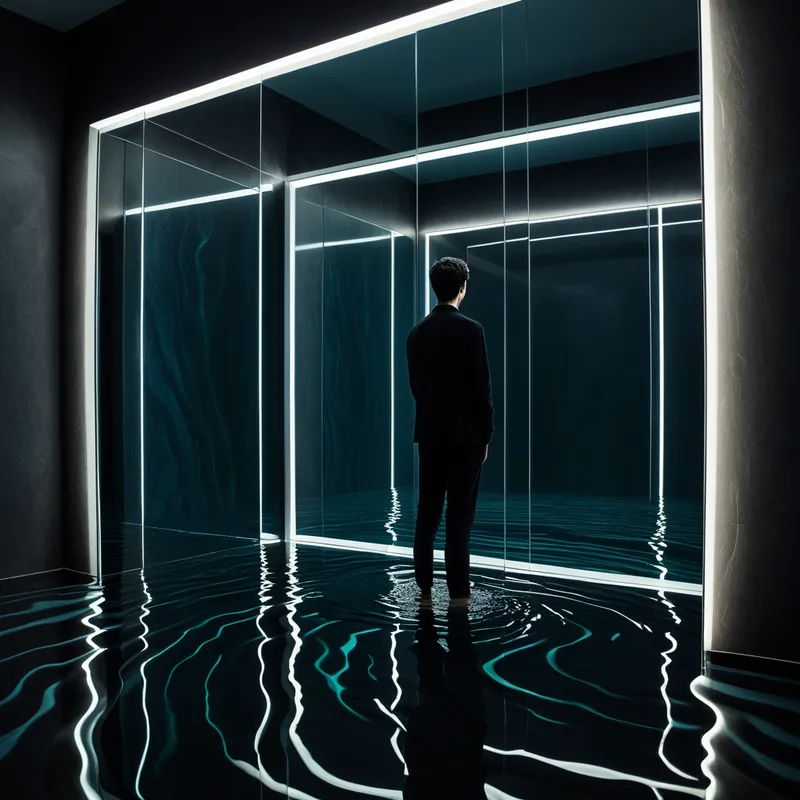
The alchemical gold is forged in the dark water where the eye of certainty dissolves. What emerges is not more information, but a new organ of perception.
Finally, there is the Integration of the Roaring. The wisdom gained is not peaceful or calm. It is the roaring, humming, chaotic understanding of life’s complexity, one’s own contradictions, and the interconnectedness of joy and suffering. The new “one-eyed” vision is holistic. It sees the light and the dark, the conscious and the unconscious, as parts of a single, dynamic process. The individual no longer merely looks at the world from a detached distance; they perceive themselves as a living node within the world’s flowing, roaring web. The sacrifice leaves a mark—a vulnerability, a recognition of one’s limitation—but that very hollow becomes the vessel for a deeper, more compassionate, and truly transformative sight.
Associated Symbols
Explore related symbols from the CaleaDream lexicon: