Odin and the Mead of Poetry Myth Meaning & Symbolism
Odin endures agony and deception to steal the sacred mead of inspiration, securing the gift of poetry and wisdom for gods and humanity.
The Tale of Odin and the Mead of Poetry
Listen, and I will tell you of the theft that gave voice to [the world](/myths/the-world “Myth from Tarot culture.”/). It begins not with a god, but with a truce. After the great war between the Aesir and the Vanir, the gods spat into a vat to seal their peace. From that mingled spittle, they fashioned a being of such profound wisdom they named him [Kvasir](/myths/kvasir “Myth from Norse culture.”/). He wandered [the nine worlds](/myths/the-nine-worlds “Myth from Norse culture.”/), answering every question posed to him, a living vessel of all-knowing.
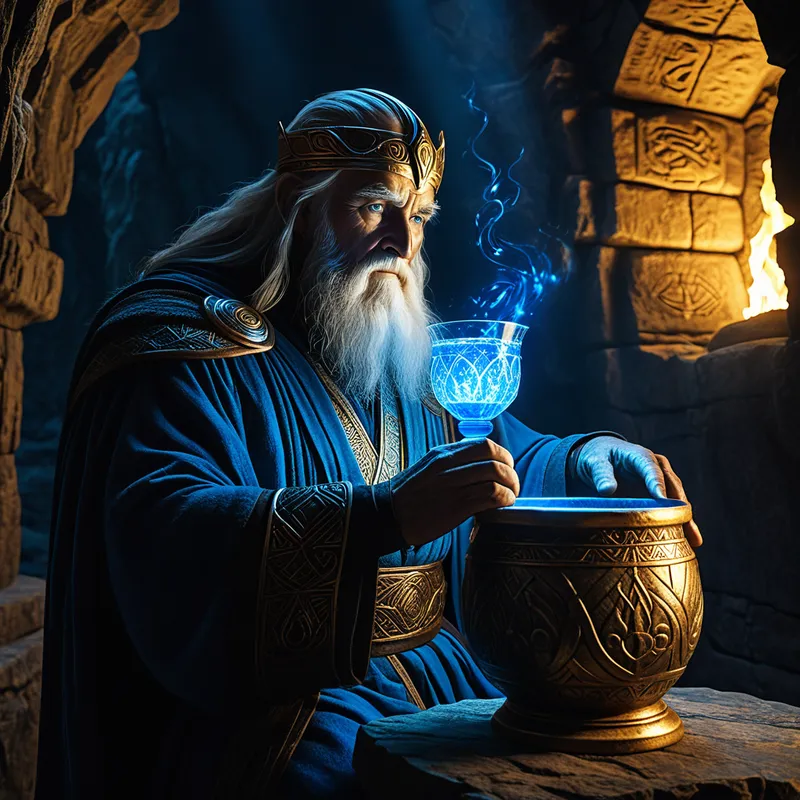
His light drew shadows. Two dark dwarven brothers, Fjalar and Gjalar, invited him to their underground hall. There, in the deep stone silence, they slew him. They did not take his gold or his weapons. They drained his blood into three wondrous vessels—the cauldrons Odrerir, and the vats Son and Bodn. They mixed the blood with honey, and from this unholy brew they distilled the [Mead of Poetry](/myths/mead-of-poetry “Myth from Norse culture.”/). A single sip could turn any tongue to silver, any mind to a fountain of song and sacred knowledge.
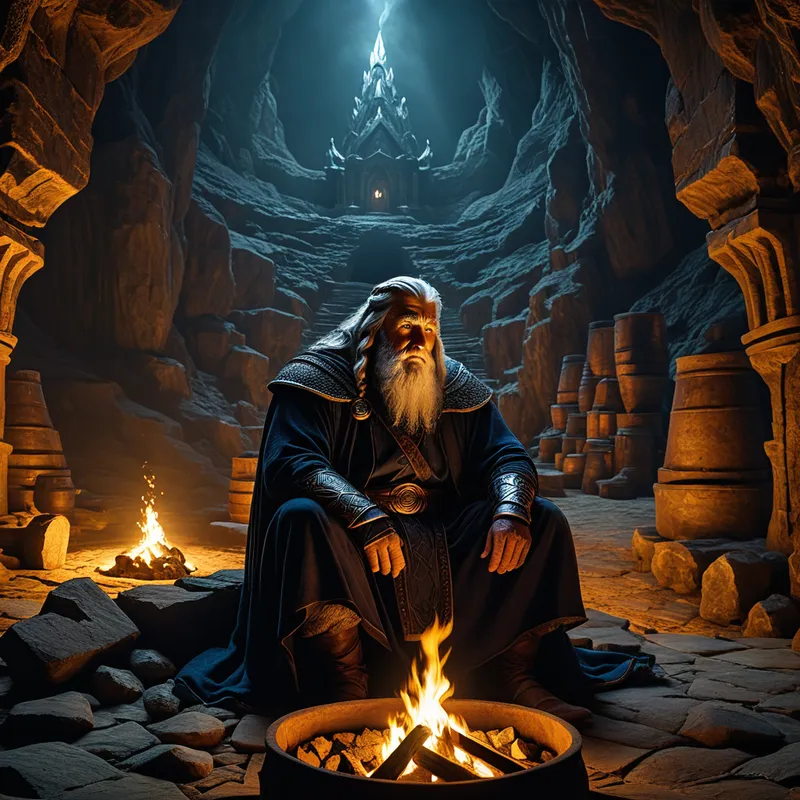
The mead passed through treacherous hands, from [the dwarves](/myths/the-dwarves “Myth from Norse culture.”/) to the giant Suttung, who hid it in the heart of a mountain called Hnitbjorg. He set his daughter, Gunnlod, to guard it within a sealed chamber, a living lock on the greatest treasure of the worlds.
This is when the whisper reached the high seat of Odin. He who had sacrificed an eye at the well of [Mimir](/myths/mimir “Myth from Norse culture.”/) for a draught of understanding heard of this liquid wisdom. His single eye saw a lack in the order of things. The gods had law and might, but the giants held the very essence of inspiration. This could not stand.
So the Lord of the Slain became a wanderer. He crossed the grey rivers and came to the land of Suttung’s brother, Baugi. Odin took the name Bolverk, the Worker of Misfortune. He offered to labor for Baugi, to do the work of nine men in one season, for one price: a sip of his brother’s mead. The work was done, the fields cleared, but Suttung laughed at the request and denied the payment.
Then came the cunning. Bolverk took out a great auger, Rati. He bade Baugi bore into the mountain’s bone. When the drill bit through, Odin changed his shape. He became a serpent, a slick, whispering [thing](/myths/thing “Myth from Norse culture.”/) of scales and purpose, and slithered into the dark, damp hole. Baugi, in betrayal, tried to stab him with the auger, but the serpent was gone, deep into the stone womb of the world.
Inside the cavern, he found her: Gunnlod, sitting in the gloom beside the three vessels that glowed with a soft, honeyed light. For three nights, the serpent became a man again, a traveler with a voice like dark mead and an eye that held the depth of the night sky. He spoke to her. He wooed her. He offered not force, but a companionship in her lonely vigil. For three nights, she yielded, and for each night, he asked to drink from one of the vessels.
On the first night, he drank deep from Son. On the second, from Bodn. On the third, he emptied the great cauldron Odrerir itself. The mead, the stolen blood-wisdom of Kvasir, now burned within him. He did not linger. He changed again, this time into a mighty eagle. With the sacred mead swelling inside him, he beat his wings and burst from the mountain’s peak.
Suttung saw and gave chase, himself taking eagle-form. A storm of feathers and fury raged across [the sky](/myths/the-sky “Myth from Persian culture.”/), the giant eagle screaming close behind the god. As Odin neared the walls of Asgard, the Aesir saw the pursuit. They rushed out vessels of all kinds—jars, vats, bowls—and set them in the courtyard. Odin the eagle, straining, began to regurgitate the mead into the waiting containers.
But Suttung was so close. In his panic and haste, Odin let some of the mead spill from his other end. This portion, unblessed by careful vessel, fell not to the gods but to the world below. This is the bad poets’ share, the inspiration of the careless and the talentless. The rest, the pure Mead of Poetry, was safely gathered. From that day, Odin would give it to those he favored—gods, and the rare mortal—the gift of the skalds, the breath of the gods, the stolen fire of speech itself.
Cultural Origins & Context
This myth is preserved primarily in the Prose Edda of Snorri Sturluson, a 13th-century Icelandic scholar, and referenced in older skaldic poetry. Snorri’s work, while a Christian-era compilation, sought to preserve the mechanics of the old skaldic art—its kennings and metaphors—many of which are rooted in myths like this one. The tale was not mere entertainment; it was the foundational charter for the poet’s craft in Norse society.
The skald, a poet and historian, held a position of immense power, capable of immortalizing a king’s deeds or shredding his reputation with satire. His skill was seen not merely as talent, but as a divine gift, a literal inspiration (breathing-in) of Odin’s mead. To hear or recite poetry was to participate in a sacred act, a temporary communion with the wisdom won by the Allfather’s sacrifice and cunning. The myth thus served to elevate the social role of the poet, linking their seemingly magical ability to shape reality with words directly to the highest god’s most daring quest.
Symbolic Architecture
At its core, this is a myth of the acquisition of [consciousness](/symbols/consciousness “Symbol: Consciousness represents the state of awareness and perception, encompassing thoughts, feelings, and experiences.”/). The mead represents the distilled essence of experiential wisdom (Kvasir, born from the mingled experiences/spit of the gods) transformed into a potable, transmissible form: inspired [language](/symbols/language “Symbol: Language symbolizes communication, understanding, and the complexities of expressing thoughts and emotions.”/), culture, and art.
The quest for wisdom is not a gentle study, but a theft from the unconscious, paid for with a piece of the self.
Odin’ [journey](/symbols/journey “Symbol: A journey in dreams typically signifies adventure, growth, or a significant life transition.”/) is a map of individuation. His first sacrifice at Mimir’s well (an eye for wisdom) is a passive [reception](/symbols/reception “Symbol: The symbol of ‘reception’ often signifies the act of welcoming or accepting new ideas, experiences, or people into one’s life.”/). The mead [quest](/symbols/quest “Symbol: A quest symbolizes a journey or search for purpose, fulfillment, or knowledge, often representing life’s challenges and adventures.”/) is active, aggressive [integration](/symbols/integration “Symbol: The process of unifying disparate parts of the self or experience into a cohesive whole, often representing psychological wholeness or resolution of internal conflict.”/). He must descend (to the giant’s lands), labor (as Bolverk), negotiate (with Baugi), penetrate the [mountain](/symbols/mountain “Symbol: Mountains often symbolize challenges, aspirations, and the journey toward self-discovery and enlightenment.”/) (the unconscious/repressed), seduce the [guardian](/symbols/guardian “Symbol: A protector figure representing safety, authority, and guidance, often embodying parental, societal, or spiritual oversight.”/) (Gunnlod, the [anima](/symbols/anima “Symbol: The feminine archetype within the male unconscious, representing soul, creativity, and connection to the inner world.”/) figure holding the [treasure](/symbols/treasure “Symbol: A hidden or valuable object representing spiritual wealth, inner potential, or divine reward.”/)), and finally assimilate the substance so fully he must become it to escape (the [eagle](/symbols/eagle “Symbol: The eagle is a symbol of power, freedom, and transcendence, often representing a person’s aspirations and higher self.”/) [flight](/symbols/flight “Symbol: Flight symbolizes freedom, escape, and the pursuit of one’s aspirations, reflecting a desire to transcend limitations.”/)). The final act—regurgitation into vessels—is the crucial step of giving form to the raw, ingested [insight](/symbols/insight “Symbol: A sudden, deep understanding of a complex situation or truth, often arriving unexpectedly and illuminating hidden connections.”/), making it usable for the [community](/symbols/community “Symbol: Community in dreams symbolizes connection, support, and the need for belonging.”/) of the [psyche](/myths/psyche “Myth from Greek culture.”/) (the Aesir).
The Dreamer’s Resonance
When this myth stirs in modern dreams, it often signals a profound psychological process of reclaiming one’s voice or authentic creativity from a place of internalized oppression or neglect. Dreaming of being in a dark cavern, finding a hidden vessel of liquid light, or transforming into a bird while carrying a precious burden points to this archetypal pattern.
The somatic experience might be one of constriction (the serpent’s tunnel) followed by a bursting, expansive release (the eagle’s flight). Psychologically, the dreamer is often in a state where a vital part of their inner wisdom (their personal “mead”) has been captured by a “giant”—perhaps an internal critic, a legacy of familial expectation, or a trauma that walls off creativity. The dream signals the psyche’s readiness to undertake the cunning, difficult, and potentially deceptive work of wooing that guardian, penetrating the defense, and reclaiming that energy for conscious life.

Alchemical Translation
The alchemical process mirrored here is the [solve et coagula](/myths/solve-et-coagula “Myth from Alchemical culture.”/)—dissolve and coagulate. The unified wisdom of Kvasir is dissolved (murdered, distilled) into a primal, chaotic fluid. Odin, as [the alchemist](/myths/the-alchemist “Myth from Various culture.”/)’s mind, must then undergo his own dissolution: losing his godly identity to become laborer, serpent, seducer, and eagle. He is the [prima materia](/myths/prima-materia “Myth from Alchemical culture.”/) humbled and transformed.
Individuation requires the ego to become small, cunning, and utterly focused to steal fire from the very complexes that bind it.
His ingestion of the mead is the coniunctio, [the sacred marriage](/myths/the-sacred-marriage “Myth from Various culture.”/) with the unconscious content. But ingestion alone is poisoning; it leads to possession by the complex. The final, critical phase is the coagula: the flight back to consciousness and the deliberate, often messy, process of “vomiting” the insight into forms—journaling, art, dialogue, therapy—that can hold it. The spilled, “bad poets’ mead” is a necessary shadow of the process, representing the raw, unintegrated, and often embarrassing first attempts that precede true mastery. The myth thus models the full cycle: from collective material (spit), to hidden treasure, to perilous integration, and finally to gifted, culture-forming creation.
Associated Symbols
Explore related symbols from the CaleaDream lexicon: