Oceanus Myth Meaning & Symbolism
Oceanus is the ancient, gentle Titan of the world-encircling river, representing the primordial, unifying waters from which all life and consciousness emerge.
The Tale of Oceanus
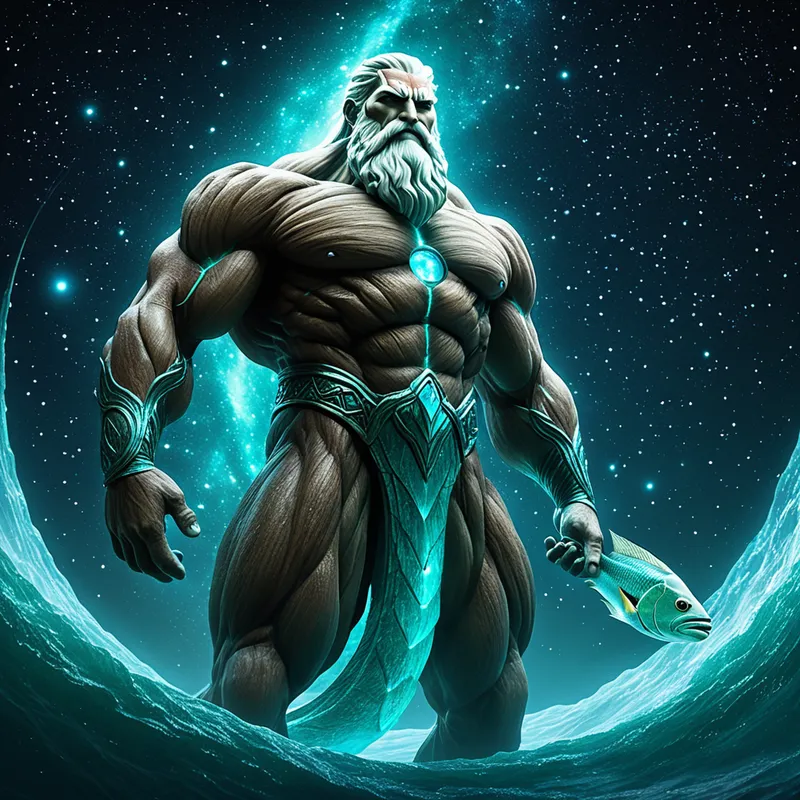
Before the sun knew its path and [the moon](/myths/the-moon “Myth from Tarot culture.”/) its phases, before the clamor of gods and the footfall of man, there was only the deep, resonant hum of potential. And from this hum, the first forms coalesced: Chaos, the yawning gap; Gaia, the broad-breasted land; and the sweet, dark embrace of Erebus. But there was another, a presence not of stone or shadow, but of ceaseless, gentle motion.
He was Oceanus. He did not rise from [the void](/myths/the-void “Myth from Buddhist culture.”/) so much as he unfolded within it, a great, serpentine body of fresh, star-flecked [water](/myths/water “Myth from Chinese culture.”/). His essence was a river so vast it had no beginning and sought no end, for its course was the ultimate boundary. With his sister-consort [Tethys](/myths/tethys “Myth from Greek culture.”/), he flowed, and from their union sprang three thousand spirits—the Oceanids, with voices like bubbling streams, and three thousand Potamoi, each a winding, singing course upon the land.
While his Titan brothers, with their tempers of earthquake and fire, plotted against [the sky](/myths/the-sky “Myth from Persian culture.”/)-father [Ouranos](/myths/ouranos “Myth from Global/Universal culture.”/), and later, his own nephew Zeus thundered for supremacy, Oceanus remained aloof. His conflict was not with other gods, but with the very concept of limit. He was [the horizon](/myths/the-horizon “Myth from Various culture.”/) itself. Sailors in their frail wooden shells would whisper of reaching his domain, where [the sea](/myths/the-sea “Myth from Greek culture.”/) became a liquid mirror to the vault of heaven, where the water was sweet and the current carried the whispers of every shore it touched. He was the quiet sustainer, the ever-present flow that received all rains, all rivers, all tears, and returned them, purified, in an eternal, gentle cycle. His was not a tale of conquest, but of perpetual, nurturing return—the great, breathing margin of [the world](/myths/the-world “Myth from Tarot culture.”/).
Cultural Origins & Context
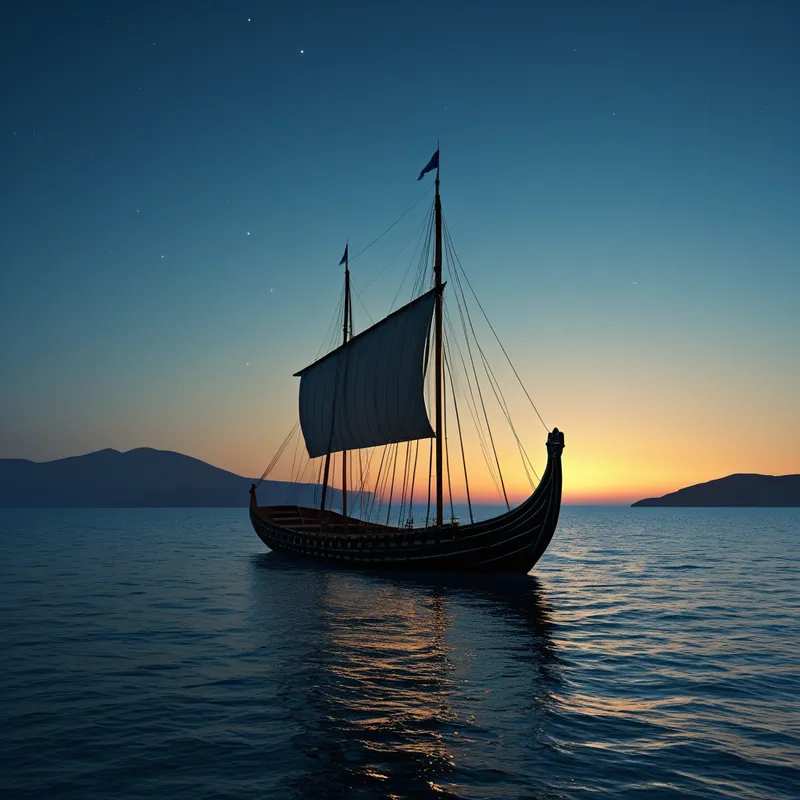
The figure of Oceanus is archaic, predating the familiar [pantheon](/myths/pantheon “Myth from Roman culture.”/) of Olympians. He emerges from the earliest layers of Greek cosmogony, most authoritatively in Hesiod’s Theogony (c. 700 BCE). Here, he is not a sea god in the later sense of [Poseidon](/myths/poseidon “Myth from Greek culture.”/), who rules the tumultuous Mediterranean. Oceanus is something more fundamental: the personification of the freshwater river believed to encircle the entire flat disc of [the Earth](/myths/the-earth “Myth from Hindu culture.”/), from which all other waters—springs, rivers, rain, and even the outer sea—were thought to flow.
This myth served a profound cognitive and societal function. For a maritime culture, the world’s edge was both a terrifying mystery and a necessary conceptual boundary. Oceanus provided that boundary not as a wall, but as a flowing, living entity. He represented the known limit of the world, beyond which lay only the formless or the divine. His stability and peaceful nature offered a psychological anchor; the cosmos was not infinite chaos but a contained, ordered system, ringed by a benevolent, ancient power. His role was less worshipped in grand temples and more invoked in the quiet understanding of sailors, cartographers, and philosophers contemplating the shape of the cosmos.
Symbolic Architecture
Oceanus represents the primordial, undifferentiated [source](/symbols/source “Symbol: The origin point of something, often representing beginnings, nourishment, or the fundamental cause behind phenomena.”/). He is not the god of an [ocean](/symbols/ocean “Symbol: The ocean symbolizes the vastness of the unconscious mind, representing deeper emotions, intuition, and the mysteries of life.”/); he is the encompassing aquatic principle from which all [differentiation](/symbols/differentiation “Symbol: The process of distinguishing or separating parts of the self, emotions, or identity from a whole, often marking a developmental or psychological milestone.”/) springs. Psychologically, he symbolizes the deepest [layer](/symbols/layer “Symbol: Layers often symbolize complexity, depth, and protection in dreams, representing the various aspects of the self or situations.”/) of the unconscious—not [the personal unconscious](/myths/the-personal-unconscious “Myth from Jungian Psychology culture.”/) of repressed memories, but the collective, impersonal psychic substrate from which all archetypal forms and potentials emerge.
He is the water before it is poured into any vessel, the potential before it becomes act, the unity that precedes and contains all duality.
His refusal to engage in the Titanomachy or other divine conflicts marks him as a [symbol](/symbols/symbol “Symbol: A symbol can represent an idea, concept, or belief, serving as a powerful tool for communication and understanding.”/) of wholeness that transcends [opposition](/symbols/opposition “Symbol: A pattern of conflict, duality, or resistance, often representing internal or external struggles between opposing forces, ideas, or desires.”/). While other gods represent specific domains (sky, war, love), Oceanus represents the field within which these domains exist. His three thousand children symbolize the manifold manifestations—the individual streams of [consciousness](/symbols/consciousness “Symbol: Consciousness represents the state of awareness and perception, encompassing thoughts, feelings, and experiences.”/), talent, and [life](/symbols/life “Symbol: The symbol of ‘Life’ represents a journey of growth, interconnectedness, and existential meaning, encompassing both the joys and challenges that define human experience.”/)—that issue from the single, boundless source. He is the ultimate [ouroboros](/symbols/ouroboros “Symbol: An ancient symbol depicting a serpent or dragon eating its own tail, representing cyclicality, eternity, self-sufficiency, and the unity of opposites.”/), the [serpent](/symbols/serpent “Symbol: A powerful symbol of transformation, wisdom, and primal energy, often representing hidden knowledge, healing, or temptation.”/) eating its own [tail](/symbols/tail “Symbol: A tail in dreams can symbolize instincts, connection to one’s roots, or the hidden aspects of personality.”/), depicting a self-sustaining [system](/symbols/system “Symbol: A system represents structure, organization, and interrelated components functioning together, often reflecting personal or social order.”/) with no external dependencies.
The Dreamer’s Resonance
When the pattern of Oceanus emerges in modern dreams, it rarely appears as a literal Titan. Instead, one dreams of vast, calm, dark bodies of water—lakes that seem bottomless, oceans stretching to a seamless horizon, or a slow, wide river with no visible banks. The dreamer often finds themselves on the shore, in a boat, or floating peacefully upon this water. The dominant somatic feeling is one of profound calm, awe, and sometimes a gentle melancholy—the “oceanic feeling” described by mystics.
This dream signals a process of reconnection with the foundational layers of the [psyche](/myths/psyche “Myth from Greek culture.”/). [The ego](/myths/the-ego “Myth from Jungian culture.”/), having been caught in the conflicts and differentiations of daily life (the “Olympian battles”), is being invited back to the source. It is a dream of respite and re-membering. The [psyche](/myths/psyche “Myth from Greek culture.”/) is engaging in a restorative dialogue with its own origins, seeking to remember the unity that underlies its fragmented experiences. There is no conflict to resolve here, only a depth to be acknowledged and reintegrated.

Alchemical Translation
The alchemical journey is not always one of violent confrontation and dramatic transformation (solve). It is also, and fundamentally, a process of return to [the prima materia](/myths/the-prima-materia “Myth from Alchemical culture.”/), the original, undifferentiated substance (coagula). Oceanus models this latter, often overlooked, phase of individuation.
The work is not to become something new, but to remember what you always were, at the source.
The modern individual, identified with their specific roles, traumas, and achievements (the individual “river-gods” and “[nymphs](/myths/nymphs “Myth from Greek culture.”/)” of their life), is called to undertake a journey not outward, but inward to the encircling river. This is the process of releasing over-identification with the ego’s battles and re-anchoring in [the Self](/myths/the-self “Myth from Jungian culture.”/)—the total, encompassing psyche. It is the cultivation of a consciousness that can hold contradictions without being torn apart, much as Oceanus holds all waters without distinction.
The [triumph](/myths/triumph “Myth from Roman culture.”/) here is one of containment and sustenance. It is the realization that one’s being is not a isolated eddy but part of a boundless, self-replenishing flow. The alchemical gold forged in this process is not a trophy, but a profound, unshakable serenity—the peace of the Titan who needs no throne, for he is already the horizon upon which all thrones are built.
Associated Symbols
Explore related symbols from the CaleaDream lexicon:
- Tidal
- Tide
- Liquid
- Endless Ocean
- Cascading Dreams
- Boundless Sea
- Waves of Change
- Iceberg
- Periwinkle Wave
- Sapphire Seascape
- Cosmic Waves
- Transcendent Wave
- Starlit Ocean
- Manta Ray
- Ocean Current
- Celestial Tide
- Inkwell Abyss
- Rolling Tides
- Fluid Wave
- Wave Pattern
- Tidal Patterns
- Embraced by the Current
- Twilight Tides
- Rippling Waves
- Time River
- Diffusion
- Dissolve
- Flowing
- Amniotic
- Tidalforce
- Ebb
- Fluid