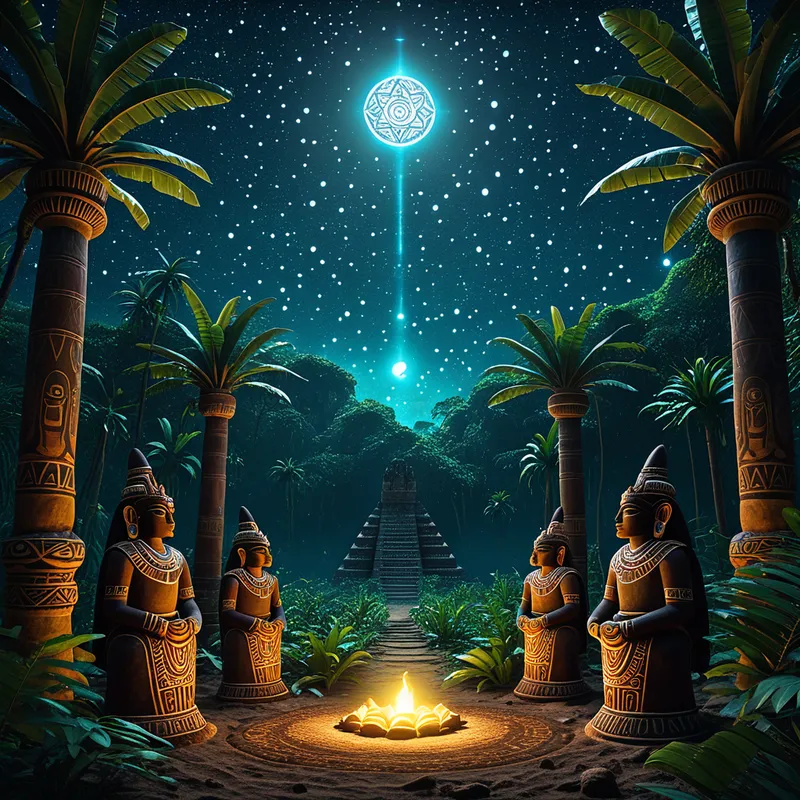
Ocarinas of the Maya Myth Meaning & Symbolism
A myth where the gods craft humanity from clay and breath, their failures and triumphs echoing through the sacred music of ocarinas.
The Tale of Ocarinas of the Maya
Listen. Before the first sun rose, when the world was a dark sea and a silent sky, the gods gathered in the Black-Water-Place. They were weary. The great turtle of the earth was firm, the ceiba tree reached its branches to the thirteen heavens, but the silence was a weight upon them. There was no one to speak their names, no one to offer the smoke of memory, no laughter to stitch the days together. The divine court was a hall of echoes.
K’inich Ajaw, Lord of the Radiant Face, struck the earth with his staff. “We must make beings who can remember. Beings who can call to us, so we may know we are.” Ix Chel, the Lady Rainbow, unspooled threads of mist and starlight. “They must be of the earth, to walk upon it, and of the dream-stuff, to see beyond it.”
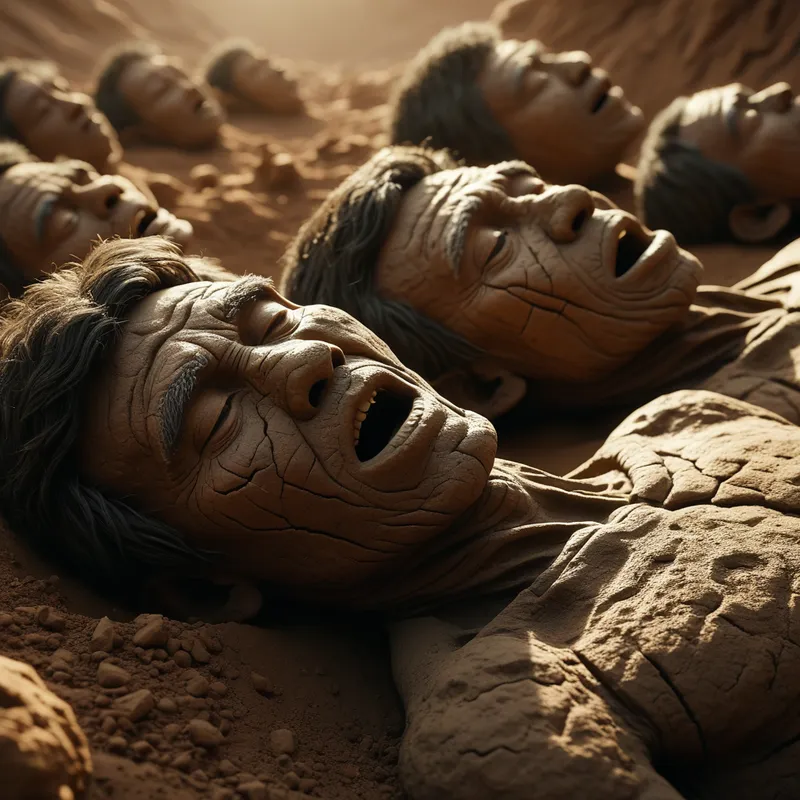
Their first attempt was with mud from the riverbanks. With great care, they sculpted forms that walked and had hands. But when the rains came, these beings dissolved into slurry, their features washing away into the streams. Their voices were the gurgle of mud, unintelligible. The gods let them return to the earth.
Their second attempt was with wood. They carved figures from the heart of the yaxche, the ceiba tree. These beings were strong! They multiplied and filled the forest. But they had no hearts, no memory. Their faces were blank, their eyes hollow. They forgot the gods entirely, chopping down the very trees of creation without a thought. Their voices were the empty knock of branch on branch. In their disappointment, the gods sent a great resinous rain that warped and cracked them, and they became the monkeys who chatter in the trees, remembering nothing.
A profound sorrow settled over the divine assembly. The silence returned, deeper now, filled with the ghosts of failed creations. It was then that Hun Hunahpu, whose body was the sustenance of the world, spoke. His voice was the sound of wind through ripe corn. “You have tried earth and wood. You have shaped the outside. But you have not given them an inside. A thing that can hold a breath, a thing that can resonate.”
He went to the sacred mountain where the first corn grew, yellow and white. He gathered the perfect kernels. Ix Chel took the corn and ground it on a stone of jade, creating a fine, golden meal. K’inich Ajaw took the meal and, with water from a cenote that had never seen the sun, kneaded it into a dough. This was not mere shaping; this was mixing the essence of life with the waters of the underworld and the light of the heavens.
Together, they formed new bodies. And into each body, Hun Hunahpu breathed. But this breath was not air alone. It was a fragment of sound, a seed of music. As the breath entered, the chest of each figure hollowed, a sacred chamber forming within. The gods then placed into their hands instruments of fired clay—ocarinas—each one unique, shaped like birds, jaguars, or rain spirits.
The first people opened their eyes. They saw the glory of the gods and their own hands. They raised the ocarinas to their lips and blew. And from the instruments came not just sound, but voice—a complex, warbling song of gratitude, of wonder, of naming. The music filled the silent world, spiraling up the ceiba tree to the heavens. The gods wept with joy, for finally, they were remembered. The people were not just of corn; they were of song. Their very bodies were vessels, and their breath through the sacred flute was the proof of the soul within.
Cultural Origins & Context
This narrative is not a single, codified myth from one inscription, but a synthesis of the core Maya creation story as told in the Popol Vuh, combined with the profound archaeological and cultural significance of ocarinas across Mesoamerica. The Popol Vuh meticulously details the failed creations of mud and wood, succeeded by the successful creation of humans from maize dough. The ocarina, or pífano, was a ubiquitous spiritual instrument.
These clay vessels were far more than toys or simple musical devices. Found in tombs, ceremonial caches, and domestic settings, they were considered tools for communication—with the gods, with the ancestors, and with the spirit world. Their often zoomorphic shapes (birds, frogs, dogs) linked the player to specific deities or natural forces. The breath forced through the chamber was seen as animating the vessel, just as the gods’ breath animated humanity. The myth, therefore, was lived daily; every time a musician played, they re-enacted the moment of their own creation, their breath becoming divine wind, their body the resonant chamber of the gods’ intent.
Symbolic Architecture
At its heart, this is a myth about the search for authentic voice and the necessary failures that precede true creation. The mud and wood beings represent preliminary, insufficient versions of the self—the ego built from unstable material (mud/emotion) or rigid structure (wood/intellect) without a core of meaning.
The true self is not merely shaped from without, but hollowed from within—a vessel created to resonate with a breath not its own.
The maize is the perfect symbol: it must die as a seed, be buried, and be reborn to become sustenance. It represents the alchemical process where base substance is transformed into spiritual nourishment. The ocarina is the critical symbol of the hollowed self. It is not a solid monument, but an instrument. Its power and purpose depend on its emptiness, its capacity to be filled by an external force (the breath, the spirit, the divine) and translate that force into meaningful, beautiful sound.
The myth posits that humanity’s defining feature is not just consciousness, but resonance—the ability to receive the transcendent and express it in a unique, earthly form. Our “song” is our individuated life, our creative expression, our prayer. To be silent is to be like the wooden people, functional but soulless.
The Dreamer’s Resonance
When this myth pattern surfaces in modern dreams, it often signals a profound crisis or process of identity formation. Dreaming of molding clay that crumbles may reflect a feeling that one’s current “shape” in the world—a career, a relationship, a self-image—is fundamentally unstable and cannot hold. Dreaming of being made of wood, stiff and unfeeling, points to a life lived by rote, all structure and no heart, leading to a fear of emotional petrification or meaningless repetition.
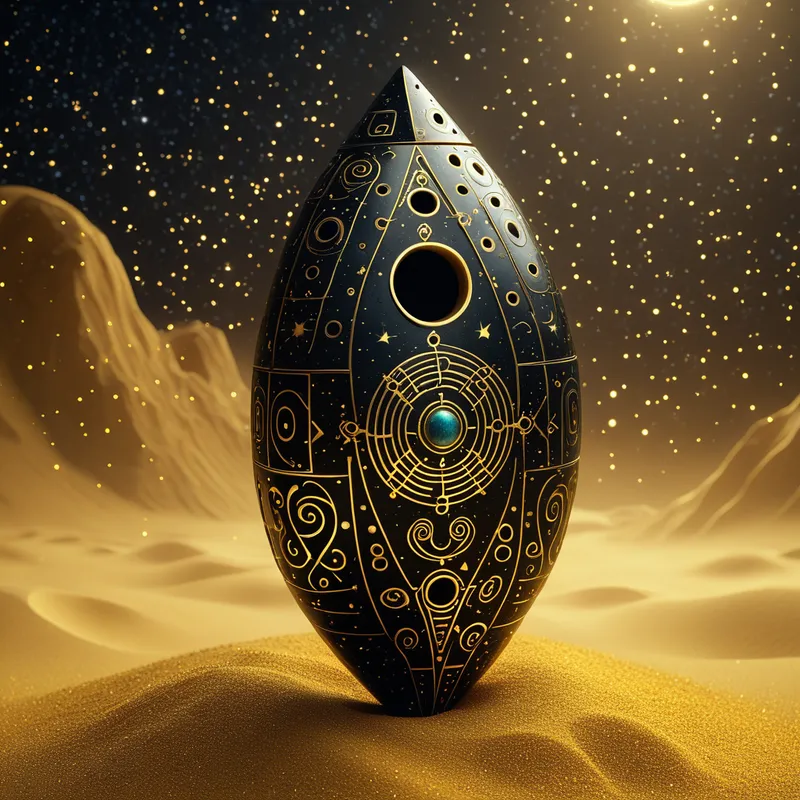
The powerful dream image of the ocarina is key. To dream of finding or playing one suggests the dreamer is discovering their own inner chamber—their capacity to hold and transform experience. To dream of being an ocarina, or having a hollow space in one’s chest, can be startling but profoundly positive. It indicates a somatic recognition of the need for emptiness, for making space for something new (spirit, inspiration, love) to enter and create resonance. The anxiety of being “empty” is being alchemized into the potential of being a “vessel.”

Alchemical Translation
For the modern individual navigating the path of individuation, this myth is a masterful map. The early, failed creations are not mistakes to be forgotten, but essential stages. We must go through the phase of the “mud self,” emotionally labile and poorly bounded, and the “wooden self,” rigidly intellectual or overly identified with persona, to learn their limitations. These are the necessary nigredo stages—the blackening, the confusion and despair that precede transformation.
The alchemical fire is the disappointment of the gods—the inner dissatisfaction that burns away these false forms. The breakthrough comes with the ingredient of maize: the sustained, cultivated, cyclical work on the self that yields spiritual sustenance. The “grinding on the jade stone” is the often-painful process of self-reflection and analysis.
Individuation is the process of becoming your own ocarina: hollowing out the illusions of the ego to create a vessel that can truthfully resonate with the depths of the Self.
The final, sacred breath is the integration of the unconscious. It is the moment when what was constructed (the ego) is animated by what is discovered (the Self). The resulting “song” is the individuated life—authentic, creative, and in a living dialogue with the transcendent. We are not the builders of our totality; we are the instruments through which a greater music seeks to be played. Our task is to become a clear, resonant vessel, and to have the courage to raise it to our lips and breathe.
Associated Symbols
Explore related symbols from the CaleaDream lexicon: