Oaths on Gungnir Myth Meaning & Symbolism
A myth where oaths sworn on Odin's spear become cosmic law, binding gods and mortals to their word under threat of profound consequence.
The Tale of Oaths on Gungnir
Hear now, and listen well, for I speak of a law older than the mountains, a truth colder than the deepest winter stream. In the time before time, when the worlds were young and the Æsir walked with purpose, there was a need. A need for a word that could not be broken, a promise that could not bend. For in the great hall of Gladsheim, where the high gods gathered, disputes arose like mist from the well of Mímisbrunnr. Words were wind, and wind could change direction.
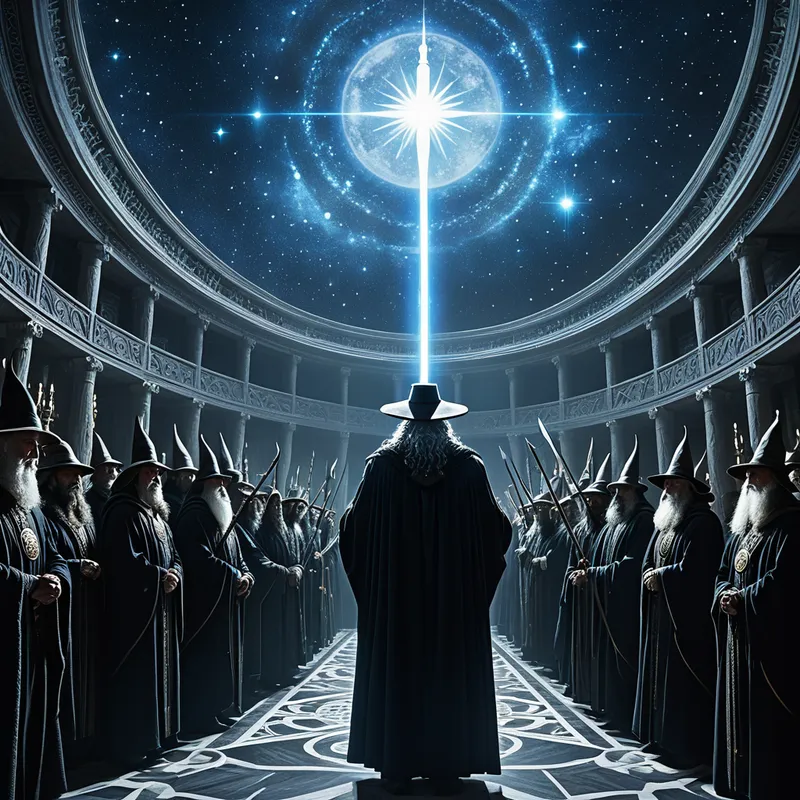
Then rose Odin, the One-Eyed, the Wanderer. His cloak was the color of a gathering storm, and in his hand he bore Gungnir. This was no mere weapon of ash and iron. Its shaft was carved with runes that hummed with the secret names of things, and its point was forged in a star’s heart. It was an axis, a truth-teller, a needle that stitched the worlds together.
He called the council to order—Thor with his hammer resting heavily, Freyja with her gaze like falcon’s gold, Forseti who listened for the balance in all things. The air in Gladsheim grew still, thick with the scent of pine from the high beams and the cold metal of awaiting arms.
“Hear me,” Odin’s voice was not loud, but it filled the spaces between breaths. “From this day, let no compact between us be mere breath. Let no treaty with the Jötnar be a shifting fog. Let no vow between kin be a fraying thread.” He raised Gungnir, and the runes upon it blazed with a pale, unwavering light. “This is the pillar of our word. What is sworn upon it is sworn upon the world-tree’s root, upon the turning of fate itself. It shall be as fixed as the nail-stars in the sky.”
And so it was decreed. When a matter of grave import was to be settled, when a peace was to be forged or a mighty alliance sworn, they would gather at the Thing. The spear would be brought forth and driven into the sacred earth, or its point held aloft. The one swearing would lay a hand upon the cold, rune-scored shaft, or speak their vow toward its unerring point. In that moment, the hum of the cosmos shifted. The oath was woven into the fabric of ørlög. To break it was not merely to betray a person; it was to tear at the ordered weave of reality, to declare war on the very principle of truth that held the nine worlds in their delicate balance. The consequence was exile, not just from the company of gods or men, but from the favor of the ordered universe—a wandering in a wasteland where no word had meaning, and no promise could ever be trusted again.

Cultural Origins & Context
This myth is not a singular story with a beginning, middle, and end, but a foundational legal and ethical principle woven throughout the tapestry of Norse lore. It is referenced in the Poetic Edda and implied in the Prose Edda, less a narrative to be told by skalds around the fire and more a sacred fact invoked by law-speakers at the Althing. Its transmission was likely twofold: as part of the divine precedent set by the gods, explaining why oaths were so sacrosanct, and as a direct model for human jurisprudence.
In a society where written contracts were rare and one’s honor was the most vital currency, the oath was the bedrock of social order. Treaties between chieftains, marriages, business dealings, and legal testimony all relied on the inviolability of the sworn word. The myth of Oaths on Gungnir provided the divine template and the terrifying cosmic stakes for this practice. It elevated oath-breaking from a social faux pas to a sacrilege. The function was profoundly societal: it created a shared psychological reality where a promise was not just a personal intention but a objective event in the world, witnessed by the gods and bound to a symbol of ultimate authority and consequence. It externalized the internal weight of integrity, making it a matter of collective survival.
Symbolic Architecture
At its core, the myth establishes a sacred geometry of word, will, and world. Gungnir is the central symbol—not merely a weapon, but a metaphysical tool. As the spear that “never misses,” it represents unwavering truth, directed intention, and the inevitable consequence of action. It is the axis mundi in microcosm, a focal point where human speech interfaces with divine law.
The oath on Gungnir is the moment the subjective will attempts to sculpt the objective world, accepting that the chisel of speech, once swung, cannot be taken back.
Odin, as the oath-giver, embodies the ruler archetype in its most profound aspect: not the tyrant, but the law-bringer, the one who instills order out of potential chaos by creating a framework where trust is possible. The act of swearing is a ritual of self-binding. The individual voluntarily surrenders a portion of their future freedom to the higher principle of their own word, making integrity a cage of their own making—a cage that paradoxically grants them the freedom to be trusted and to operate within a society.
The terrible consequence for breaking the oath—existential exile—symbolizes the psychological state of the oath-breaker. It is the inner landscape of the person who has severed their connection to their own core truth. They become an outcast in the realm of meaning, adrift in a personal Ginnungagap where relationships are impossible because their word is now meaningless, even to themselves.

The Dreamer’s Resonance
When this myth pattern stirs in the modern unconscious, it rarely appears as a Viking god and a literal spear. Instead, the dreamer may encounter a potent, immovable object—a stone pillar, a frozen tree, a monolithic machine—upon which they are compelled to inscribe a promise. They may dream of signing a contract in ink that becomes part of their skin, or speaking words that solidify in the air like iron bars.
Somatically, this dream process often accompanies a feeling of immense pressure, a “point of no return” in waking life. It is the psyche working through a moment of serious commitment: a marriage, a career path, a vow to oneself to change a deep-seated pattern, or the heavy burden of a secret that must be kept. The body may feel the weight of the “oath,” manifesting as tension in the jaw (the seat of speech), the shoulders (carrying a burden), or the solar plexus (the center of will). The dream is the psyche’s ancient court, convening to ensure the dreamer understands the gravity of the promise they are making or have made. It is a confrontation with the cost of integrity.

Alchemical Translation
The alchemical journey modeled here is the transmutation of casual intention into sworn purpose—the leaden dross of “maybe” into the golden certainty of “I am.” In the process of individuation, we must eventually move from the fluid, exploratory phase of the explorer to the committed, structuring phase of the ruler. We must plant our own Gungnir.
This begins with identifying what, in our personal cosmos, is worthy of being our “spear”—the core value, the central truth, the non-negotiable principle that will guide our actions. It might be compassion, creativity, honesty, or justice. The alchemical act is to “swear upon it.” This is not a public declaration, but a deep, inner ritual where we bind our future choices to that principle.
Individuation requires us to become our own Odin and our own Thing, to hold our own spear-court and judge our actions against the oaths we have sworn to our deepest self.
The struggle is the inevitable tension that follows. The oath will be tested. Temptations to break it for short-term gain, comfort, or approval will arise—these are the Jötnar of chaos and dissolution. Upholding the oath often feels like a sacrifice, a narrowing. Yet, this is the alchemical solve et coagula: the dissolution of the old, amorphous self and the coagulation of a new, more integrated self around a spine of sworn truth. The “exile” that follows breaking an oath to oneself is the depression, anxiety, and self-estrangement of living out of alignment. Conversely, keeping the oath, despite the cost, forges an unshakeable inner authority. The individual becomes a sovereign realm, ordered and trustworthy, capable of forging lasting alliances with others and with destiny itself. They have woven their word into their own ørlög, becoming an active co-creator of their fate.
Associated Symbols
Explore related symbols from the CaleaDream lexicon: