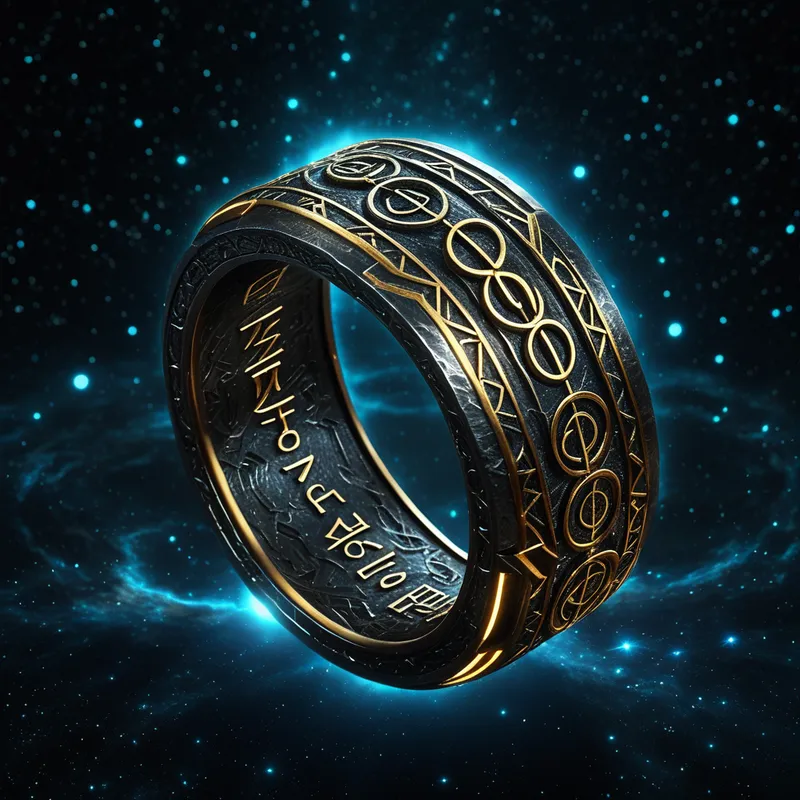
Oath Ring Myth Meaning & Symbolism
A sacred ring forged by gods, upon which oaths are sworn, binding mortals and deities to cosmic law and the terrible price of betrayal.
The Tale of the Oath Ring
Hear now, a tale not of blood and thunder, but of silence and weight. In the time before time was counted, when the breath of the giant Ymir still misted [the void](/myths/the-void “Myth from Buddhist culture.”/), the gods of Asgard knew a dread truth: a kingdom built on strength alone is a hall built on sand. Chaos gnawed at the roots of the [Yggdrasil](/myths/yggdrasil “Myth from Global/Universal culture.”/). Promises were wind, and words were weapons with no sheaths.
So it was that the All-Father, Odin, the one-eyed seeker, journeyed not for mead or magic, but for a foundation. From the deep forges of [the dwarves](/myths/the-dwarves “Myth from Norse culture.”/), masters of craft and cunning, he commanded a circle. Not a crown, not a shackle, but a boundary. They took iron from the heart of a fallen star and gold from the tears of the sun, and in their smokes they whispered spells of binding. They forged a ring, vast and heavy, its inner band etched with the primal [runes](/myths/runes “Myth from Norse culture.”/) of Ansuz for oath, Tiwaz for [justice](/myths/justice “Myth from Tarot culture.”/), and Mannaz for the binding of kindred.
This ring, Varar hringr, was brought to the great plain of Idavollr. There, under the watchful eyes of the gods—stern Thor with his hammer, golden [Freyr](/myths/freyr “Myth from Norse culture.”/), and fierce [Freyja](/myths/freyja “Myth from Norse culture.”/)—[the law](/myths/the-law “Myth from Biblical culture.”/) was proclaimed. The ring was placed upon a stand of ash-wood. No temple housed it, for its temple was the community itself.
From that day, any oath of grave import—a treaty between kings, a vow of loyalty from a warrior to his lord, a pledge of peace between feuding families—was sworn upon its cold, gleaming surface. The oath-taker would place their hand upon the ring, feel the ancient runes bite into their palm, and speak their vow to the listening sky. The air would grow still. The very roots of Yggdrasil seemed to tremble. For the oath was no longer just words; it was now a thread woven into the fabric of ørlǫg. It became a part of the sworn one’s soul-stuff, a weight they carried henceforth.
And woe to the oath-breaker. The myth whispers of no immediate lightning strike. Instead, a colder fate. The broken oath would fester within the breaker, a spiritual rot. Their luck, their hamingja, would seep away. Their name would become a byword for treachery, shunned by gods and mortals alike. They were cast outside [the sacred circle](/myths/the-sacred-circle “Myth from Various culture.”/) of trust, the frith, that held [the world](/myths/the-world “Myth from Tarot culture.”/) together. In their exile, they fed the wolves of chaos that ever sought to devard the ordered world. The ring judged silently, implacably, its justice as inevitable as winter.
Cultural Origins & Context
The concept of the Oath Ring is not confined to a single, canonical myth from the Poetic Edda or Prose Edda, but is woven into the very legal and social fabric of the Norse world. It is a ritual object, a holy object, referenced in sagas and law codes. The most famous literary incarnation is the ring owned by the god Ullr or, in temple inventories, the ring upon which oaths were sworn to Thor.
In the practical, assembly-based society of the Norse, where written contracts were rare, a man’s word was his bond—but that bond required a sacred anchor. The oath ring, often kept in a local temple or at the þing site, served this purpose. It was a physical manifestation of the community’s conscience and its collective will to survive. The chieftain or godi (priest-chieftain) would often wear or hold a large ring during legal proceedings, transforming secular promises into sacred covenants.
This practice elevated law from mere human agreement to cosmic principle. By swearing on the ring, one invoked not just the witnesses present, but the entire [pantheon](/myths/pantheon “Myth from Roman culture.”/) and the structure of reality itself. The mythic narrative surrounding it—its divine origin, its unbreakable nature—was the story the culture told itself to enforce the social contract. It was a story of containment, creating a ring of order against the ever-present threat of chaos, betrayal, and social collapse.
Symbolic Architecture
At its core, the [Oath](/symbols/oath “Symbol: A solemn promise or vow, often invoking a higher power or sacred principle, binding individuals to specific actions or loyalties.”/) Ring is the [symbol](/symbols/symbol “Symbol: A symbol can represent an idea, concept, or belief, serving as a powerful tool for communication and understanding.”/) of [the Self](/myths/the-self “Myth from Jungian culture.”/) as a binding agent. It is not [the ego](/myths/the-ego “Myth from Jungian culture.”/), but the greater, integrative center of the [psyche](/myths/psyche “Myth from Greek culture.”/) that holds opposites in [tension](/symbols/tension “Symbol: A state of mental or emotional strain, often manifesting physically as tightness, pressure, or unease, signaling unresolved conflict or anticipation.”/) and demands integrity.
The ring is the circumference of the individuated psyche; to step outside it is to shatter one’s own wholeness.
The Circle represents totality, completion, and the sacred [boundary](/symbols/boundary “Symbol: A conceptual or physical limit defining separation, protection, or identity between entities, spaces, or states of being.”/). It demarcates the inner from the outer, the sworn from the unsworn, order from [chaos](/symbols/chaos “Symbol: In Arts & Music, chaos represents raw creative potential, uncontrolled expression, and the breakdown of order to forge new artistic forms.”/). The Iron symbolizes the unwavering, hard necessity of law and the [strength](/symbols/strength “Symbol: ‘Strength’ symbolizes resilience, courage, and the ability to overcome challenges.”/) required to uphold a promise. The Gold represents the sacred value, the luminosity of [truth](/symbols/truth “Symbol: Truth represents authenticity, honesty, and the quest for knowledge beyond mere appearances.”/) and honor that gives [the law](/symbols/the-law “Symbol: Represents external rules, societal order, moral boundaries, and the tension between personal freedom and collective structure.”/) its worth. The Runes are the immutable, archetypal patterns—the fundamental laws of both the [cosmos](/symbols/cosmos “Symbol: The entire universe as an ordered, harmonious system, often representing the totality of existence, spiritual connection, and the unknown.”/) and the [soul](/symbols/soul “Symbol: The soul represents the essence of a person, encompassing their spirit, identity, and connection to the universe.”/).
Psychologically, the act of swearing an oath represents the [moment](/symbols/moment “Symbol: The symbol of a ‘moment’ embodies the significance of transient experiences that encapsulate emotional depth or pivotal transformations in life.”/) a conscious commitment is made to a value, a [relationship](/symbols/relationship “Symbol: A representation of connections we have with others in our lives, often reflecting our emotional state.”/), or a [path](/symbols/path “Symbol: The ‘path’ symbolizes a journey, choices, and the direction one’s life is taking, often representing individual growth and exploration.”/). This commitment moves an [impulse](/symbols/impulse “Symbol: A sudden, powerful urge or drive that arises without conscious deliberation, often linked to primal instincts or emotional surges.”/) from the unconscious [realm](/symbols/realm “Symbol: The symbol of ‘Realm’ often signifies the boundaries of one’s consciousness, experiences, or emotional states, suggesting aspects of reality that are either explored or ignored.”/) of possibility into the conscious realm of actuality, binding psychic [energy](/symbols/energy “Symbol: Energy symbolizes vitality, motivation, and the drive that fuels actions and ambitions.”/) to a specific [purpose](/symbols/purpose “Symbol: Purpose signifies direction, meaning, and intention in life, often reflecting personal ambitions and core values.”/). The “[weight](/symbols/weight “Symbol: Weight symbolizes burdens, responsibilities, and emotional loads one carries in life.”/)” of the oath is the [responsibility](/symbols/responsibility “Symbol: Responsibility in dreams often signifies the weight of duties and the expectations placed upon the dreamer.”/) of [consciousness](/symbols/consciousness “Symbol: Consciousness represents the state of awareness and perception, encompassing thoughts, feelings, and experiences.”/). The oath-breaker is not merely a social [villain](/symbols/villain “Symbol: A character representing opposition, moral corruption, or suppressed aspects of self, often embodying fears, conflicts, or societal threats.”/) but an [image](/symbols/image “Symbol: An image represents perception, memories, and the visual narratives we create in our minds.”/) of psychic [disintegration](/symbols/disintegration “Symbol: A symbol of breakdown, loss of form, or fragmentation, often reflecting anxiety about personal identity, control, or stability.”/)—the ego reneging on a commitment made to the deeper Self, resulting in a [loss](/symbols/loss “Symbol: Loss often symbolizes change, grief, and transformation in dreams, representing the emotional or psychological detachment from something or someone significant.”/) of inner [authority](/symbols/authority “Symbol: A symbol representing power structures, rules, and control, often reflecting one’s relationship with societal or personal governance.”/), [direction](/symbols/direction “Symbol: Direction in dreams often relates to life choices, guidance, and the path one is following, emphasizing the importance of navigation in personal journeys.”/), and vitality (the [loss](/symbols/loss “Symbol: Loss often symbolizes change, grief, and transformation in dreams, representing the emotional or psychological detachment from something or someone significant.”/) of hamingja).
The Dreamer’s Resonance
When the Oath Ring appears in modern dreams, it rarely manifests as a literal artifact. Instead, one might dream of a solemn, unbreakable circle of light; a wedding band that feels impossibly heavy; a [round table](/myths/round-table “Myth from Arthurian culture.”/) where a fateful decision is made; or being asked to sign a contract in blood. The somatic sensation is often one of profound pressure—a weight on the chest, a tightening around the finger or throat.
This dream motif signals a critical moment of psychic oath-taking. The dreamer is at a crossroads where a deep, perhaps unconscious, part of the Self (the inner ruler archetype) is demanding a commitment. It could relate to a relationship, a career path, a creative project, or an ethical stance. The anxiety in the dream mirrors the terror of binding one’s future self, of limiting freedom for the sake of integrity. To dream of breaking the ring, or of being unable to touch it, speaks to a fear of commitment or a deep, unacknowledged betrayal of one’s own values. The dream presents the ring as an invitation to courage, to bind the fragmented parts of oneself into a coherent whole through a conscious vow.
Alchemical Translation
The alchemical process mirrored in the Oath Ring myth is Coagulatio—the making solid, the fixation of the volatile spirit into a lasting form. It is the stage where the insights from the unconscious ([Solutio](/myths/solutio “Myth from Alchemical culture.”/)—dissolution) must be given structure and commitment.
The prima materia of the soul is a chaotic potential; the oath is the philosopher’s stone that grants it coherent, lasting form.
First, the Forging (Separation): The ego (Odin) recognizes the need for law amidst inner chaos. It must journey into the depths (the dwarf-forge of the unconscious) to retrieve the raw materials of one’s core values (iron and gold) and shape them into a conscious principle (the ring).
Second, the Swearing (Conjunctio): This is [the sacred marriage](/myths/the-sacred-marriage “Myth from Various culture.”/) of word and deed, intention and action. The conscious mind places its “hand” upon the Self-made principle, binding the ego’s will to the soul’s deeper purpose. This creates the lapis, the sacred stone of the integrated personality.
Third, the Upholding (Mortificatio & Sublimatio): The true alchemy is living the oath. Every temptation to break it is a mortificatio, a death of the old, opportunistic self. Each act of fidelity is a sublimatio, an elevation, where the base metal of casual promise is transmuted into the gold of authentic character. The “price” of betrayal is not punishment from the gods, but the failure of the alchemical work—the substance reverts to chaos, and the individuation process stalls.
For the modern individual, the myth teaches that freedom is not found in the absence of vows, but in the conscious, solemn choosing of them. Our oaths—to ourselves, to our loved ones, to our work, to truth—are the rings we forge. They are the architecture of a soul that can withstand the winds of ørlǫg. To live without them is to be formless. To live within them, despite their weight, is to become a sovereign realm unto oneself.
Associated Symbols
Explore related symbols from the CaleaDream lexicon: