Oath of Tyr Myth Meaning & Symbolism
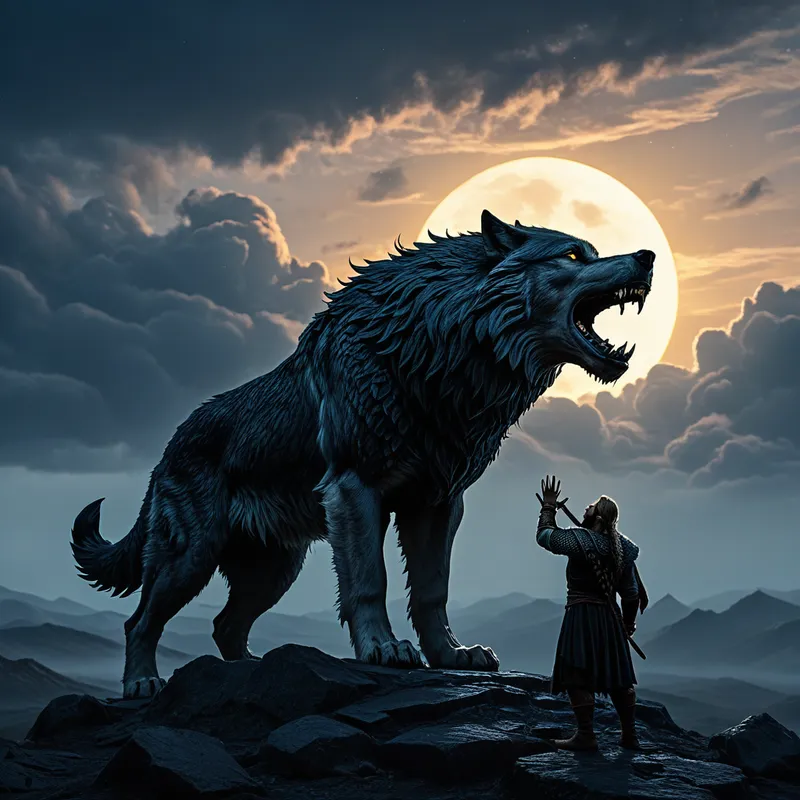
The god Tyr sacrifices his hand to bind the monstrous wolf Fenrir, an act of sacred oath and conscious sacrifice to preserve cosmic order.
The Tale of Oath of Tyr
Listen, and hear the price of order. In the dawn of the world, when the roots of Yggdrasil were still tender, a shadow grew in the halls of the Æsir. It was the wolf, Fenrir, a child of chaos and trickery, whose growth knew no bounds. He was fed by the gods themselves, for even in their might, they feared what they did not understand. Yet with each passing season, his jaws grew wider, his eyes burned brighter with a cunning, feral intelligence, and the dread in Asgard deepened like a winter frost.
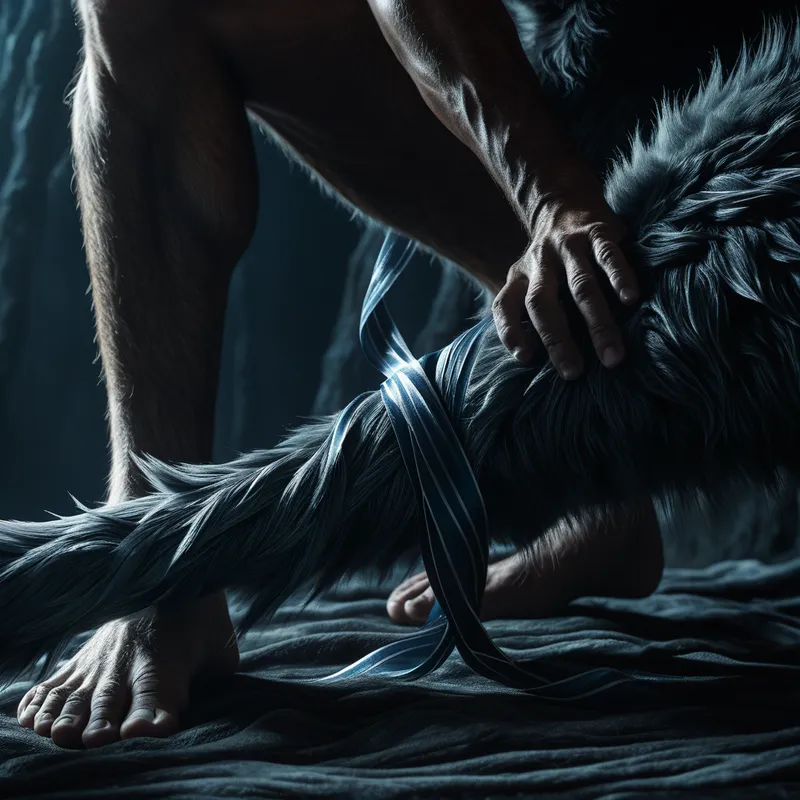
The gods saw the omens. They heard the prophecies whispered by the Norns at the well of Urd: this wolf would be their doom. So, with heavy hearts, they resolved to bind him. They commissioned the clever dwarves of Svartalfheim, who forged a fetter of impossible things: the sound of a cat’s footfall, the beard of a woman, the roots of a mountain, the sinews of a bear, the breath of a fish, and the spittle of a bird. From these six impossibilities, they crafted Gleipnir, a ribbon smooth as silk and thin as a hair, yet stronger than any iron chain.
They brought the ribbon to Lyngvi, in the midst of a mist-shrouded lake. “Test your strength, mighty Fenrir,” they said, presenting the delicate bond. The wolf’s nostrils flared, sensing the magic woven within its subtle form. “I see no fame for myself if I break such a slight thread,” he growled, his voice like grinding stones. “But if there is trickery here, a magic meant to hold me fast, then you must place a hand in my jaws as a pledge of good faith. A token of your oath that this is a test, and not a trap.”
A cold silence fell. The wind stilled. The gods looked at one another, and none would meet the wolf’s burning gaze. To place a hand in those jaws was to gift it to the beast. Then, one stepped forward. It was Tyr, whose name means “god.” He was the bravest, the one who kept the law of the thingstead, the one who understood the weight of a promise. Without a word, he placed his right hand—the hand of oaths, the hand of giving and taking—into the mouth of the beast.
The other gods bound Fenrir with Gleipnir. The wolf strained, thrashing, but the more he struggled, the tighter the magical ribbon held. He was trapped. Then the truth of the trickery shone in his eyes. With a final, world-shaking roar of betrayal, he closed his jaws. The sound of rending flesh and breaking bone was brief, swallowed by the sudden, absolute silence that followed. Tyr stood, his wrist a fountain of crimson, his face a mask of agony and profound resolve. He had given his hand, but he had kept his word. The wolf was bound, and the price of that binding was paid in full, a sacrifice that echoed through the nine worlds.
Cultural Origins & Context
This myth is preserved primarily in the Poetic Edda, specifically in the poem Lokasenna and detailed in Snorri Sturluson’s 13th-century Prose Edda. It was not merely a story of divine adventure but a foundational narrative for a culture built on the precarious balance between chaos and order. In the harsh, honor-based society of the Norse, an oath was not a casual promise but a sacred contract, a weaving of one’s personal luck and fate (ørlög) with the cosmic order. To break an oath was to unravel that order, inviting chaos (ørlǫg) into one’s life and community.
Tyr, once perhaps the chief god before Odin’s ascendancy, embodied this principle. He was the god of the thing (the governing assembly), of law, and of just war. The myth served as an ultimate exemplar: the preservation of the social and cosmic whole sometimes requires a terrible, personal sacrifice, and a true leader is one who pays that price knowingly and without flinching. It was a story told to reinforce the absolute sanctity of oaths and the severe consequences—both personal and cosmic—of upholding or breaking them.
Symbolic Architecture
At its heart, the Oath of Tyr is a myth about the conscious, willing sacrifice required to bind the uncontrollable, chaotic aspects of existence. Fenrir is not mere “evil”; he is a force of primal, destructive potential, a part of the cosmos that cannot be destroyed but must be contained for life and order to proceed. He represents the untamed shadow, the ravenous instinct, the catastrophic event that lurks in the future.
The sacrifice is not an accident of war, but a deliberate payment for a conscious choice. It is the price of the contract with chaos itself.
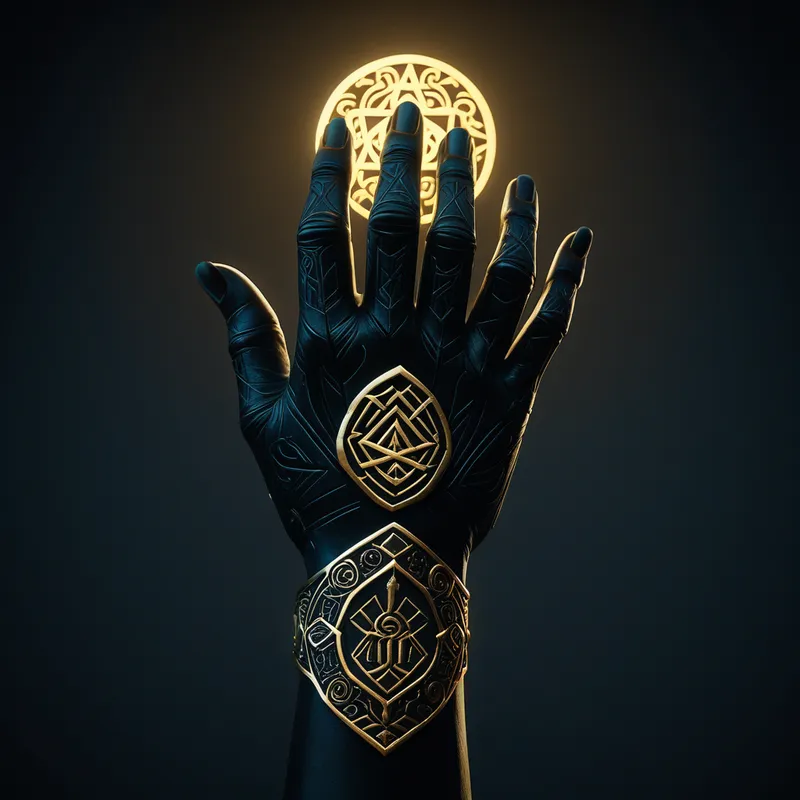
Tyr’s hand is the ultimate symbol. The right hand is the hand of action, of pledge, of agency. In sacrificing it, Tyr willingly limits his own capacity for martial action (he is the god of war) to enact a greater, lawful good. The binding with Gleipnir—fashioned from “impossibilities”—signifies that chaos cannot be restrained by brute force (the earlier, broken iron chains) but only by cunning, paradox, and magic: by engaging with the irrational on its own terms. Tyr’s act transforms the oath from a mere verbal agreement into a somatic, irreversible reality. His maiming is a permanent testament to the cost of order, a divine wound that forever marks the boundary between the bound chaos and the functioning world.
The Dreamer’s Resonance
When this myth stirs in the modern psyche, it often manifests in dreams of necessary but painful containment. One might dream of willingly restraining a wild animal, of signing a contract with one’s own blood, or of a profound, self-inflicted limitation (like a hand that will not grasp). The somatic feeling is one of tense, agonizing resolution—a knot pulled tight in the stomach, a clenched jaw held steady.
Psychologically, this signals a process where the conscious ego (Tyr) is facing a burgeoning, potentially destructive complex or impulse (Fenrir) within the unconscious. This could be a rage, a compulsive desire, or a raw talent so powerful it threatens to consume one’s life. The dreamer is at the point of making a sacred pact: to acknowledge this force, to engage with it honestly (the oath), and to consciously limit its expression for the sake of their own wholeness and social integrity. The “loss” of the hand in the dream is not a castration but a sacred wounding, the acceptance that integrating this power will cost a part of one’s previous identity or freedom.
Alchemical Translation
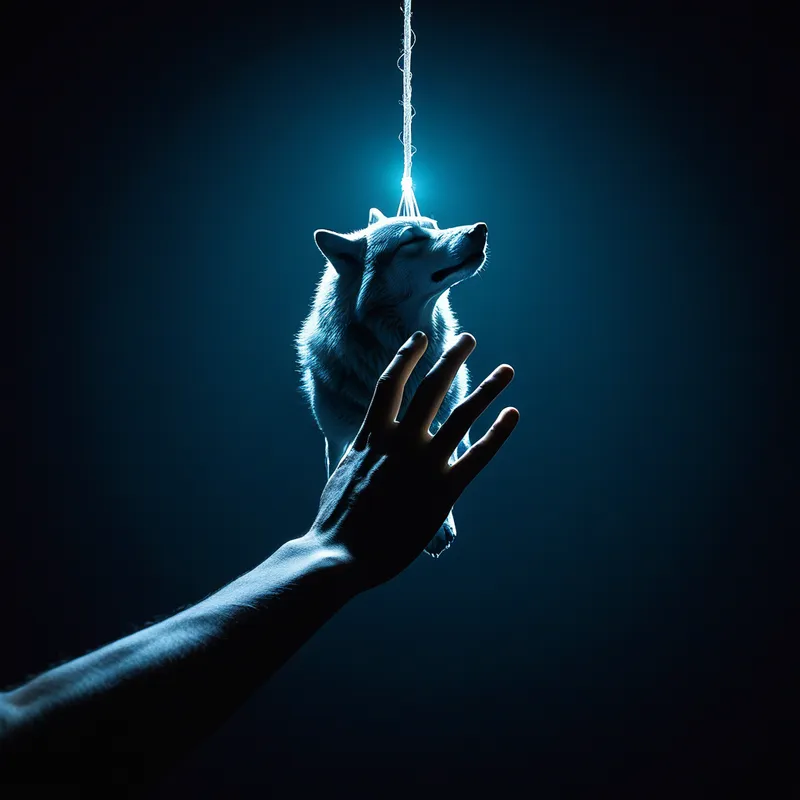
The alchemical process mirrored here is the sacrificium, the necessary sacrifice in the work of individuation. The goal is not to slay the wolf (which would be impossible and would unbalance the psyche), but to bind it, to integrate its energy in a managed form. The first step is the nigredo: the recognition of the dark, growing threat within (Fenrir’s unchecked growth). The crafting of Gleipnir represents the alchemical artifice—the conscious work of the ego gathering paradoxical, “impossible” insights from the unconscious to create a binding insight or new attitude.
The individuated Self is not the Self that has destroyed its demons, but the Self that has learned to sit, bound and present, at its own hearth.
Tyr’s act is the crucial moment of transmutation. The ego’s willing sacrifice of a prized function (its “hand,” perhaps a rigid identity, a cherished ambition, or an old way of being) is the catalyst. By paying the price, the chaotic libido (Fenrir) is bound and its raw power is made available to the psyche in a contained, non-destructive way. The god who is maimed is also the god who has fulfilled the law and preserved the world. So too, the modern individual emerges from this inner ordeal not “whole” in a childish sense of having everything, but complete in a mature sense: scarred, limited in one way, but immeasurably strengthened in sovereignty, integrity, and the hard-won peace that comes from having faced the wolf and kept one’s oath.
Associated Symbols
Explore related symbols from the CaleaDream lexicon: