Nyx Myth Meaning & Symbolism
The myth of Nyx, the first and most powerful goddess of Night, from whom all things, both light and dark, ultimately descend.
The Tale of Nyx
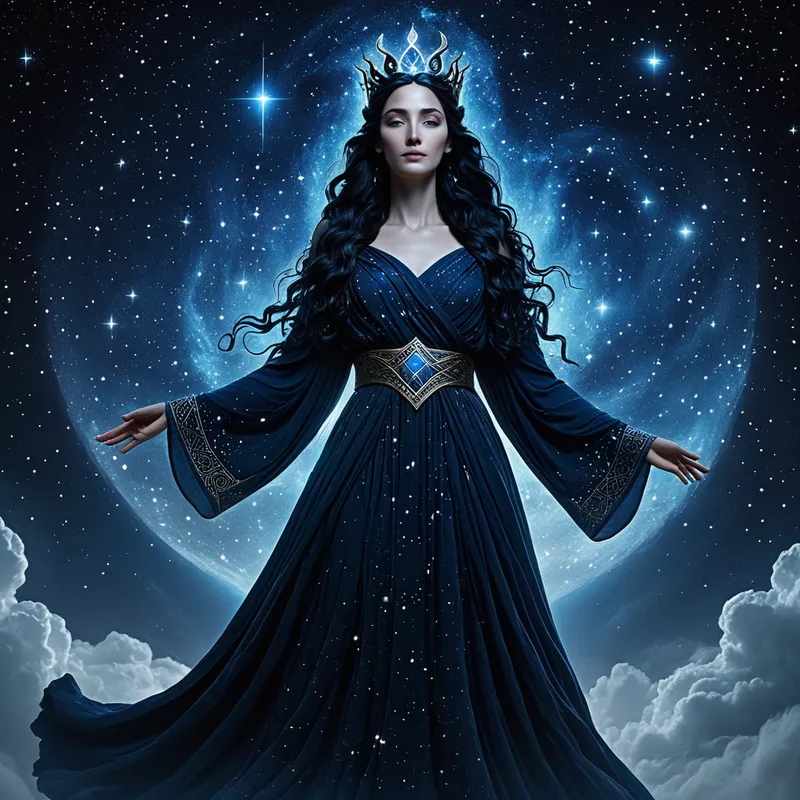
Before the sun carved its first path, before the mountains rose and the seas learned their tides, there was a breath. A sigh in the absolute void. From this sigh, from the yawning gap of Chaos, she emerged. Not born, but simply being. She was Nyx, and she was Night itself.
Her form was not a shape as mortals know it, but a presence—a vast, velvety expanse, darker than the deepest cave, yet alive with a potential colder and more fertile than any womb. She was the first cloak, the original cover. Into her embrace spilled the first things: Aether, the bright upper air, and Hemera, the Day. But they were not her only children. From her alone, without consort, she brought forth the weightier kin.
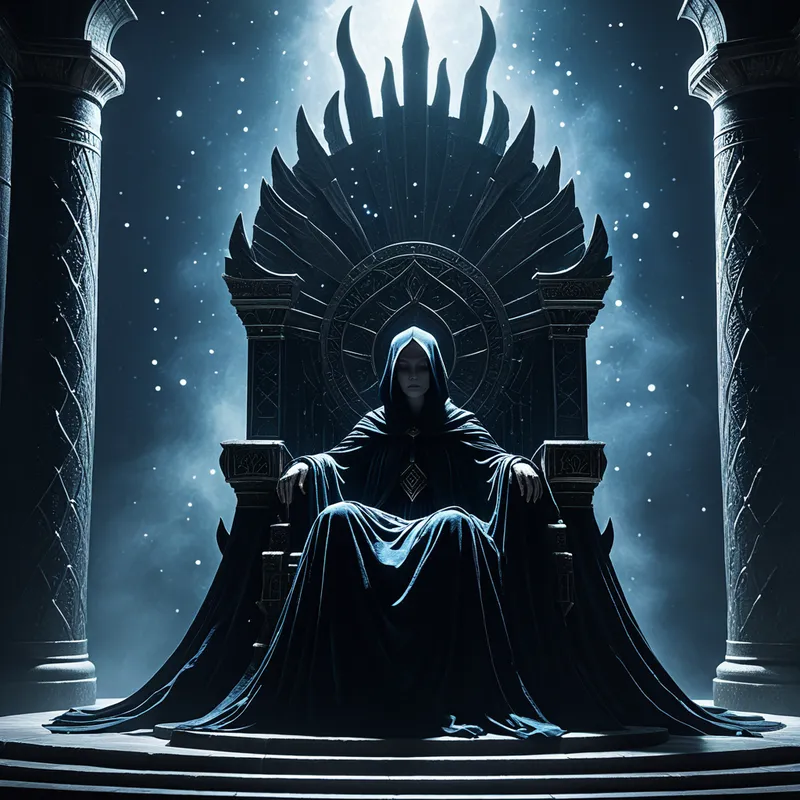
In her palace of bronze and shadow at the world’s edge, where the rivers of the underworld whisper into the cosmos, Nyx sat sovereign. From the folds of her star-strewn robe stepped Ananke, the inescapable coil of necessity. With her came the Moirai, who spin, measure, and cut the thread of every life. From her silence came Hypnos, gentle and beguiling, and his twin, Thanatos, of the iron heart. From her depth emerged Nemesis, and the Erinyes, with serpents in their hair. Strife, Deceit, Old Age—all these potent forces were her progeny, born from the fertile dark of her being.
Even the king of gods, Zeus himself, knew to tread softly in matters concerning Nyx. Homer tells of a time when Eris, her daughter, was barred from a feast, and Zeus, fearing the wrath of the mother, dared not intervene. For Nyx held a power older than Olympus, a primordial authority that the flash of thunder could not intimidate. Each evening, Hemera, the Day, would tire and sink into the western sea. Then Nyx would emerge from her palace, drawn in her chariot by shadowy steeds, and her dark mantle would spread across the sky, a gentle, inevitable command for all creation to rest, to dream, and to confront what the light had hidden. This was her eternal rhythm, her unspoken law—the first and final truth of the cosmos.
Cultural Origins & Context
The myth of Nyx originates from the earliest layers of Greek cosmogony, preserved in the works of Hesiod’s Theogony (c. 700 BCE) and referenced with awe in Homer’s Iliad. She belongs to the Protogenoi, the “first-born” deities, who are not anthropomorphic personalities in the later Olympian sense, but elemental forces personified. Her story was not a popular cult narrative with temples and festivals; instead, it was the intellectual and poetic property of bards and philosophers, a foundational piece of their understanding of cosmic order.
Hesiod uses her lineage to map the architecture of reality itself, explaining how abstract concepts like Fate, Death, and Retribution are intrinsic, born-from-the-beginning parts of existence. Her myth functioned as a philosophical anchor, establishing a primal, maternal source for all aspects of life, both the celebrated (Light, Day) and the feared (Death, Strife). She represented the acknowledgment that darkness is not merely the absence of light, but a generative, sovereign principle in its own right. The telling of her story was an act of cosmic cartography, situating humanity within a universe where the terrifying and the necessary emerge from the same ancient, dark womb.
Symbolic Architecture
Nyx is the archetype of the Primordial Container. She symbolizes the unconscious matrix from which all conscious life and its attendant phenomena emerge. She is not evil, but prior. Her darkness is not void, but potential—the fertile, unformed state before differentiation.
The night does not create monsters; it reveals the monsters we have always carried, and in that revelation lies the possibility of naming them, and thus, of taming them.
Her autonomous generation of her children signifies a profound psychological truth: the core structures of our psychic reality—our fate (the Moirai), our capacity for rest and oblivion (Hypnos), our mortality (Thanatos), our moral compass (Nemesis)—are not imposed from an external father-god, but arise endogenously from the depths of our own being. Nyx is the prima materia of the soul. Zeus’s fear of her underscores that even the pinnacle of conscious ego-power (the ruling principle) must respect and cannot ultimately control the autonomous, generative power of the unconscious.
The Dreamer’s Resonance
When the pattern of Nyx manifests in modern dreams, it often signals a profound encounter with the personal and collective unconscious. It is not merely a dream of darkness, but of a generative darkness.
The dreamer may find themselves in a vast, starless landscape that feels simultaneously empty and intensely alive with potential. They may witness strange, archetypal forms coalescing from the shadows—figures representing unacknowledged grief, latent creativity, ancestral memory, or primal fear. This is the somatic and psychological process of the unconscious asserting its foundational reality. The ego’s daytime structures are being dissolved back into the Nyxian night, not for destruction, but for reconstitution. The dreamer is experiencing what psychologist James Hillman called “soul-making,” where the psyche insists on presenting its full, primordial family, demanding recognition of all its children, not just the agreeable ones.

Alchemical Translation
The myth of Nyx models the first, non-negotiable stage of psychic transmutation or individuation: the nigredo. This is the descent into the personal night, the confrontation with the shadow, the depression, and the confusion that precedes renewal.
Individuation does not begin with striving toward the light, but with a conscious, respectful descent into the native darkness that bore us.
The alchemical work is to sit in the bronze palace of one’s own Nyx—to cease fleeing the inner night and instead learn its sovereignty. One must acknowledge the self-generated nature of one’s “fates” and “demons.” The triumph is not in defeating Nyx, which is impossible, but in achieving what Zeus instinctively knew: a respectful relationship with her. To integrate the Nyx archetype is to accept that light (consciousness) is her child, born from her and returning to her daily. It is to find creativity, wisdom, and ultimate authority not by forever shining a light into the dark, but by understanding that the dark itself is the source of the light. The modern individual’s journey is to become a conscious citizen of both realms, to let the ego-sun set, and to trust that the nourishing, revealing, generative night holds the blueprint for what comes next.
Associated Symbols
Explore related symbols from the CaleaDream lexicon: