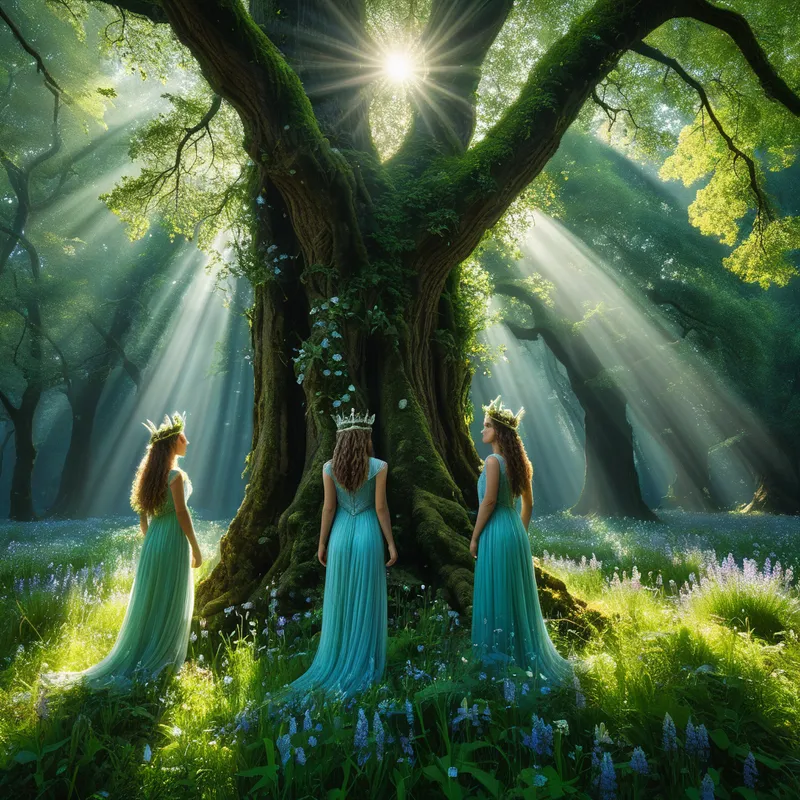
Nymphs Myth Meaning & Symbolism
The Nymphs are the wild, sacred soul of nature in Greek myth, spirits of springs, trees, and mountains, embodying the untamed life force that animates the world.
The Tale of Nymphs
Listen. Before the walls of cities, before the plow cut the earth, the world was alive with a different breath. It was not empty land, but a thrumming, whispering body. And its soul was the Nymphs.
You would not see them if you strode through the woods with a hunter’s direct gaze. You had to be still. You had to kneel by the spring where the water bubbles cold from the dark heart of the rock. There, in the shimmer just beneath the surface, you might see her—the Naiad, her hair the color of wet stone and green moss, her eyes holding the depth of the underground rivers. She is the spring itself; to pollute her waters is to wound her flesh.
Walk into the mountain pass where the wind howls. That is not merely wind. It is the voice of the Oread, her form carved from cliff-face and cloud, her laughter the crash of falling stone, her sorrow the long, cold silence of the high peaks. She is the bones of the world, ancient and unmoving, yet her spirit rides the eagle’s cry.
But venture into the deep grove, where the oldest oak stands, its branches a cathedral. Touch its bark. Feel the slow, patient pulse. That is the Hamadryad. She was born with the acorn and will die with the tree’s fall. Her song is the rustle of leaves, a language too slow for mortal ears. To cut her tree is not logging; it is murder.
Their tales are not of great wars, but of intimate, terrible encounters with the forces that seek to possess or break the wild. The god Apollo desires the Nymph Daphne. He is relentless, a force of consuming passion. She flees, her breath ragged, the heat of his divine pursuit at her back. In her ultimate desperation, she cries out to her mother, the Earth. And the Earth answers. As Apollo’s hand closes on her shoulder, her skin becomes smooth bark, her hair leaves, her limbs branches. She transforms into the laurel tree, forever sacred, forever free from his grasp. Her victory is a metamorphosis into another form of wildness.
Another Naiad, Galatea, is loved by the monstrous Cyclops Polyphemus. He serenades her with a clumsy, violent song, offering her the dominion of his cave. But her heart belongs to the mortal shepherd Acis. In a fit of jealous rage, Polyphemus crushes Acis with a boulder. Galatea’s grief does not end in death, but in transfiguration. From Acis’s blood, she conjures a river, giving his spirit a permanent, flowing form—a different kind of life, woven back into the landscape she embodies.
This is their world: a constant, vibrant negotiation between life force and form, between being seen and being consumed, between eternal flow and sudden, sacred arrest.
Cultural Origins & Context
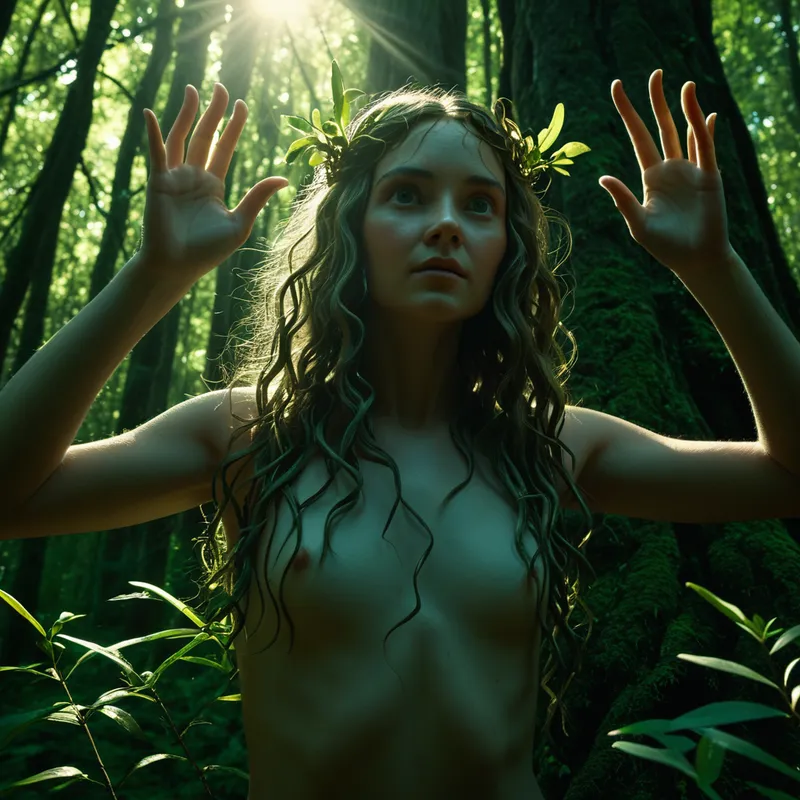
The Nymphs were not the stuff of grand epic poetry alone, reserved for kings and heroes. They were the deities of the local, the immediate, the everyday. Every Greek village, every farm, had its own Nymph of the local spring or the guardian of a particular grove. Their myths were folk traditions, passed down by farmers, shepherds, and travelers—those whose lives depended on reading the moods of the natural world.
They occupied a unique tier in the divine hierarchy. They were not Olympians, yet they were immortal. They were lesser divinities, but everywhere present. Rituals for them were simple: a libation of honey or wine poured into a spring, a strip of wool tied around a sacred tree, a humble offering left at a mountain shrine. To neglect them was to risk drought, barrenness, or a haunting madness—a nympholepsy—where one became possessed by the longing for their wild beauty.
Their primary societal function was to sacralize the landscape. They made nature personal. A forest wasn’t just timber; it was the home of the Dryads. A river wasn’t just water; it was the body of the Naiad. This created a powerful ecological ethic rooted in religious awe. To harm a place was to insult its spirit, with tangible, often dire, consequences. They were the psychological bridge between human consciousness and the animate, ensouled world.
Symbolic Architecture
The Nymphs represent the archetypal anima mundi—the world soul. They are the psychic energy of nature itself, the specific, localized consciousness inherent in every living phenomenon. They symbolize the principle of life not as a abstract force, but as a presence with a distinct character and will.
They are the embodiment of the sacred particular: the genius of this place, this tree, this stream. In a psychological sense, they represent the autonomous, living complexes within the personal and collective unconscious. Each Nymph is a complex—a knot of energy, memory, and image with its own life.
The different types of Nymphs map onto different psychic territories. The Dryads symbolize deep-rooted, enduring patterns of growth and identity (the Self). The Naiads represent the flow of emotion, intuition, and the unconscious (the psychic flow). The Oreads embody the enduring structures of the psyche, our core principles and traumas (the psychic bedrock).
Their stories of pursuit and transformation are masterclasses in psychological defense and adaptation. Daphne’s metamorphosis is not a defeat, but the ultimate assertion of autonomy.
When a consuming force (a possessive complex, an overwhelming passion, a societal demand) threatens to obliterate a core aspect of the soul, the psyche’s deepest defense may be radical transformation—a retreat into a more essential, if seemingly static, form of being to preserve its core integrity.
The Dreamer’s Resonance
To dream of a Nymph is to encounter a personified fragment of one’s own instinctual, natural psyche. It is often a signal that the wild, untamed, and purely organic layers of the self are seeking recognition or are under threat.
A Nymph appearing in a modern dream—perhaps as a woman made of light and leaves in a corporate office, or a figure weeping in a polluted urban stream—points to a specific somatic and psychological process. It is the process of neglect or violation of an instinct. The somatic feeling might be a tightness in the chest (a constrained pneuma), a dryness in the throat (a blocked Naiad), or a deep ache in the bones (a burdened Oread).
Psychologically, the dreamer is likely experiencing a life that is too cerebral, controlled, or artificial. The Nymph is the embodied protest of the biological and ecological self. She appears to restore a lost connection, to warn of a coming “drought” of vitality, or to offer healing from a sacred, forgotten source within the dreamer’s own psychic landscape. The feeling is one of profound, aching beauty mixed with urgency—a call back to one’s own inner springs and groves.

Alchemical Translation
The alchemical journey modeled by the Nymph myths is not the hero’s conquest, but the soul’s reclamation and integration. The goal is not to slay the dragon, but to learn its language; not to possess the Nymph, but to honor her autonomy and receive her gifts.
The modern individual’s process of individuation often requires a “nympholeptic” phase—a deliberate, passionate descent into this wild, instinctual layer of the psyche. This is the nigredo, the blackening, where one confronts the neglected, polluted, or wounded “springs” within. It is the painful recognition of one’s own internal dryads withering from lack of attention.
The alchemical operation here is solutio—dissolution in the sacred waters of the Naiad. It is a surrender to the fluid, emotional, non-linear intelligence of the unconscious, allowing rigid ego structures to soften and dissolve.
Daphne’s transformation into the laurel is the coagulatio—the re-solidification into a new, more authentic form. The ego, having been dissolved, now re-coagulates around the core of the Self, like bark around the heartwood. One becomes rooted in one’s own true nature, even if it means appearing static or “tree-like” to the outer world’s demand for constant, frantic growth.
Finally, to achieve a relationship with the Nymphs is to achieve the alchemical coniunctio—the sacred marriage between consciousness and the animate unconscious. It is to walk through the world not as a master, but as a respectful inhabitant of a psyche teeming with autonomous, sacred life. One tends the inner grove, listens to the inner spring, and draws strength from the inner mountain. The Nymphs, once external spirits of nature, are recognized as the eternal, living architecture of the soul itself. The wilderness is not out there; it is the foundational condition of the here, within.
Associated Symbols
Explore related symbols from the CaleaDream lexicon: