Nut Myth Meaning & Symbolism
The goddess Nut, arched over the earth, swallows the sun each evening and births it each dawn, embodying the cosmic cycle of death and rebirth.
The Tale of Nut
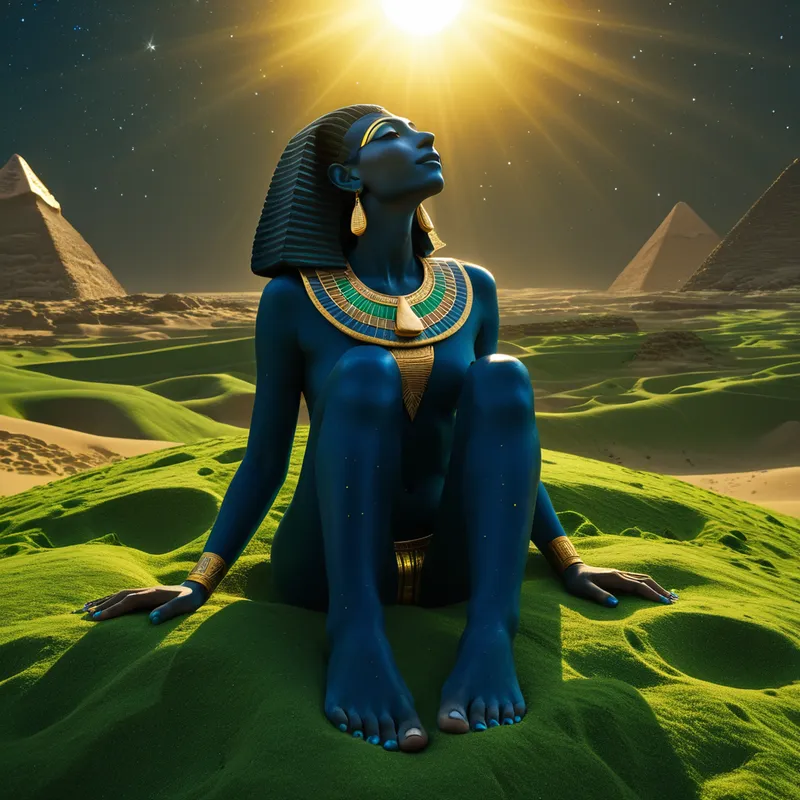
In the time before time, when [the world](/myths/the-world “Myth from Tarot culture.”/) was a dark and watery chaos, a great sigh stirred the deep. From the primordial waters of Nun, a mound of earth rose. And upon it, the first gods were born. Geb, the rich, green land, lay flat and fertile. And above him, born not beside but directly from the same breath, was Nut. She was the vault of heaven itself, her body a deep, lapis lazuli blue, dusted with the first, tentative sparks of light.
From the beginning, they were entwined. Geb reached up with his hills and valleys, and Nut curved down with her rain and mist. Their embrace was so complete, so total, that no space existed between them. No light could fall upon [the earth](/myths/the-earth “Myth from Hindu culture.”/), for [the sky](/myths/the-sky “Myth from Persian culture.”/) lay upon it like a lover. No life could stir, for there was no room to breathe, to stand, to become.
This troubled the sun god, Ra, who in his first rising found his path blocked by the seamless union of earth and sky. He could not journey. The order of day and night, the very cycle of life, was impossible. A great stillness, beautiful yet sterile, held the world in a suffocating clasp.
Ra summoned the god of air and sunlight, Shu. His command was a [thunderclap](/myths/thunderclap “Myth from Various culture.”/) in the silent firmament: “Separate them.” With a mighty heave, Shu placed his shoulders beneath the arched body of Nut and pushed. A groan echoed through the cosmos, the sound of cosmic bones shifting. He lifted [the star](/myths/the-star “Myth from Tarot culture.”/)-studded goddess high, high above the weeping earth. Her body stretched into a perfect, graceful arc, her fingertips and toes coming to rest on the four horizons. The space between them, filled now with Shu’s light and air, became the world we know.
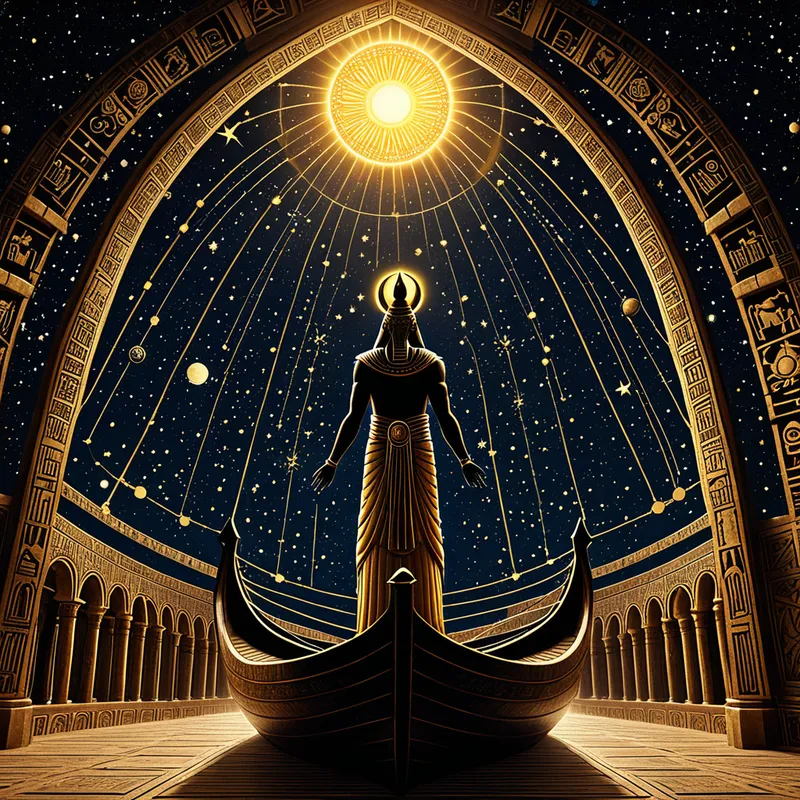
But Nut’s story was not one of mere separation, but of transformed connection. Every evening, as Ra aged and weakened, Nut would bend her mouth to the western horizon. She would swallow the great sun whole, and he would travel through the dark, starry corridors of her body—through the perilous night, past demons and through [the underworld](/myths/the-underworld “Myth from Greek culture.”/). And every dawn, exhausted from her labor, she would give birth to him anew in the east, a child fresh and golden, and the cycle would begin again. She became the great cycle itself, the mother who consumes to give birth, the dark womb that is also the road to renewal. She did not abandon Geb; she embraced him from a distance, her tears becoming the rain that fell upon him, her laughter the thunder, her starry belly the blanket under which all life slept and dreamed.
Cultural Origins & Context
The myth of Nut is not a single, codified story from one [papyrus](/myths/papyrus “Myth from Egyptian culture.”/), but a cosmological framework woven into the very fabric of ancient Egyptian thought. It was articulated in the [Pyramid Texts](/myths/pyramid-texts “Myth from Egyptian culture.”/) (circa 2400-2300 BCE), the Coffin Texts, and most vividly in the Book of the Dead. It was not merely a “story” told for entertainment, but a sacred truth painted on tomb ceilings and carved inside sarcophagus lids.
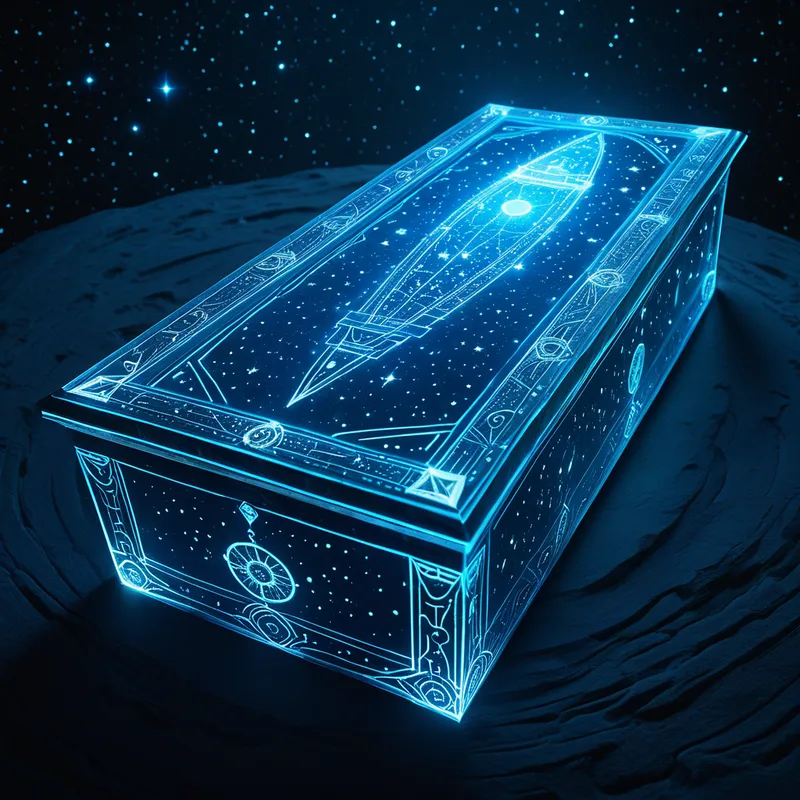
The primary tellers and users of this myth were priests and the royal family, for whom it was a map of reality and a promise of eternity. To be buried under a lid depicting Nut was to be placed directly back into her body, ensuring one’s own journey through the night of death and rebirth at dawn, just like Ra. Her image on a coffin was a literal, magical act—a hope to be swallowed by the sky and born again. The myth functioned as the ultimate explanation for the most fundamental observable realities: the cycle of day and night, the existence of the air and weather, and the promise of life after death. It provided a comforting, maternal structure to a cosmos that could otherwise seem vast and indifferent.
Symbolic Architecture
Nut represents the archetypal principle of the Cosmic Container. She is not the [creator](/symbols/creator “Symbol: A figure representing ultimate origin, divine power, or profound authorship. Often embodies the source of existence, innovation, or personal destiny.”/) of things, but the creator of the [space](/symbols/space “Symbol: Dreaming of ‘Space’ often symbolizes the vastness of potential, personal freedom, or feelings of isolation and exploration in one’s life.”/) in which things can happen. Her [separation](/symbols/separation “Symbol: A spiritual or mythic division between realms, states of being, or consciousness, often marking a transition or loss of connection.”/) from Geb is the primordial act of [differentiation](/symbols/differentiation “Symbol: The process of distinguishing or separating parts of the self, emotions, or identity from a whole, often marking a developmental or psychological milestone.”/) that creates [consciousness](/symbols/consciousness “Symbol: Consciousness represents the state of awareness and perception, encompassing thoughts, feelings, and experiences.”/) itself.
The psyche cannot know itself in a state of undifferentiated union. It requires a sky to reflect upon the earth.
Psychologically, Geb and Nut in their eternal embrace symbolize a pre-conscious state—a blissful but unconscious identification, such as that of an [infant](/symbols/infant “Symbol: The infant symbolizes new beginnings, innocence, and the potential for growth and development.”/) with its [mother](/symbols/mother “Symbol: The symbol of ‘Mother’ represents nurturing, protection, and the foundational aspect of one’s emotional being, often associated with comfort and unconditional love.”/), or an individual fused with their [family](/symbols/family “Symbol: The symbol of ‘family’ represents foundational relationships and emotional connections that shape an individual’s identity and personal development.”/) or tribe. Shu, [the force](/myths/the-force “Myth from Science Fiction culture.”/) of separation, represents the necessary, often painful, act of ego-consciousness that creates psychic space. It is the act of differentiation, of saying “I am not that,” which allows for observation, [relationship](/symbols/relationship “Symbol: A representation of connections we have with others in our lives, often reflecting our emotional state.”/), and ultimately, individuation.
Nut’s daily cycle of swallowing and birthing the sun is the ultimate [symbol](/symbols/symbol “Symbol: A symbol can represent an idea, concept, or belief, serving as a powerful tool for communication and understanding.”/) of transformative containment. She does not destroy the sun (the conscious ego, the light of [awareness](/symbols/awareness “Symbol: Conscious perception of self, surroundings, or internal states. Often signifies awakening, insight, or heightened sensitivity.”/)); she takes it into herself (the unconscious) for renewal. This models the essential psychological process of withdrawing from the external world (introversion) to be digested and reformed by the inner world (the unconscious), before re-emerging refreshed.
The Dreamer’s Resonance
When the pattern of Nut manifests in modern dreams, it rarely appears as a literal Egyptian goddess. Instead, one may dream of vast, arched structures—immense bridges, cathedral ceilings, or the inside of a giant ribcage. One might dream of being safely contained in a dark, starry space, or conversely, of feeling crushed by a low, oppressive sky. The somatic feeling is often one of expansion or constriction in the chest.
To dream of the arched vault is to encounter the [psyche](/myths/psyche “Myth from Greek culture.”/)’s own need for a “container.” This often surfaces during life transitions—the end of a relationship, a career change, a period of depression or incubation. The dream is asking: What old union (with a person, an identity, a belief) needs to be separated from to create psychic air and light? What part of you needs to be “swallowed” by the night—taken out of the harsh light of day-consciousness—to be reformed and reborn? The dream may signal that the dreamer is in the “night journey” phase, feeling lost in the belly of the whale, and needs to trust the process of inner renewal.
Alchemical Translation
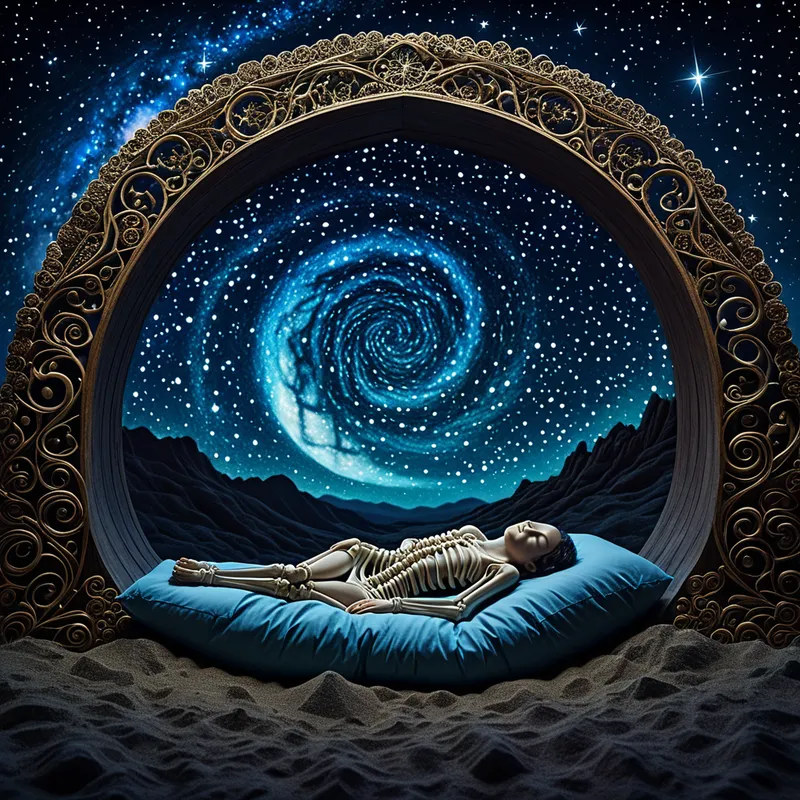
The alchemical process mirrored in Nut’s myth is the [Nigredo](/myths/nigredo “Myth from Alchemical culture.”/), followed by a new dawn. The modern individual’s journey of individuation is not a linear path upward, but a cyclical one of descent and return.
First comes the Primal Union (Geb and Nut): A state of unconscious identification, comfort without growth. Then, the Crisis of Separation (Shu’s Intervention): A painful but necessary rupture—a life event, an insight, a depression—that forces a space between [the ego](/myths/the-ego “Myth from Jungian culture.”/) and its unconscious attachments. This feels like a tearing apart, a loneliness, a “falling upward” into responsibility for one’s own psyche.
The goal is not to return to the embrace, but to learn to breathe in the space that was created.
The core work is Transformative Containment (Nut’s Body): Learning to willingly enter the “night.” This is the practice of holding one’s pain, confusion, or creative potential within [the vessel](/myths/the-vessel “Myth from Alchemical culture.”/) of [the self](/myths/the-self “Myth from Jungian culture.”/) (or therapy, or art, or ritual) instead of projecting it outward or fleeing from it. It is to be both the swallowed sun and the swallowing sky—to allow one’s conscious attitudes to be dissolved and reformed by the unconscious.
The outcome is Cyclical Rebirth (The New Dawn): The realization that the self is not a static entity, but a process of continual death and rebirth. One learns to trust the container of one’s own being—the arched sky of the soul—to manage these cycles. The individual becomes both the earth (Geb, the grounded reality of life) and the sky (Nut, the boundless potential of spirit), with the breath of consciousness (Shu) moving freely between them. They achieve not a static perfection, but a living, breathing cosmos within.
Associated Symbols
Explore related symbols from the CaleaDream lexicon: