Nuckelavee Myth Meaning & Symbolism
A skinless, demonic horse-rider from Orcadian lore, Nuckelavee embodies the raw, untamed, and terrifying shadow that must be faced and survived.
The Tale of Nuckelavee
Hear now a tale from the edge of the world, where the sea gnaws the land and the wind carries the salt of ancient tears. In the Orcades, where the sun is a stranger in winter and the haar clings like a shroud, there dwells a terror that knows no pity. Its name is spoken in whispers, if spoken at all: Nuckelavee.
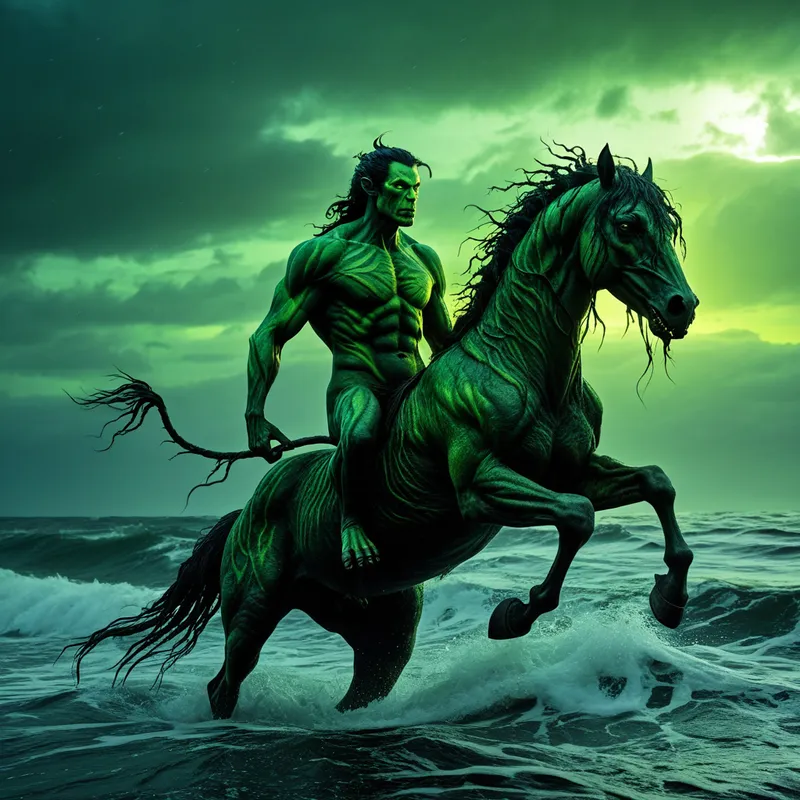
It is a creature born of the deep salt and the black peat, a blasphemy against nature’s form. It has no skin. What should be hidden is laid bare: great ropes of yellow sinew, pulsing black veins, muscles raw and slick as if freshly flayed. From the body of a monstrous horse, powerful and hateful, sprouts the torso of a man, fused at the creature’s back. The horse’s head is vast, with a gaping maw, a single fiery eye burning with malice. The man’s arms are long, dragging clawed fingers through the surf, and his head is so huge it seems to topple forward, a mouth that can swallow a man’s hope whole. Its breath is a pestilence, a green miasma that blights crops, withers livestock, and brings fever to any soul it touches.
Nuckelavee is a creature of the sea, but it hates the touch of fresh water. It is a lord of the shore, the liminal space where solid earth yields to the hungry ocean. It rides forth from the waves when the storms are fiercest, or when the oppressive summer heat lies heavy on the land, bringing drought and despair. It seeks the inland burns and lochs, its very presence poisoning them, for its deepest nature is one of corruption and barrenness.
The people knew its habits. They knew to fear the tainted wells and the sickly cattle. But knowledge is not always protection. There is a story of a man, a crofter, who encountered the beast. He was riding home at twilight, the haar creeping in from the Pentland Firth. The air grew cold, then colder still, and a stench of rotting seaweed and open grave filled his nostrils. His horse reared in blind panic, and there, materializing from the mist, was the skinless horror. The man felt his blood turn to ice. The creature’s eye fixed upon him, and it let out a sound that was neither scream nor roar, but the grinding of continents at the world’s end.
He did the only thing his terror-stricken mind could recall. He spurred his horse not away, but toward the creature, veering at the last second to splash through a shallow tidal pool where a freshwater burn met the sea. The Nuckelavee shrieked, a sound of pure agony, and recoiled as if burned. The man did not look back. He rode until his steed foundered, and he fell, gasping, on the doorstep of his home, the image of the raw, exposed demon seared forever into his soul. He had survived by remembering the one thing it could not endure: the cleansing touch of the living, fresh water that it so desperately poisoned.
Cultural Origins & Context
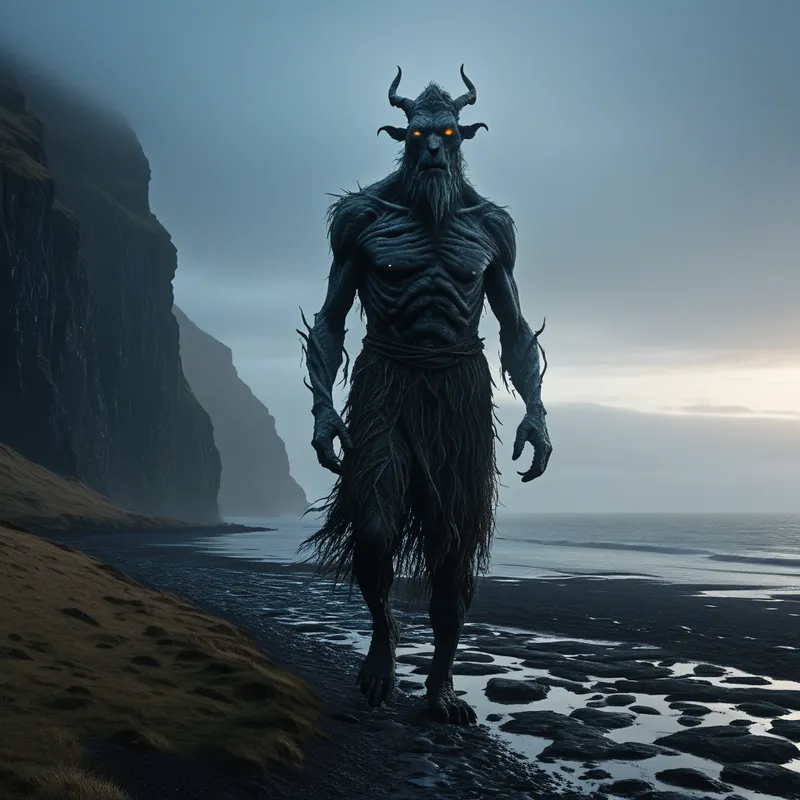
The myth of the Nuckelavee is not a story for the hearth, but a warning for the shore. It belongs to the oral tradition of the Orcadian fisherfolk and crofters, a people whose lives were intimately, and often brutally, dictated by the sea and the thin soil. Passed down through generations, likely with roots in pre-Norse and Norse mythology (sharing kinship with monsters like the Nix or Näck), its primary tellers were not bards but grandparents, its stage not a hall but a storm-battered coastline.
Its societal function was multifaceted. On a practical level, it was a etiological myth, explaining the very real blights that could strike an island community—mysterious livestock illnesses, crop failures, and poisoned wells were given a face and a name. More profoundly, it served as a narrative container for the existential dread of island life. The sea was both provider and devourer; the Nuckelavee became the incarnate spirit of its destructive, merciless aspect. The myth enforced cultural boundaries: stay away from certain shores at certain times, respect the freshwater sources, and understand that nature holds horrors as well as harvests. It was a story of survival, teaching that even the most absolute terror has a weakness, a rule by which it is bound.
Symbolic Architecture
The Nuckelavee is a masterpiece of symbolic horror, a pure expression of the shadow in its most untamed, visceral form. Its lack of skin is its most potent symbol. Skin is our boundary, our container, that which separates our inner workings from the outer world. The Nuckelavee has none. It is all raw interiority exposed—the pulsing heart of rage, hunger, and instinct made monstrously visible. It represents what happens when the unprocessed, primal aspects of the psyche break containment and erupt into conscious life.
The shadow, when utterly denied, does not disappear; it festers, grows, and returns as a skinless horror, showing us everything we refused to see in ourselves.
Its hybrid form—man fused to horse—speaks to a corrupted unity. It is not a centaur, a symbol of integrated animal wisdom and human intellect. It is a forced, agonizing merger where both aspects are degraded: the horse, a symbol of power and instinct, becomes a vessel of pestilence; the man, a symbol of consciousness, is reduced to a screaming, parasitic head. This symbolizes a psyche where instinct and intellect are not in harmony but are locked in a mutually destructive embrace. Its hatred of fresh water is equally telling. Fresh water is life, purity, flow, and renewal. The Nuckelavee, as an entity of stagnation, salt (a preserver, but also a corrosive), and psychic poison, cannot tolerate its cleansing properties. It can only exist in, and create, its own corrupted environment.
The Dreamer’s Resonance
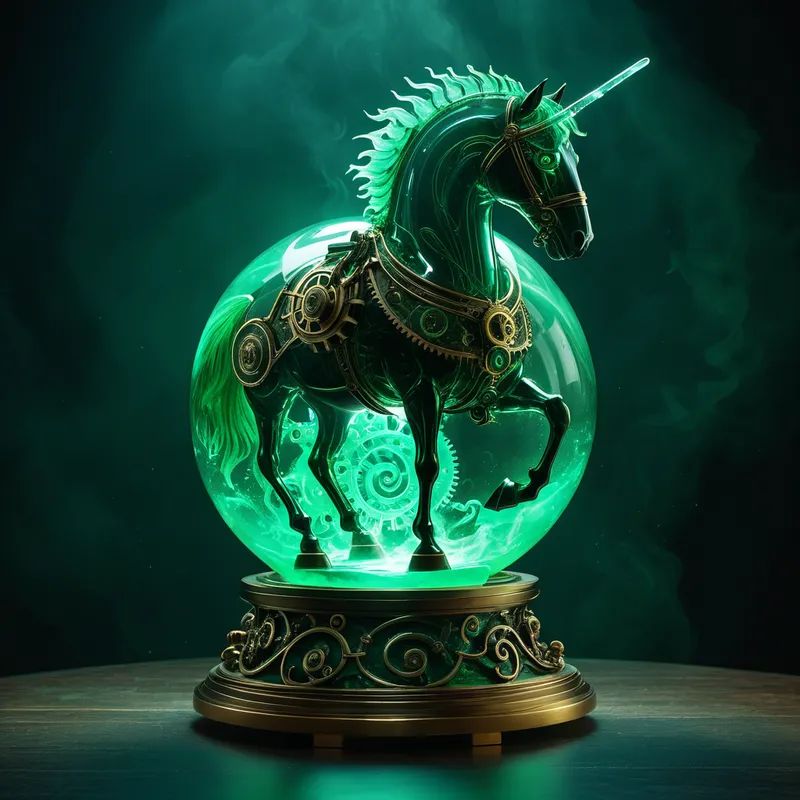
When the pattern of the Nuckelavee stirs in the modern dreamer, it signals a profound confrontation with the “skinless” content of the psyche. To dream of this entity is not to dream of a mere monster, but to encounter the feeling of being psychologically flayed—of having one’s protective layers (denials, personas, rationalizations) stripped away, leaving the raw nerves of shame, rage, or trauma exposed.
The somatic experience is often one of chilling dread, a feeling of being poisoned or contaminated, or of paralysing cold. The dreamer may be fleeing the creature or, more tellingly, may be forced to witness its grotesque form up close. This is the psyche presenting its own unintegrated shadow in its most terrifying guise. The process at work is one of brutal honesty. The dream is forcing an acknowledgment of what has been kept hidden, of the “toxic” emotions or instincts that have been allowed to fester and are now blighting one’s inner landscape—perhaps manifesting as chronic anger, self-sabotage, or a sense of inner barrenness. The dream is the initial, horrifying sighting of the problem in its full, unvarnished horror.
Alchemical Translation
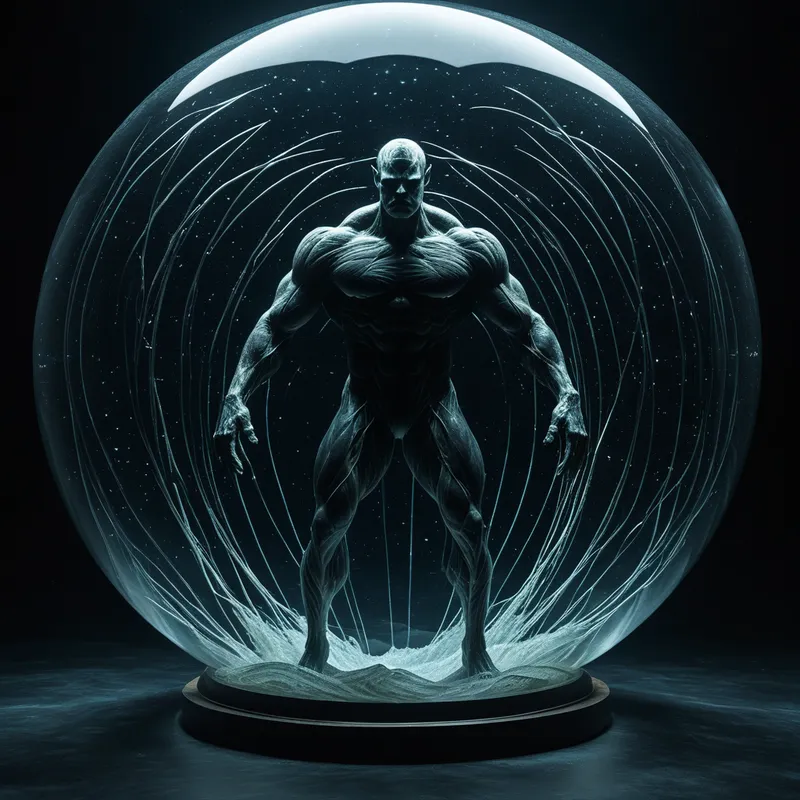
The alchemical journey modeled by the Nuckelavee myth is not one of slaying the dragon, but of understanding its nature and enforcing its proper bounds. The hero’s triumph is not in destruction, but in containment and purification, key stages in the individuation process.
The first step, nigredo, is embodied by the creature itself: the blackening, the confrontation with the rotting, shadowy material of the self. One must have the courage to look upon the skinless thing, to name the poison. The second step is the application of the “fresh water”—the albedo, or whitening. This is the conscious, life-giving principle. In psychological terms, it is bringing the light of awareness, compassion, and conscious intent to the raw shadow. It is the act of saying, “I see this rage, this fear, this shame within me.” The fresh water does not kill the Nuckelavee; it drives it back into the sea. The sea here represents the unconscious, its proper domain.
The goal is not to eradicate the shadow, but to build a well of conscious awareness so pure and deep that the shadow can no longer poison the land of the living self.
The final transmutation is the establishment of a boundary—the skin that the Nuckelavee lacks. By facing the raw content, acknowledging its power and its poison, and applying the cleansing water of conscious understanding, the psyche slowly grows a new “skin.” This is the integrated self, where the powerful instincts (the horse) and the conscious mind (the man) are no longer a grotesque fusion of mutual torment, but a coordinated whole. The terror remains in the depths, where it belongs, but it is known, its rules understood, and the land of the conscious ego is protected from its blight. The individual becomes the crofter who knows the path and carries, within their own being, the life-giving water that sets the bounds for the terror.
Associated Symbols
Explore related symbols from the CaleaDream lexicon: