Nowruz Celebration Myth Meaning & Symbolism
The myth of the cosmic battle between the spirit of light and the dragon of winter, culminating in the victory of spring and the creation of the New Day.
The Tale of Nowruz Celebration
Listen, and let the old tale be told again, as the world holds its breath between darkness and dawn.
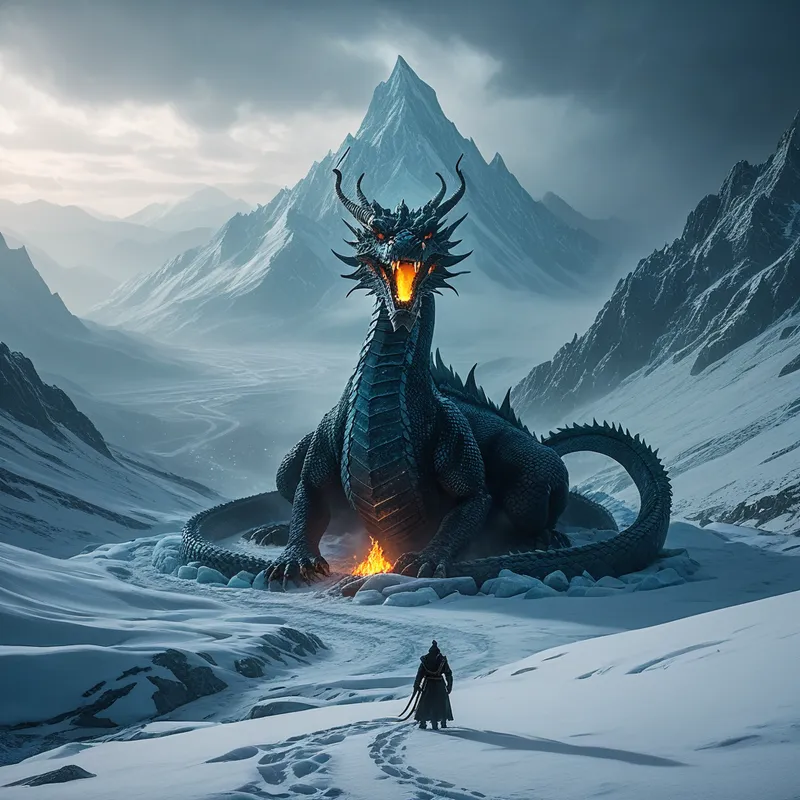
In the time before time was measured, the world lay in the grip of a deep and unyielding winter. It was the reign of Azhi Dahaka, the great serpent of chaos. His three foul heads spewed not fire, but a bitter frost that stole the warmth from the earth and the hope from the hearts of men. Rivers stood still as glass, trees were skeletons clawing at a grey sky, and silence—a heavy, waiting silence—smothered the land. This was the Long Darkness, and it seemed it would never end.
But in the celestial realms, a watch was kept. The great deity Ahura Mazda, the Lord of Wisdom and Light, witnessed the suffering of the world. The divine order, Asha, was under siege by the lie of Druj. And so, the forces of light prepared a counterstroke, not with a legion of angels, but through a spark placed within the world itself.
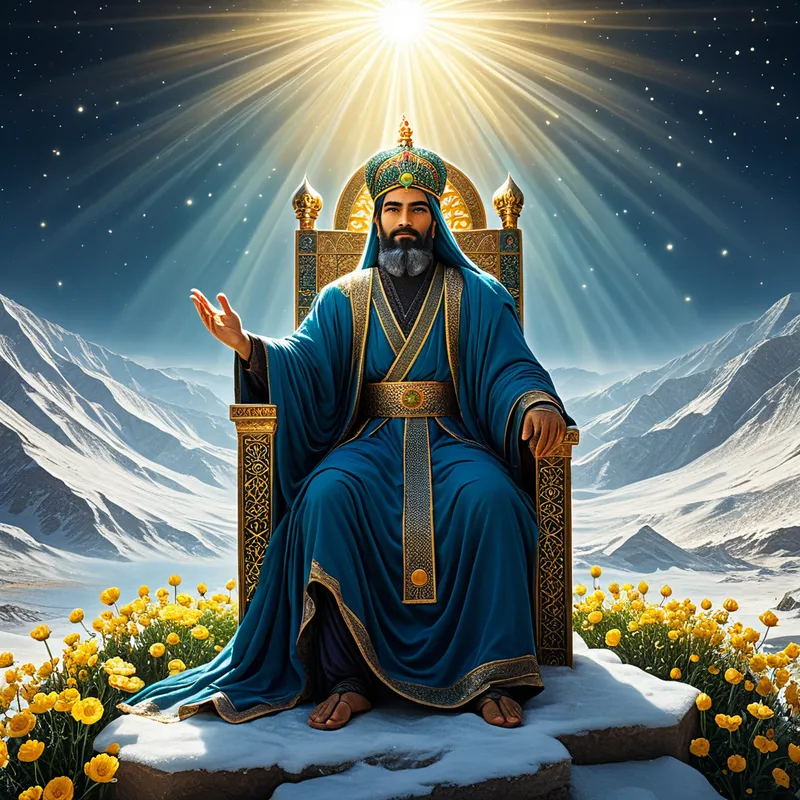
This spark was the legendary Jamshid, the Shining King. Possessing the divine Farr, he was a beacon in the mortal realm. On a day when the despair was deepest, Jamshid ascended to a high place—some say a mountaintop, others say a throne crafted of precious metals and sunlight. He raised his hands, not in supplication, but in command. He called upon the essence of Atar, the sacred fire.
And the fire answered. It did not roar; it unfolded. A gentle, persistent warmth radiated from the king, a visible glow that pushed against the edges of the frozen air. Where his light touched the dead ground, a miracle occurred. A single, brave crocus pierced the iron-hard soil. Then another. The ice on the rivers groaned and cracked, not with violence, but with the sound of a long-held breath being released. The sun, which had hung pale and weak, seemed to strengthen, its rays gaining purchase on the earth.
This was the declaration of war. Enraged, Azhi Dahaka stirred from his glacial lair. The final battle was not one of clashing armies, but a profound struggle of essences. The dragon’s breath sought to extinguish the new warmth, to reclaim the land for sterile eternity. But the light of Jamshid, fed by the prayers and the rekindled hearth-fires of the people, held firm. It was a day-long, night-long tension that stretched the cosmos taut.
Then, at the precise moment of the vernal equinox, balance was achieved—and shattered in favor of creation. The dragon’s power broke. The Long Darkness retreated, slithering back to the hidden places of the world. The sun rose on a new morning, a morning unlike any before. The air was sweet with the scent of thawing earth and blooming sonbol. Birdsong returned, not as a memory, but as a fresh invention. Jamshid looked upon a world reborn and declared this day Nowruz. The first New Day. And on that day, it is said, he placed upon a cloth seven sacred items, each a testament to the victory of life over not-death, a mirror of the seven creations of Ahura Mazda. The celebration had begun, and would begin again, every year, for all time.
Cultural Origins & Context
The myth of Nowruz is not a single story from a single book, but the deep cultural memory of the Persian world, woven from strands of pre-Zoroastrian tradition, Zoroastrian cosmology, and later epic poetry. Its oldest roots likely lie in ancient Indo-Iranian celebrations of the vernal equinox, a pivotal moment in the pastoral and agricultural calendar. With the reforms of the prophet Zarathustra, this seasonal event was alchemized into a profound spiritual metaphor. The conflict between Asha (Cosmic Order, Truth) and Druj (The Lie, Chaos) became the theological framework for the battle between spring and winter.
The myth was carried and polished through generations by the Mobeds (Zoroastrian priests) around ritual fires, and later immortalized in the grand national epic, the Shahnameh (The Book of Kings) by Ferdowsi. Here, the figure of Jamshid is central. His establishment of Nowruz is portrayed as the pinnacle of his just rule, the moment civilization—with its laws, arts, and celebrations—is fully realized. The myth’s societal function was multifaceted: it explained the cosmic reason for the seasons, legitimized kingship through the concept of the divine Farr, and provided an annual ritual framework for the renewal of both community and personal moral commitment. It was, and remains, a master narrative that binds cosmological time, social order, and individual hope into one celebratory act.
Symbolic Architecture
At its heart, the Nowruz myth is a grand allegory for the perennial victory of consciousness over entropy, of organized life over chaotic dissolution. Azhi Dahaka is more than a winter dragon; it is the psychological force of stagnation, despair, nihilism, and the "coldness" that freezes our inner growth. It is the inertia that says, "This is all there is; change is impossible."
The New Day does not merely follow the Old Night; it is wrested from it through an act of conscious, illuminated will.
Jamshid represents the archetypal ego in its highest, most responsible function. He is not a god, but a human (or semi-divine) vessel for the divine light (Farr). His throne of sunlight signifies the seat of consciousness itself. His act of "raising the light" is the essential human task: to bring awareness, order, and meaning into the chaos of existence. The seven items of the Haft-Seen table are not arbitrary. They are a symbolic microcosm: sabzeh (rebirth), samanu (power), senjed (love), sir (health), sib (beauty), somāq (patience), and serkeh (wisdom). Together, they map the constituents of a complete and flourishing life, reborn each year.
The Dreamer's Resonance
When this myth stirs in the modern unconscious, it often manifests in dreams of profound seasonal transition within the psyche. One might dream of being trapped in a house that is slowly being encased in ice, representing a life or emotional state that has become frozen and isolated. The dreamer may feel a desperate need to "light a fire" or find a hidden source of warmth.
Alternatively, the dream could feature a confrontation with a multi-headed serpent or a looming, shadowy presence of immense cold—a personification of a complex, entrenched problem or depression (Azhi Dahaka). The pivotal moment in such dreams is rarely a violent battle, but the discovery of a small, persistent light (a candle, a mirror reflecting the sun, a single glowing ember) that, when focused upon, begins to thaw the environment. This is the somatic signal of hope re-engaging the nervous system, of a latent psychological energy (the Jamshid-self) mobilizing to end an inner "Long Darkness." The dream is an indicator that the dreamer is at the equinox point of an inner cycle, poised between the death of an old state and the birth of a new one.
Alchemical Translation
The process modeled by the Nowruz myth is the very blueprint of Jungian individuation—the journey toward psychic wholeness. The "Long Darkness" is the state of being identified with one’s personal history, complexes, and the frozen patterns of the persona. Azhi Dahaka represents the shadow in its most collective, terrifying form: the chaotic, devouring aspect of the unconscious that resists conscious integration.
The hero’s journey here is internal. The "throne of sunlight" we must ascend is the difficult achievement of self-reflection and conscious awareness. To "raise the light" is to consciously engage in the work of introspection, therapy, art, or any discipline that illuminates the contents of the unconscious. This act is what challenges the dragon of stagnation.
The alchemical fire of Nowruz is not destruction, but purification and revelation; it melts the frozen armor around the heart to reveal the living gold of the authentic self beneath.
The victory at the equinox symbolizes the achievement of a new psychic equilibrium. The old, rigid order (the endless winter) is replaced by a dynamic, living order (spring). The creation of the Haft-Seen table is the final, crucial step: it is the conscious, ritualized integration of what has been learned. The dreamer must lay out the "seven symbols" of their own renewed being—their new growth (sabzeh), their forged strength (samanu), their reclaimed capacity for love (senjed). Nowruz, therefore, is not just a cultural celebration, but an eternal inner mandate. It calls us to annually, and in every moment of potential renewal, to confront our inner winters, to summon our inherent Farr, and to consciously create, once more, a New Day for the soul.
Associated Symbols
Explore related symbols from the CaleaDream lexicon: