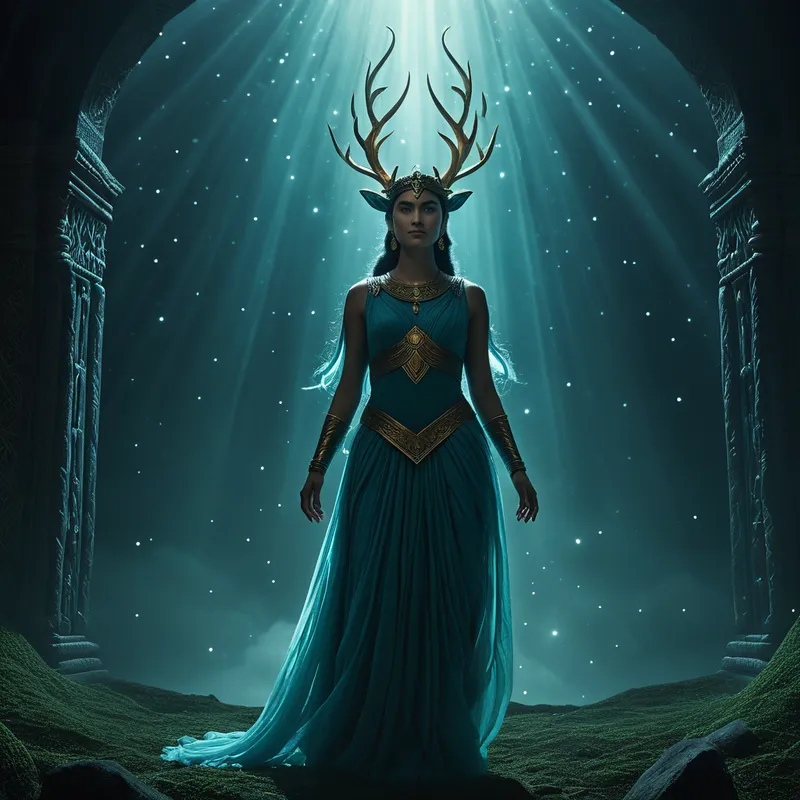
Nommo Dogon Ancestors
The Nommo are the primordial, amphibious ancestors of the Dogon people, revered as divine beings who descended from the stars to bring civilization and profound cosmic knowledge.
The Tale of Nommo Dogon Ancestors
In the beginning, there was Amma, the one God, alone in the cosmic egg. From Amma’s creative solitude, the universe was spun. Yet the world was barren, a silent, dry plain awaiting the breath of life. Amma fashioned the earth as a female body, but his first union with her was premature, resulting in a single, flawed being: the jackal, Ogo, who rebelled and tore a piece of the placenta to create his own imperfect world, bringing chaos into the nascent order.
To restore balance and fulfill the original design, Amma performed a second, sacred union. From this, the perfect twins were born: the Nommo. They were primordial, complete, androgynous beings of immense power and wisdom, amphibious in nature, their bodies shimmering with the essence of both water and light. They were the first ancestors, the divine templates for all life.
But the chaos of Ogo’s rebellion had created a rift in the cosmos. To mend this wound and instruct the wayward creation, Amma decreed a great sacrifice. The Nommo were slain, their bodies dismembered and scattered across the world to purify and fertilize it. From this sacred dispersal, the life force of the Nommo permeated all things. Yet this was not an end, but a transformation.
Amma then resurrected the Nommo, reconstituting them in a celestial ark. This vessel, woven from the fibers of the universe itself, descended from the star system Sirius—the Dogon say from Po Tolo—bringing the resurrected ancestors back to the dry earth. The ark’s descent was a cataclysm of wind and thunder, a roaring vortex that finally came to rest, bringing not destruction, but the first gift: water. It struck the earth, carving out the rivers and filling the wells, ending the great drought.
From the ark emerged the Nommo, now in their quadruple form—four pairs of male-female twins, eight ancestors in total. They stepped onto the revived earth, their fishtails brushing the now-damp soil, and began the great work of civilization. They taught the people, the Dogon, everything: the art of weaving and smithing, the science of agriculture, the structure of society, and the profound mysteries of language and the cosmos. They imparted the knowledge of the stars, of the intricate dance of Sirius and its hidden companion, and laid down the rituals and moral order that would sustain human life. They became the teachers, the healers, the law-givers, the living link between the divine Amma, the vast cosmos, and the community of humans. They did not leave; they remained, present in the water that gives life, in the words of the elders, and in the very bloodline of the people.
Cultural Origins & Context
The myth of the Nommo is the foundational narrative of the Dogon people, who inhabit the Bandiagara Escarpment in present-day Mali. This is not a relic of a forgotten past but a living, breathing cosmology that structures Dogon worldview, social organization, and daily practice. The myth is preserved and transmitted through intricate oral traditions, ritual performances, and symbolic art, most notably in the detailed sand tracings and the architecture of their dwellings and granaries.
The depth of Dogon astronomical knowledge, particularly their reported awareness of Sirius B—a white dwarf star invisible to the naked eye—long before its confirmation by Western astronomy, has sparked intense fascination and debate. Whether this represents an astonishing preservation of ancient knowledge or a more complex cultural encounter, it underscores the sophistication of the Dogon cosmological system. The Nommo narrative is the heart of this system. It is not merely a story of creation but a continuous charter for existence, linking every individual to the ancestral source, the celestial order, and the moral imperative to maintain balance. The Dogon society, organized around the principle of twinness and complementary pairs, mirrors the primordial androgyny of the Nommo, striving to embody that original state of wholeness.
Symbolic Architecture
The Nommo are a master symbol of integration. They exist at the confluence of profound dualities, not as a compromise, but as a transcendent third thing. They are celestial and chthonic, divine and ancestral, spirit and matter. Their amphibious nature is the key.
The Nommo, born of the stars yet dwelling in the water, symbolize the impossible and necessary marriage of cosmos and psyche. They are the living bridge where the vast, cold patterns of the stars meet the fluid, unconscious depths of the soul. Their fishtail is not a limitation, but the root of their power—an anchor in the primordial waters of life from which their stellar consciousness grows.
Their story is one of death, dismemberment, and resurrection, an archetypal pattern of sacrifice for the sake of a greater wholeness. The scattering of their body parts is not a grotesque end, but a sacred sowing; each fragment becomes a seed of order and knowledge in the barren field of the world. Their return in the ark is the descent of consciousness itself—a traumatic, thundering arrival that brings the life-giving water of meaning to the parched landscape of instinct and chaos. They are the ultimate Senex figures, the sages who do not hoard knowledge but pour it forth as a civilizing, structuring force.
The Dreamer's Resonance
To encounter the Nommo in the inner landscape is to confront the call of one’s own deepest ancestry and potential. Psychologically, they represent the integrated Self, the state of wholeness that precedes and follows the ego’s fragmented experience. The ego, like the rebellious jackal Ogo, often acts prematurely, creating a personal world of chaos and isolation. The Nommo represent the corrective, the call back to a more complete pattern.
They resonate as the internal teachers, the guides who emerge from the depths of the unconscious (the water) bearing the structured knowledge (the stars) needed to navigate one’s life. Their dismemberment mirrors the painful but necessary process of ego-dissolution—where our rigid self-concepts must be broken apart so that our essential life force can be distributed and integrated into all aspects of our being. Their resurrection is the promise that from this sacrifice, a more authentic, guided consciousness can be rebuilt. The dream of the Nommo might manifest as finding ancient, wise beings in a dream, receiving profound instruction at the shore of a vast lake or ocean, or experiencing a thunderous insight that finally irrigates a long-dry emotional or intellectual desert.

Alchemical Translation
In the alchemical vessel of the soul, the myth of the Nommo maps the entire opus. The initial state is nigredo: the barren, dry earth, the chaotic rebellion of Ogo, representing the primal, confused state of the psyche. The sacrifice of the Nommo is the mortificatio and separatio—the necessary dissolution and breaking down of original, divine wholeness into the materia prima, the raw, scattered components of soul-stuff.
The ark’s descent is the coniunctio, the sacred marriage. It is the vessel that contains the volatile (the star-born spirit) and the fixed (the water-bound body), subjecting them to the transformative fire of atmospheric entry. The impact is the moment of coagulation, where spirit crashes into matter and gives it new form. The resulting civilization is the rubedo, the reddening—the manifestation of the perfected work in the world of time and community.
The Nommo themselves are the Philosopher’s Stone, the lapis. They are the agent and the goal: the divine ancestor who performs the transformation and is also the transformed state of being. To integrate the Nommo is to achieve the alchemical gold—a consciousness that is simultaneously grounded in the life-giving waters of the unconscious and illuminated by the precise, ordering light of cosmic awareness. It is the state of being a living ancestor to one’s own future.
Associated Symbols
Explore related symbols from the CaleaDream lexicon:
- Water — The primordial element of life, chaos, and the unconscious, from which the Nommo emerge and which they bring to the barren earth.
- Star — The celestial origin and cosmic knowledge of the Nommo, representing divine order, destiny, and the vast patterns of existence.
- Fish — The amphibious nature of the Nommo, symbolizing adaptability, deep wisdom from the unconscious, and the fertility of the life force.
- Sacrifice — The dismemberment of the Nommo, representing the necessary dissolution of a prior state of being to fertilize and renew the world.
- Ark — The vessel of transformation and descent, carrying the seeds of civilization and consciousness from the celestial realm to the earthly plane.
- Ancestor — The Nommo as primordial progenitors and guides, linking the living to the divine source and the moral wisdom of the past.
- Twins — The principle of duality and complementarity, reflecting the androgynous, paired nature of the Nommo and the foundational structure of a balanced cosmos.
- Knowledge — The profound cosmic and practical instruction brought by the Nommo, representing civilization, order, and the sacred gift of understanding.
- Thunder — The sound of the ark’s descent, symbolizing the disruptive, awe-inspiring arrival of divine consciousness into the human sphere.
- River — The life-giving channels carved by the ark’s impact, representing the flow of ancestral wisdom, fertility, and the course of destiny through the landscape of life.
- Order — The cosmic and social structure instituted by the Nommo, standing in opposition to the primordial chaos introduced by the jackal Ogo.
- Drowned Ancestors — A potent image echoing the Nommo’s aquatic nature, symbolizing wisdom that resides in the depths, preserved and waiting to be recalled.