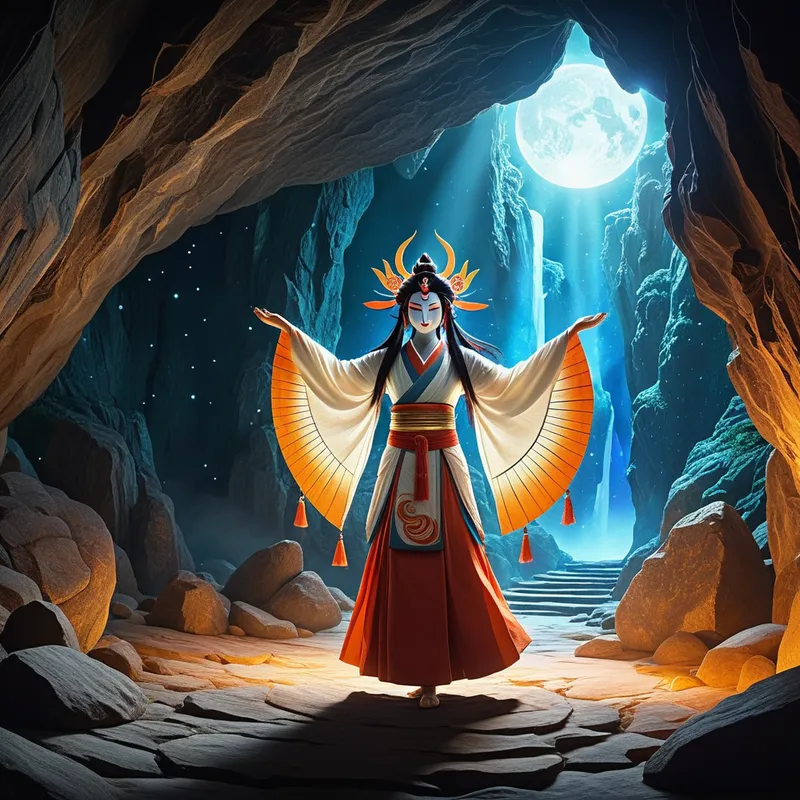
Noh Theater Performers Myth Meaning & Symbolism
A myth where a goddess, enraged, hides in a cave, plunging the world into darkness until a shaman's ecstatic dance lures her out, birthing sacred theater.
The Tale of Noh Theater Performers
Listen, and let the silence between the words speak. Before there was theater, there was darkness. A terrible, absolute darkness that fell not from the sky, but from the heart of heaven itself.
The sun goddess, Amaterasu, radiant and life-giving, had retreated. Her brother, the storm kami Susanoo, in a fit of chaotic rage, had defiled her sacred weaving hall. In grief and fury, she sealed herself within the Ama-no-Iwato, a celestial cave of stone. With her light imprisoned, the world—both the Plain of High Heaven and the reed plains below—was swallowed by an endless, cold night. The eight million kami wailed in despair, their voices lost in the void.
On the banks of the Ama-no-Yasukawa, the assembled deities devised a plan. They gathered roosters whose crow heralds the dawn. They fashioned a sacred mirror, Yata-no-Kagami, and hung jewels from the Ame-no-Sakaki tree. But light and treasure could not pierce the goddess’s sorrow. Then, the kami Ame-no-Uzume stepped forward. She was not the most powerful, but she possessed a different magic—the magic of ecstatic embodiment.
Before the sealed cave mouth, she overturned a wooden tub. Upon this makeshift stage, she began to dance. But this was no ordinary dance. It was a possession, a sacred frenzy. She stamped her feet until the very earth of heaven trembled. She loosened her garments, revealing her spirit in a act of shocking, divine vulnerability. The other kami, witnessing this raw display, roared with a laughter that shook the stars—not a mockery, but a collective, cathartic eruption of life force.
Inside her stony tomb, Amaterasu heard the thunderous joy. Curiosity, a sliver of light in her dark heart, stirred. “How can there be laughter while I am hidden?” she wondered. She opened the cave door just a crack. In that instant, the kami holding the mirror cried out, “Behold! A deity more glorious than you has appeared!”
Drawn by her own reflection, a brilliance she had forgotten, Amaterasu leaned further out. The god of strength, Ame-no-Tajikarao, seized the moment and pulled the rock door wide open forever. Light flooded back into the universe. The world was reborn.
And Ame-no-Uzume, her dance complete, stood bathed in the returned sun. She had not commanded or pleaded. She had become the vessel for a force greater than herself—the irresistible, chaotic, life-affirming pulse of existence itself. In that act, the first sacred stage was born, and the first performer transformed into a bridge between darkness and light.
Cultural Origins & Context
This foundational myth is recorded in Japan’s oldest chronicles, the Kojiki (712 CE) and the Nihon Shoki (720 CE). It is not merely a story about the origin of the sun, but a aetiological narrative for the sacred origins of kagura, the ceremonial dances performed at Shinto shrines. Kagura, meaning “kami-entertainment,” is considered the direct precursor to Noh theater.
The myth was preserved and performed by ritual specialists and kannushi, serving a crucial societal function: it modeled a ritual technology for managing cosmic and psychological crisis. It taught that when order (Amaterasu) collapses into chaos or depression (the cave), the solution is not brute force, but a performed invocation of ecstatic life (Ame-no-Uzume’s dance). This established performance as a sacred, shamanic act of communal healing and balance restoration, a core principle that would be formalized centuries later by masters like Zeami Motokiyo in the refined, spiritual theater of Noh.
Symbolic Architecture
The myth is a perfect symbolic map of a profound psychological process. The cave is not just a physical space; it is the interior world, the unconscious, where a vital part of the psyche retreats in trauma, shame, or depression. Amaterasu represents the conscious ego, the illuminating Self, whose withdrawal plunges the entire personality into stagnation and meaninglessness.
The mask does not hide the face; it reveals the condition of the soul that wears it.
Ame-no-Uzume is the archetype of the transformative performer, the psychopomp who navigates the threshold. Her dance is the key. It symbolizes the surrender of the personal ego to a transpersonal force—the archetypal energy of the Trickster or the Divine Feminine in its ecstatic aspect. By “loosening her garments,” she strips away social persona, revealing raw, instinctual life. The overturned tub is the butai, the sacred space where ordinary reality is suspended. The mirror, Yata-no-Kagami, is the ultimate symbol of self-reflection and consciousness—we cannot recognize our own light until it is held up before us by another, or by an art form.
The laughter of the kami is critical. It is the catharsis, the release of collective tension that makes the return of light possible. The entire drama models a movement from isolated, wounded introspection, through embodied, communal ritual, to reintegration and enlightenment.
The Dreamer's Resonance
When this mythic pattern stirs in the modern dreamer, it signals a profound encounter with the shadow and a call for revelation. To dream of being trapped in a dark, enclosed space (a cave, a sealed room) while knowing a vital light is hidden within, mirrors Amaterasu’s retreat. It speaks of a depression or creative block that feels absolute.
Dreaming of witnessing or performing a strange, compelling, even embarrassing dance or ritual points to the awakening of the Ame-no-Uzume function within. The dream ego is being shown that the way out of paralysis is not through more analysis (staying in the cave) but through somatic, expressive action that may feel undignified or “unlike you.” The appearance of a mask in a dream, especially one that both attracts and frightens, is a direct symbol of the persona being challenged by a powerful archetypal identity waiting to be embodied. The psychological process is one of moving from a state of passive suffering to active, ritualized expression—allowing a deeper, often chaotic, part of the self to “dance” its truth to the surface.
Alchemical Translation
The individuation journey modeled here is one of sacred theatricality. The modern seeker is both Amaterasu (the hidden Self) and Ame-no-Uzume (the active agent of its recovery). The “cave” is any entrenched complex, neurosis, or period of spiritual aridity that eclipses our inner light.
Individuation is not a silent meditation alone in a cave; it is the ecstatic, vulnerable dance performed at the cave’s mouth, calling one’s own spirit back into the world.
The alchemical operation is solutio (dissolution) followed by coagulatio (coagulation). Ame-no-Uzume’s dance is the solutio: the deliberate dissolution of rigid ego boundaries through embodied, emotional expression. One must be willing to “stamp upon the stage,” to make a sound, to move in ways that feel awkward, to express the grief or rage trapped in the darkness. This dissolves the rock door of resistance.
The mirror is the coagulatio. It is the moment of self-recognition, where the dissolved elements re-form at a higher level. In psychological terms, this is the confrontation with the Self in the form of a symbol, a dream image, or a creative work that reflects one’s totality back to oneself. One does not simply leave the cave; one is drawn out by the vision of one’s own completed, radiant image. The final act, the pulling open of the door by Ame-no-Tajikarao, signifies the irreversible commitment to this new, illuminated state of being. The born-again light is not the innocent light of the beginning, but the hard-won light of consciousness that has known and integrated its own darkness. The performer and the audience, the psyche and its depths, are forever changed.
Associated Symbols
Explore related symbols from the CaleaDream lexicon: