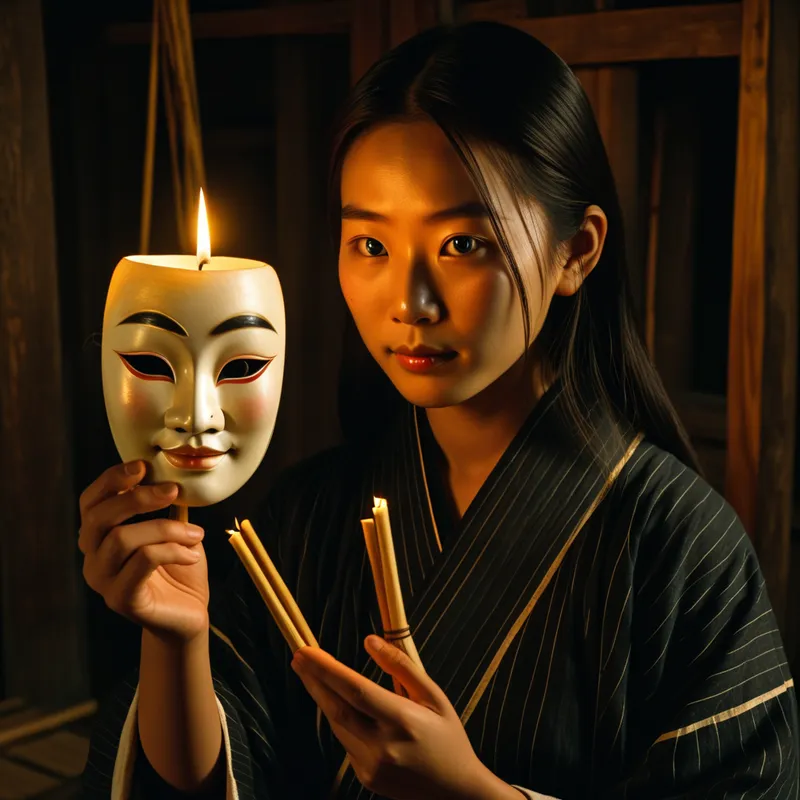
Noh Theater Masks Myth Meaning & Symbolism
A divine artisan carves a mask that captures a living spirit, birthing the art of Noh and the sacred paradox of the hidden face.
The Tale of Noh Theater Masks
Listen, and let the silence of the ancient cypress grove settle upon you. In a time when the boundary between this world and the other was as thin as rice paper, there lived a master carver named Hitomi. His hands were guided not by ambition, but by a deep, listening stillness. He did not seek to create beauty, but to discover the face that already lived within the heart of the wood.
One night, under a moon so full it seemed to bleed silver light, a vision came to him. It was not a dream, but a presence—the spirit of a young noblewoman who had perished, her story of love and loss untold, her soul unable to cross the Sanzu River. She had no face, only a profound longing to be seen. She whispered not with sound, but with the scent of fading plum blossoms and the chill of an unresolved past. “Give me form,” her silence pleaded. “Give me a vessel, so my tale may be danced, and my spirit may find rest.”
For forty-nine days and nights, Hitomi fasted and prayed. He selected a block of hinoki, feeling the life-force still humming within its rings. His chisel became an instrument of communion. He did not carve features; he uncovered them. He followed the grain as if it were the map of her sorrow. With each delicate stroke, he felt her essence drawing closer—the curve of a cheek that remembered a lover’s touch, the slight downturn of lips that held an unsung elegy, the hollows of eyes that had witnessed an irrevocable parting.
On the dawn of the fiftieth day, he applied the final strokes of paint, mixing powdered shell for the white base, using soot and ochre to hint at life beneath the pallor. As he held the finished mask up to the weak morning light, a tremor passed through the workshop. The air grew dense and cold. The painted eyes, which a moment before had been mere pigment on wood, now held a depth—a conscious, watching stillness. The mask was no longer an object. It was a threshold.
Hitomi, understanding his role was now that of a priest, not an artist, presented the mask to a celebrated dancer, a man whose body was a conduit for stories. “Do not act,” Hitomi instructed. “Put it on, and be prepared to be acted upon. Listen with your bones.”
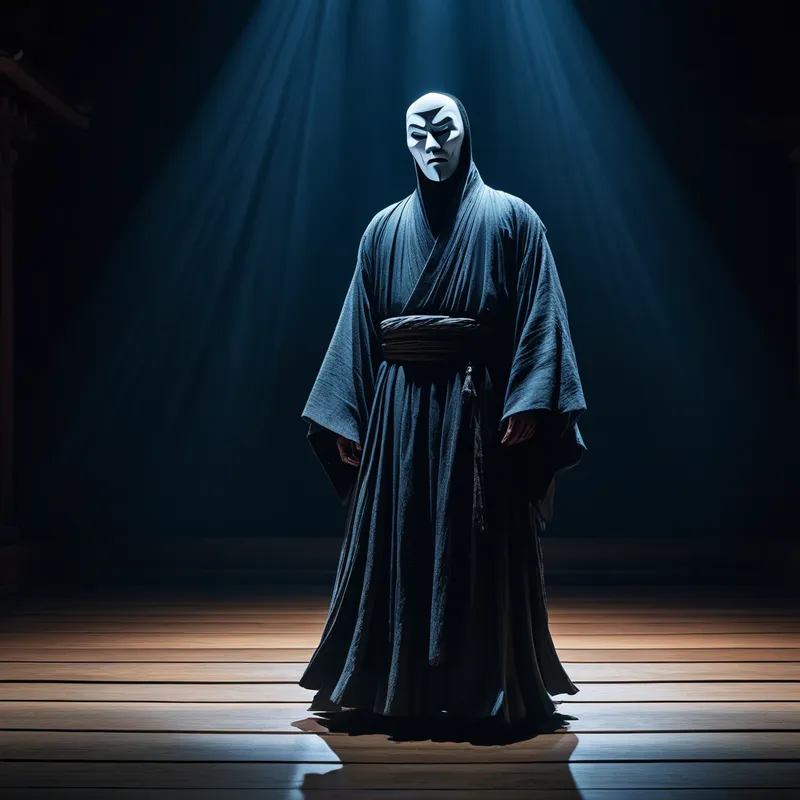
That evening, on a simple platform beneath the open sky, the dancer donned the mask. As it settled against his face, a shudder convulsed his frame. His own identity fell away like a discarded robe. His movements became alien, angular, possessed of a terrible, graceful gravity. He was no longer a man, but the vessel for the woman’s ghost. Through his slow, deliberate turns and the haunting, modulated chant that erupted from his throat, her entire tragedy unfolded—the stolen meetings, the cruel fate, the eternal yearning. The audience did not watch a performance; they witnessed a kami-oroshi, a descent of the spirit. When the dance concluded, the dancer collapsed, the mask clattering to the floor. And all present felt a change in the wind—a lightness, a release, as if a knot in the world had been loosened.
The spirit had spoken. It had been seen. And in that seeing, it found its passage. From that night forward, the art of Noh was born—not as entertainment, but as a sacred technology for hosting the unseen.
Cultural Origins & Context
This foundational myth, woven into the oral traditions of Noh-ke, reflects the profound syncretism at the heart of Japanese spiritual thought. It emerges from the confluence of indigenous Shinto animism, where spirits (kami) inhabit all things, and Buddhist concepts of impermanence (mujō) and the liberation of souls from attachment. Noh theater itself crystallized in the 14th and 15th centuries under masters like Zeami Motokiyo, who codified its aesthetics as a spiritual path.
The myth was not written in a single text but passed down through generations of actors and carvers as a sacred charge. It served a crucial societal function: to legitimize Noh as a ritual act, not mere spectacle. In a society deeply concerned with ancestral spirits and unresolved emotions (onryō), Noh provided a formal, controlled, and beautiful container for confronting the turbulent aspects of the collective psyche. The stage became a himorogi—a purified ritual space—where the community could safely encounter the ghosts of history, trauma, and passion, and through artistic form, facilitate their integration or release.
Symbolic Architecture
At its core, the myth of the Noh mask is a profound exploration of the paradox of identity and the nature of the soul’s embodiment. The mask is not a disguise, but a revelation. It operates on a sacred logic of inversion: to hide the individual face is to reveal the archetypal one.
The mask is the frozen moment where a story becomes a face, and a face becomes a fate. It is the solidified sigh, the crystallized memory, waiting for a living body to thaw it back into motion.
The carver, Hitomi, represents the conscious ego’s capacity to listen to the unconscious. His work is an act of midwifery, drawing forth latent psychic content—a complex, a trauma, an archetype—and giving it a defined form. The spirit of the noblewoman symbolizes all that is unresolved within the personal and collective psyche: memories that haunt, emotions that were never fully felt, stories that demand to be told. She is the autonomous complex seeking consciousness.
The dancer’s possession is the critical alchemical stage. His voluntary surrender of ego-control allows the unconscious content to take temporary, ritualized possession of the body of consciousness. This is not psychosis, but a sacred, temporary dissolution of the ego boundaries for the purpose of integration. The mask is the temenos, the sacred vessel that makes this dangerous transaction safe and aesthetically transformative.
The Dreamer’s Resonance
When the imagery of Noh masks arises in modern dreams, it signals a profound encounter with what psychologist James Hillman called the “imaginal.” It is seldom a casual symbol. To dream of wearing a Noh mask suggests the dreamer is feeling compelled to play a role that feels alien yet powerful, perhaps embodying a social persona or a repressed aspect of self that has taken control. The somatic feeling is often one of stiffness, constraint, or a strange, disembodied power—the literal weight of the mask.
To dream of seeing a Noh mask, particularly one that shifts expression or seems alive, indicates a direct confrontation with an autonomous complex. This could be the haunting “ghost” of a past relationship (the shite), the frozen anger of a parent, or the idealized, untouchable image of the lover or the sage. The mask is that content presenting its face to consciousness, asking not just to be analyzed, but to be danced—to be fully embodied and expressed in the theater of one’s life, so that its energy may be transformed.
Alchemical Translation
The myth models the complete cycle of psychic transmutation, or individuation. It begins with the nigredo: the dark, inchoate suffering of the unexpressed spirit (the depression, the anxiety, the nagging complex). The carver’s listening and shaping is the albedo: the conscious work of giving form to this darkness, through journaling, therapy, art, or deep reflection. The mask is the symbol that emerges, a concrete representation of the inner figure.
Individuation is not about becoming a unified, mask-less self. It is about consciously choosing which masks to wear, and knowing the sacred spirits you agree to host when you do.
The dancer’s possession is the rubedo, the reddening, the passionate and often frightening stage of enactment. This is where the insight must be lived. One must voluntarily “put on the mask” of the discovered complex—feel the old grief fully, express the long-held rage in a safe container, embody the vulnerability of the orphan—not to be consumed by it, but to allow its story to be told through you. The ritualized space of the Noh stage translates to the therapeutic container, the creative act, or the intentional relational dialogue.
The final release of the spirit is the citrinitas, the yellowing or illumination. It is the insight, the release, the transformation of raw, haunting psychic energy into meaningful narrative and wisdom. The complex, having been fully witnessed and expressed, loses its compulsive, haunting power and is integrated into the larger tapestry of the self. The ego, like the dancer after his collapse, returns, but is forever changed, having served as a vessel for a truth greater than itself. The individual learns that the self is not a single face, but a skilled company of actors, and consciousness is the master who knows when to wear the mask, and when to take it off, in the sacred play of becoming whole.
Associated Symbols
Explore related symbols from the CaleaDream lexicon: