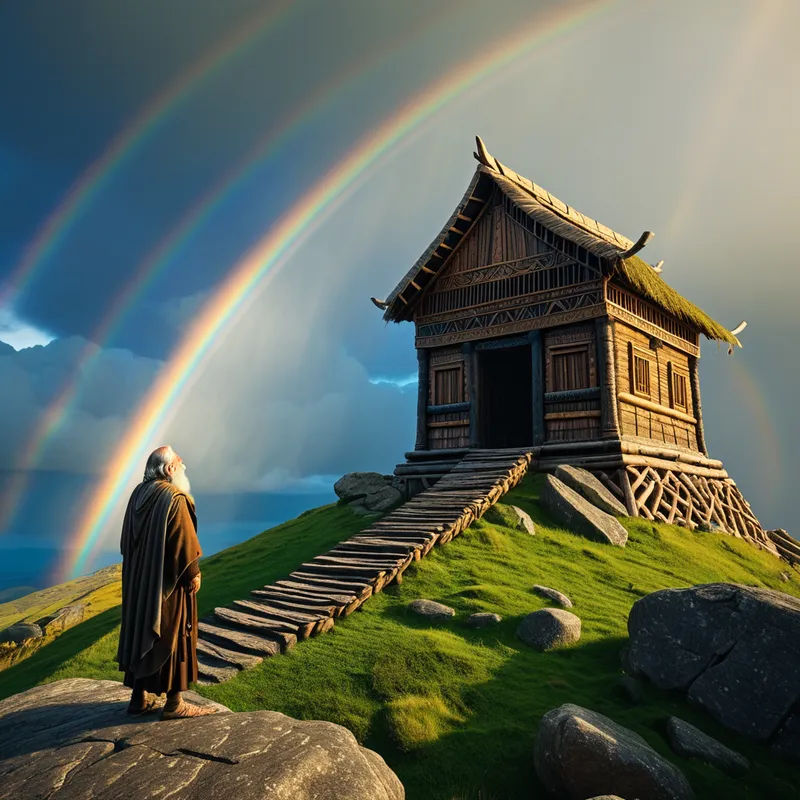
Noah's Covenant Myth Meaning & Symbolism
After a cleansing flood, a righteous man receives a divine promise of mercy, sealed by a rainbow, establishing a new covenant between heaven and earth.
The Tale of Noah's Covenant
Listen, and hear a tale written in water and light, a story of an ending that became a beginning.
The world had grown heavy with a corruption that seeped into the very soil, a violence that echoed in the hearts of men until the clamor reached the heavens. YHWH saw the canvas of creation, meant for beauty, now stained beyond recognition. A profound grief, deeper than any ocean trench, settled in the divine heart. The decision was not wrath, but the terrible surgery of a surgeon who must cut away the infected flesh to save the body. The fountains of the great deep would be broken open, and the windows of the sky would be torn asunder.
But in the midst of the gathering shadow, one man walked a different path. Noah was a man of integrity in a crooked generation. To him came a voice, clear and commanding, with instructions of salvation that defied all reason: build an ark, a mountain of wood and pitch, a womb of gopher wood in a world destined for water. For one hundred and twenty years, the sound of his hammer was a counter-rhythm to the coming storm, a testament to faith in a promise unseen.
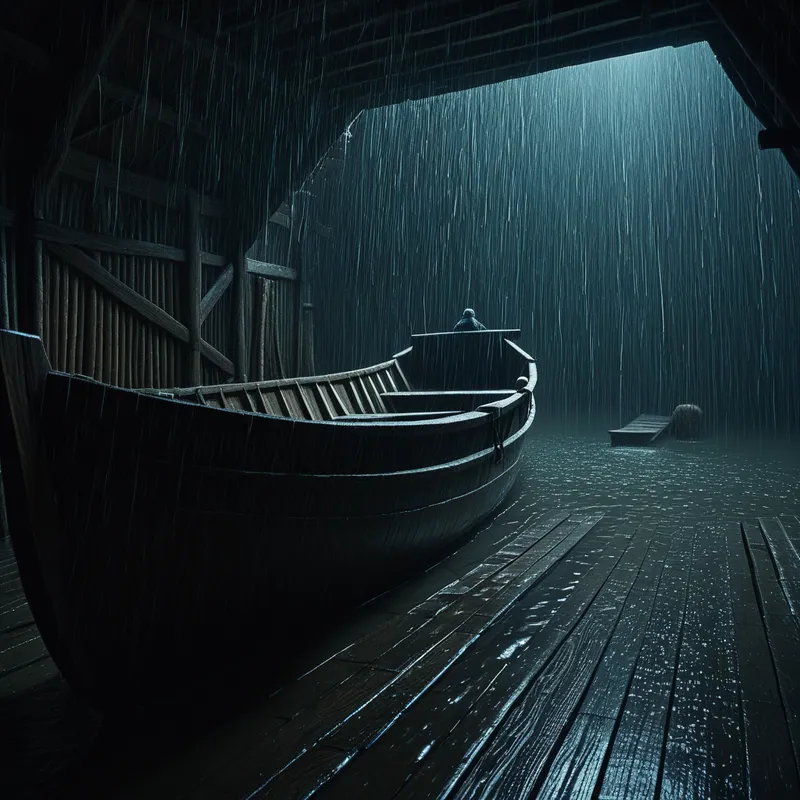
Then the rains came. Not as a shower, but as the unleashing of primordial chaos. The waters above and the waters below met in a cataclysm that erased the world. For forty days and forty nights, the drumming on the ark’s roof was the only music, and inside, in the close, dark, animal-scented hold, was held the fragile seed of all life. The ark was tossed on the face of the deep, a coffin and a cradle, carrying the ghost of a world within its ribs.
The waters prevailed, and then, they receded. The ark ground to a halt on the bones of the mountains of Ararat. A raven was sent out, and it did not return, finding its sustenance in the carrion of the old world. A dove returned with nothing. Then, a second time, it returned with a freshly plucked olive leaf—the first green scripture of the new earth. Finally, it flew out and did not return.
Noah emerged, blinking, into the silence of a washed world. His first act was one of gratitude. He built an altar and offered a sacrifice. The scent of that offering, the aroma of devotion rising from a purified earth, reached the heavens. And YHWH made a covenant.
The voice spoke not of past destruction, but of future grace. “Never again.” Never again would all flesh be cut off by the waters of a flood. The rhythm of the world—seedtime and harvest, cold and heat, summer and winter, day and night—would not cease. This was the promise.
And the sign was not carved in stone, but painted across the sky with water and light. “I have set my bow in the clouds,” declared the voice. It was a warrior’s bow, unstrung and laid aside, its arc pointing away from the earth, a weapon of war transformed into a bridge of peace. Whenever the clouds gather, and the rain threatens memory, the rainbow appears. It is a reminder, a divine self-reminder, of the covenant between the Creator and all living creatures, for all generations.
Cultural Origins & Context
This narrative forms a pivotal chapter in the Book of Genesis, the foundational text of the Abrahamic traditions—Judaism, Christianity, and Islam. Its origins are woven from ancient threads, with clear parallels to earlier Mesopotamian flood epics like the Epic of Gilgamesh. However, the Abrahamic telling undergoes a profound theological transformation.
In the Israelite context, likely solidified during the Babylonian Exile (6th century BCE), the story was not merely a tale of survival but a cornerstone of covenantal theology. It was told and retold to answer fundamental questions: Why is there suffering? Does God abandon creation? The story functioned to establish a foundational principle: that the relationship between the divine and the world is governed by a binding promise (berit in Hebrew). It moved the concept of divinity from capricious force to relational partner, setting the stage for the later covenants with Abraham and Moses. It served as a mythic anchor, assuring a community often facing its own existential floods that the fundamental order of life was guaranteed by a divine oath.
Symbolic Architecture
The myth is a dense symbolic ecosystem, a map of psychic catastrophe and reconstitution.
The flood represents the necessary, terrifying dissolution of a corrupted psychic structure. It is the unconscious, in its awesome and annihilating power, rising to cleanse a consciousness that has become irredeemably hostile to life.
Noah is the archetype of the tzaddik, the righteous remnant. He is not a heroic warrior, but a faithful preserver. His ark is the symbol of the temenos, the sacred container. It is the ego-structure, fragile yet resilient, that can hold the totality of the Self—the chaotic instincts (the animals), the familial complexes, and the guiding spiritual principle—through the storm of transformation. The forty days and nights signify a complete period of incubation and trial, a psychic gestation in the dark waters of the unconscious.
The dove with the olive leaf is the first messenger of the reconciling function, the symbol of peace and the return of life-affirming spirit after a period of pure analytic or depressive dissolution. Most potent is the bow in the clouds. It is the symbol of tension and conflict (the bow) resolved into a bridge of beautiful, spectral connection. It represents the transformation of divine wrath (judgment) into divine memory (covenant), a promise etched in the very atmosphere of relationship.
The Dreamer's Resonance
When this myth stirs in the modern dreamer, it signals a profound process of psychic flooding and the desperate search for an ark. To dream of overwhelming waters, of saving animals, or of seeing a rainbow after a storm is to experience the somatic reality of this archetype.
The dreamer may be undergoing a period where old attitudes, relationships, or life structures feel “corrupt” and unsustainable. The rising floodwaters in a dream are the feeling of being emotionally or psychologically overwhelmed by contents of the unconscious that can no longer be ignored. The ark is the dreamer’s attempt to find or build a principle of preservation—this could be a new commitment to therapy, a spiritual practice, a creative project, or simply a disciplined routine that creates a “container” amidst chaos. The dream animals represent instinctual energies and personality traits that the dreamer is trying to save from destruction. The appearance of the rainbow in a dream is a profound symbol of hope and the promise of renewal emerging from the depths of despair, indicating that the period of sheer survival is giving way to the possibility of a new, more conscious relationship with the self.

Alchemical Translation
The alchemical journey mirrored in Noah’s Covenant is the process of solutio (dissolution) followed by coagulatio (coagulation), all under the auspices of a new, conscious covenant with the Self.
The individuation process requires a flood. The ego, comfortable in its old, often arrogant or one-sided land, must be dissolved. Its certainties are drowned. This is a terrifying, necessary nigredo.
The individual, like Noah, must heed the call to build an ark. This is the conscious work of creating a vessel strong enough to hold the psyche through its own dissolution—through analysis, through shadow work, through enduring depression or life crisis. One gathers all aspects of the personality (the “animals”) into this vessel, committing to preserve the totality, not just the pleasant parts.
The long voyage in the dark is the period of integration, where one must live with the chaotic, smelly, confined reality of one’s own unresolved psyche. The sending forth of the birds represents the tentative testing of the new psychic terrain. When the dove does not return, it signifies that the spirit has found a new, solid ground upon which to dwell.
Emerging from the ark, one offers a “sacrifice”—the old, inflated ego is surrendered on the altar of the greater Self. In return, a covenant is established. This is the new, grounded relationship between the ego and the Self. The rainbow is the symbol of this hard-won integration. It is the beautiful, transient, yet recurring evidence that the psyche’s fundamental law is not perpetual conflict, but a cyclical promise of renewal. The warrior’s bow of inner conflict is laid aside, and in its place shines the bridge connecting the heights of spirit and the depths of the earth, a permanent, if fragile, testament to the promise of wholeness.
Associated Symbols
Explore related symbols from the CaleaDream lexicon: