Noah's Ark Myth Meaning & Symbolism
A righteous man builds an ark to survive a divine flood, preserving life and a covenant for a cleansed world's rebirth.
The Tale of Noah's Ark
In the deep time of the world, when the hearts of men had turned wholly to wickedness and their thoughts were only of violence, the very fabric of creation groaned. The Elohim looked upon the earth and saw that it was corrupt, filled with ruin. A great grief settled in the divine heart, a resolve as deep and terrible as the foundations of the world.
But in that generation, one man walked differently. Noah, a man of the soil, was righteous in his time. He walked with God. And to him, the Holy One spoke a secret of coming cataclysm: “The end of all flesh is come before me. Make for yourself an ark of gopher wood.”
The command was precise, a geometry of salvation: three hundred cubits long, fifty cubits wide, thirty high. A single door in its side, a window finished to a cubit above. Pitch it within and without. For I, said the Voice, will bring a flood of waters upon the earth to destroy all flesh under heaven. Everything on the dry land shall die. But with you I will establish my covenant.
Noah did all that he was commanded. For decades, under a sun that knew nothing of rain, he labored. The sound of his adze and hammer became the heartbeat of a coming mystery. Neighbors mocked; the world carried on with its feasting and fighting. But Noah built. He gathered his sons—Shem, Ham, and Japheth—and his wife, and his sons’ wives. And he gathered the creatures.
They came in the deep instinct of the covenant, two by two, male and female: the shambling bulk of the elephant, the sinuous glide of the serpent, the beating wings of the sparrow. The clean beasts came by sevens, a promise of future sacrifice and sustenance. The scent of the earth, of fur and feather and scale, filled the vast, dark hold. Then the Elohim shut them in.
And the fountains of the great deep burst apart, and the windows of the heavens were opened. Rain fell not as drops, but as a solid curtain, a crushing weight of water from above, while the seas rose from below to meet it. The ark lifted from the trembling earth. It was borne upon the face of the waters as the world drowned—every mountain, every city, every field, every laughing child and scheming king, swallowed by the roaring, churning deep. For forty days and forty nights, the deluge reigned. Inside the ark, in the creaking dark, was the only sound of life in all the world: the lowing of cattle, the shuffle of hooves, the breath of eight humans, and the relentless drumming of the rain.
The waters prevailed upon the earth for one hundred and fifty days. Then God remembered Noah. A wind passed over the earth, and the waters assuaged. The ark came to rest on the mountains of Ararat. Noah sent forth a raven, which went to and fro. He sent a dove, which found no rest and returned. He waited seven days, sent the dove again, and it returned with a freshly plucked olive leaf in its beak. Hope, green and fragile. He waited again, sent the dove once more, and it did not return.
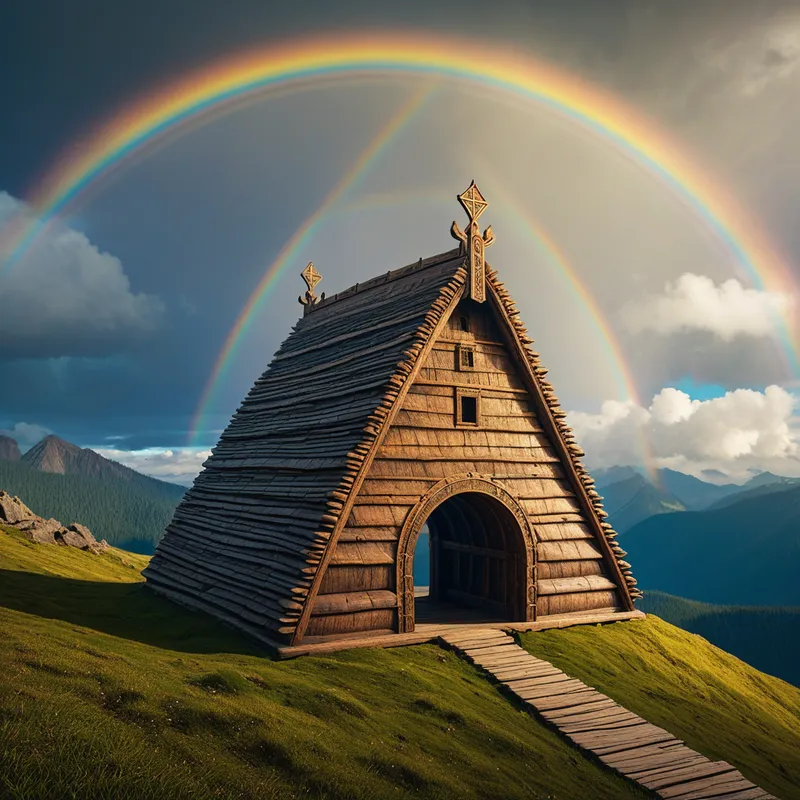
Then God spoke: “Go out from the ark, you and your wife, and your sons and your sons’ wives with you. Bring out with you every living thing.” And they went out, onto the mud and stone of a naked world. And Noah built an altar and offered clean beasts as a sacrifice. The scent of the offering rose, a sweet savor. And the Elohim set his bow in the cloud—a rainbow, the warrior’s weapon laid aside, now a bridge of luminous color. “Never again,” spoke the Voice. “While the earth remains, seedtime and harvest, cold and heat, summer and winter, day and night, shall not cease.” The covenant was set. The story of the world began a second time.
Cultural Origins & Context
The story of Noah’s Ark is a foundational narrative within the Torah, specifically the book of Genesis. Its literary form suggests it is a masterful compilation and theological refinement of far older Mesopotamian flood traditions, most notably the Epic of Gilgamesh, where the hero Utnapishtim builds a boat to survive a god-sent deluge. The Biblical authors, likely during or after the Babylonian Exile (6th century BCE), transformed this common ancient Near Eastern motif.
They stripped it of its polytheistic squabbles and reframed it within a strict monotheistic covenant theology. The story was not merely an etiological tale for geological features or animal diversity; it served as a pivotal hinge in the primeval history (Genesis 1-11), explaining the moral architecture of the world. It answered profound questions: Why is there evil? Why does God not simply destroy it? What is humanity’s relationship to creation and to the divine after such a rupture? It functioned as a mythic reset, establishing the principle of divine justice tempered by mercy, and setting the stage for the covenant with Abraham. It was told to reinforce communal identity, moral order, and the profound, non-negotiable bond between the Creator, humanity, and all living things.
Symbolic Architecture
At its core, the Ark myth is a supreme allegory of containment and selective preservation through an epoch of dissolution.
The Ark is not a ship for sailing; it is a womb for the world. It is the sealed vessel in which the essence of a doomed system is held in trust, in darkness and suspension, until the chaotic waters of un-creation subside and a new ground emerges.
The Flood represents the necessary, terrifying dissolution of a corrupt or outworn psychic or cultural order. It is the nigredo of the soul—the drowning of all that is familiar. Noah, the Tzaddik, symbolizes the intact core of consciousness, the part of the Self that remains in alignment with a transpersonal principle (the divine) even when the entire collective psyche has devolved into violence and narcissism. His building project is an act of radical faith in a future he cannot see, based on a word he alone hears.
The animals, taken in pairs, represent the totality of instinctual life and the potential for all future differentiation. The single window, oriented upward, signifies the one point of conscious connection to the transcendent during the ordeal. The mountain of Ararat is the emerging lapis, the first solid ground of a new consciousness. The rainbow covenant is the integration of the ordeal: a promise that life itself, in its cyclical nature, will continue, and that divine judgment is now bound by a law of grace.

The Dreamer's Resonance
When this myth pattern stirs in the modern dreamer, it often signals a profound psychological crisis of inundation. The dreamer may experience dreams of rising floodwaters, tsunamis, or being trapped in a safe but claustrophobic space (a basement, a bunker, a large vessel). This is the somatic expression of feeling overwhelmed by unconscious contents—a tidal wave of emotion, a dissolution of one’s known identity, or the collapse of a life structure (a career, a relationship, a belief system).
The Ark in the dream is the nascent, fragile structure of the emerging Self. Dreaming of building an ark suggests the ego is heeding an inner directive to prepare for a coming storm of transformation, often gathering inner resources (“animals”) or values that must be preserved. Being inside the ark, hearing the storm outside, speaks to a necessary period of incubation, where one must endure the chaos in a state of contained waiting. The release of the dove is the dreamer’s testing of the environment for signs of life, for the possibility of new beginnings. This dream sequence maps the process of holding the tension between annihilation and preservation until a new psychic ground becomes habitable.
Alchemical Translation
The journey of Noah is a perfect map of the individuation process. It begins with a divine discontent—the Self’s judgment upon an ego-life that has become corrupt, stagnant, or lived in bad faith. The call to build the ark is the call to undertake the opus, to construct a vas hermeticum, a sealed container of the work. This is the conscious commitment to therapy, to art, to a spiritual discipline—a structure strong enough to hold the coming conflict.
The forty days and nights in the flood mirror the alchemical solutio: the total dissolution of the old persona in the waters of the unconscious. Everything one thought one was is washed away. The ego, like Noah, is reduced to its essential function: caretaker of the spark of life in the dark.
The long, drifting wait on the waters is the stage of mortificatio and putrefactio—the death and decomposition of the old attitudes. It is a passive, suffering phase where the ego does not act but is acted upon. The grounding on Ararat is the coagulatio, the precipitation of a new, solid sense of Self from the solution. The sending forth of the birds represents the cautious, iterative testing of this new reality. Finally, the exit and the sacrifice—the offering up of the transformed experience—leads to the covenant, the coniunctio symbolized by the rainbow. This is the integration where the conscious personality (humanity) establishes a new, conscious relationship with the Self (the divine), with the promise that the process of death and rebirth is now part of a sacred, enduring order. The individual emerges not just saved, but as the progenitor of a new world within.
Associated Symbols
Explore related symbols from the CaleaDream lexicon:
- Flood
- Zoo
- Residential
- Wooden Crate
- Freight Train
- Lifeboat
- Shipwreck
- Architect's Model
- Lifesaver
- Marooned Ship
- Handcrafted Birdhouse
- Massive Cargo Ship
- Craftsman Cottage
- Cluttered Garage
- Cathedral Roof
- Sinking Ship
- Hide Shelter
- Wooden Mortise
- Survivor's Signal Fire
- Ark Covenant
- Blueprint
- Buoyancy
- Rainshadow
- Herd