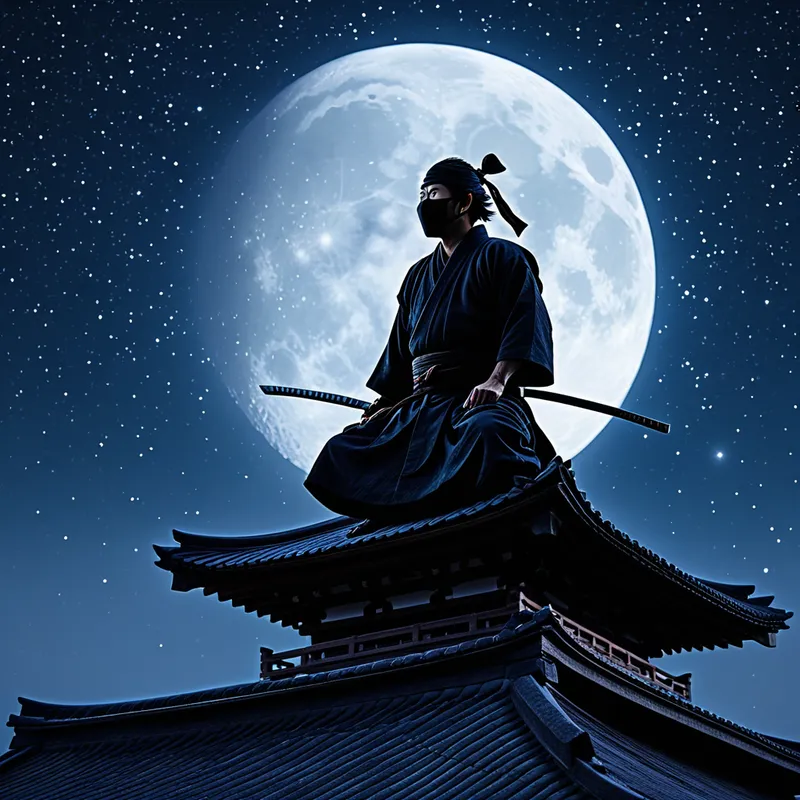
Ninja Myth Meaning & Symbolism
The myth of the shadow warrior who masters the void, sacrificing identity to become an agent of fate, a vessel for the unseen.
The Tale of Ninja
Listen. Not to the clash of steel, but to the silence between breaths. Not to the shout of war, but to the whisper of straw sandals on damp earth. In the age of warring states, when lords built castles of stone but ruled with hearts of paper, the true power did not walk in the sun. It flowed in the darkness, a current beneath the visible world.
They were called Shinobi. They were the children of the borderlands—of Iga and Koga, where mountains swallowed voices and mists hid paths. They were not born of gods, but of necessity. A peasant, watching his field burn, learns to move without being seen. A samurai, stripped of his lord, learns that honor is a luxury for the living. From this crucible of survival, a new being was forged.
Follow one. See not a face, for it is hidden by the tengui. See only the intent. He becomes water, seeping through the cracks in a fortress wall. He becomes wind, a sigh that stirs a lantern flame but leaves no trace. He is a shadow cast by no body, a thought that enters the mind of a sleeping general. His tools are not just the shuriken or the ninjato, but the cricket’s chirp he mimics to signal safety, the poison distilled from a mountain root, the map memorized and then eaten.
His greatest battle is not against a guard, but against himself. He must kill his own fear, his own scent, his own desire to be known. To complete his mission—to steal the scroll, to open the gate, to deliver the silent message—he must become mu, nothingness. He is the un-blossom, the un-sound. When he is most successful, the world does not know he was ever there. The castle falls, and history credits the great army at the gates, never the single shadow that slipped the bolt the night before. His triumph is his own erasure. He dissolves back into the night, a story that was never told, a name that was never spoken.
Cultural Origins & Context
The myth of the ninja is a historical palimpsest written in shadow. Unlike the Bushido-driven samurai, celebrated in official chronicles and gunki monogatari, the ninja’s story emerged from the margins. It was born in the tumultuous Sengoku Jidai, a time when espionage, sabotage, and unconventional warfare became vital tools for survival. The myth was not propagated by court poets but through oral tradition, secret scrolls (densho), and later, popular theater and woodblock prints.
These were the tales of the ryu, passed from master to disciple in hidden valleys. They served a dual societal function: as practical manuals of guerrilla warfare and as a counter-narrative to the rigid, hierarchical samurai ideal. The ninja myth gave a name and a terrifying potency to the power of the oppressed, the outsider, and the strategically cunning. It was the story of the mind defeating the sword, of adaptability overcoming brute force, forever haunting the periphery of Japan’s ordered society.
Symbolic Architecture
Psychologically, the ninja is the ultimate archetype of the Shadow, not as a villain, but as a necessary, skilled operative of the unconscious. The ninja represents all we disown, suppress, or deem “unacceptable” in our quest for a respectable, sunlit ego.
The ninja is the art of becoming what the situation demands, sacrificing the comfort of a fixed identity for the power of pure potential.
The black costume symbolizes the Mu, the fertile void from which all forms emerge. The tools are symbols of psychic functions: the kaginawa is the ability to connect disparate parts of the psyche; the metsubushi are moments of dazzling insight that create confusion in old patterns; the disguise is the capacity for kyojitsu tenkan ho (mixing truth and falsehood), essential for navigating complex social and internal landscapes. The mission itself is the call from the Self to retrieve a vital piece of psychic information (the scroll, the key) held captive by a tyrannical complex (the castle lord, the rigid belief).
The Dreamer's Resonance
When the ninja archetype stirs in modern dreams, it signals a profound somatic and psychological process: the mobilization of the shadow for a covert operation of the soul. You may dream of moving through familiar spaces unseen, of possessing secret knowledge, or of needing to bypass a formidable obstacle not by confrontation, but by ingenious, silent means.
This is not a call to literal deception, but to psychological infiltration. The dreamer is being guided to access repressed skills, intuition, and resilience. The somatic feeling is often one of heightened alertness coupled with deep calm—a focused readiness. It indicates a phase where old, conscious strategies (the frontal assault) have failed, and the psyche is activating its clandestine resources. You are learning to navigate your own internal politics, to listen to the whispers of your intuition (choho), and to achieve your goals through adaptability rather than force.

Alchemical Translation
The ninja’s path is a stark model of psychic alchemy, a roadmap for individuation through radical self-negation and skillful means. The first alchemical stage is Nigredo: the descent into the shadow. One must don the “black clothes,” consciously entering and embracing the denied parts of oneself—the anger, the cunning, the fear.
The ultimate transmutation is not from lead to gold, but from a solid ego to a fluid presence, capable of any shape yet anchored in none.
The training—the mastery of tools, terrain, and mind—is the Albedo, the whitening, where these raw shadow elements are refined into conscious skills. The silent infiltration of the castle is the Rubedo, the reddening or great work: the conscious ego (the ninja) penetrates the fortified complex (a neurosis, a trauma) not to destroy it, but to retrieve the treasure (a lost memory, a creative spark, a feeling function) and return it to the larger Self.
The final, most profound step is the escape and dissolution. The successful ninja does not claim the castle for himself; he returns to the void. In psychological terms, the integrated content becomes part of the whole personality, not a new possession of the inflated ego. The individual learns to wield these powers without being identified with them, to act in the world effectively while remaining, in essence, empty and free. One becomes an agent of fate, a vessel for the unseen, completing missions for the soul with the silence of falling snow.
Associated Symbols
Explore related symbols from the CaleaDream lexicon: