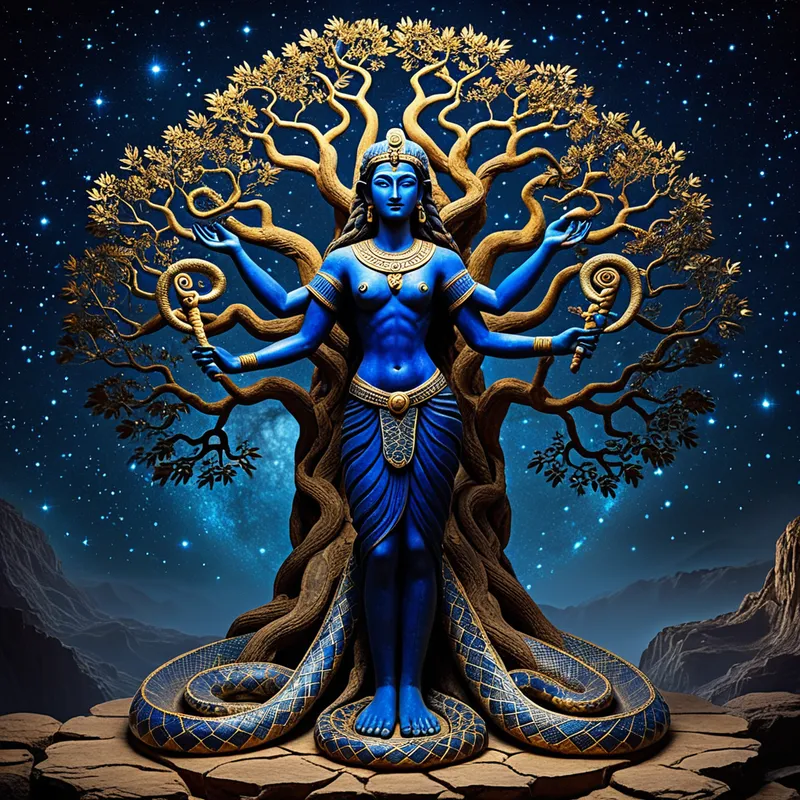
Ningishzida Myth Meaning & Symbolism
The serpent-dragon god of the underworld tree, Ningishzida, embodies the profound journey through death, transformation, and the promise of cyclical rebirth.
The Tale of Ningishzida
Hear now the tale whispered in the dust of forgotten temples, a story not of the bright heavens but of the deep, fertile dark. In the time before time, when the Apsu mingled with the salt waters of Tiamat, there was born a god of a different nature. His name was Ningishzida.
He was not a god of storms or kingship, but of the silent, growing things. His form was that of a great, horned serpent, a mušhuššu, whose scales held the patina of ancient bronze and whose eyes held the stillness of deep earth. His domain was the root, the foundation, the hidden place where life gathers its strength. He was the guardian of the Gishzida, the Good Tree, whose branches were said to touch the heavens and whose roots drank from the waters of the underworld.
But a shadow fell upon the divine order. The great goddess Ereshkigal, who rules the desolate Kur in lonely sovereignty, demanded a consort. The heavens above trembled at the thought of descending into that silent, dust-choked realm. Who would go? Who would willingly leave the light of the sun for the house of no return?
It was Ningishzida who answered. Not with a warrior’s cry, but with a serpent’s silent resolve. He shed his place among the growing things of the world and made the descent. Down through the seven gates of the underworld he passed, and at each gate, a piece of his luminous, earthly nature was stripped away. His verdant color faded to the grey of tomb-dust. The vibrant pulse of life stilled into the patient, endless rhythm of the deep earth. He arrived before Ereshkigal’s throne not as a conqueror, but as a supplicant, transformed. He became her husband, the god who is both serpent and tree, rooted eternally in the land of the dead.
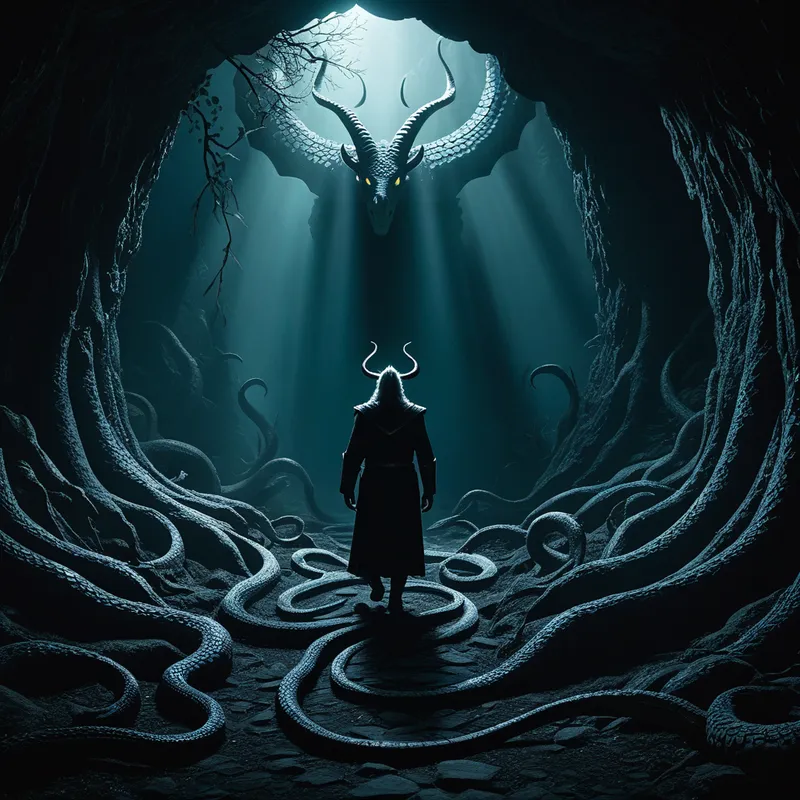
And here, in the heart of darkness, his true purpose unfolded. He became the psychopomp. When a mortal king or hero died, their soul, confused and fearful, would find not a monstrous jailer, but Ningishzida. In his form as a serpent coiled at the base of the world tree, or as a somber, bearded god holding a staff entwined with twin serpents, he would guide them. He led the shades through the labyrinthine roots of his tree, through the gloom of the Kur, to their final rest. He was the pathfinder in the realm of no paths, the living presence in the land of the dead. He did not bring them back to life, but he gave meaning to their death—a guided journey, a solemn integration into the great, silent cycle. He became the promise that even in finality, there is a guardian; even in ending, there is a sacred process.
Cultural Origins & Context
The myth of Ningishzida emerges from the rich, alluvial soil of ancient Sumer, dating back to the Early Dynastic period (c. 2900–2350 BCE). His worship was centered in the city of Girsu, and he was deeply connected to the funerary cults of local rulers. Unlike the grand cosmic narratives of Enuma Elish, the stories of Ningishzida were likely woven into liturgical texts, lamentations, and incantations performed by temple priests (gudapsû) and lamentation singers.
His myth served a crucial societal function: to mediate humanity’s profound anxiety about death. In a culture where the afterlife was viewed as a bleak, shadowy existence, Ningishzida offered a thread of connection and order. He modeled a divine acceptance of the underworld, transforming it from a purely terrifying abyss into a realm with its own logic and sacred guardianship. By guiding the souls of kings, he legitimized their passage and, by extension, the continuity of earthly order even beyond the grave. His myth was a cultural container for the trauma of mortality, offering a divine archetype who had himself undergone the ultimate transition and emerged not as a victim, but as a sovereign guide.
Symbolic Architecture
Ningishzida is a masterpiece of chthonic symbolism, an embodiment of the paradoxical unity of opposites that lies at the root of psychic life.
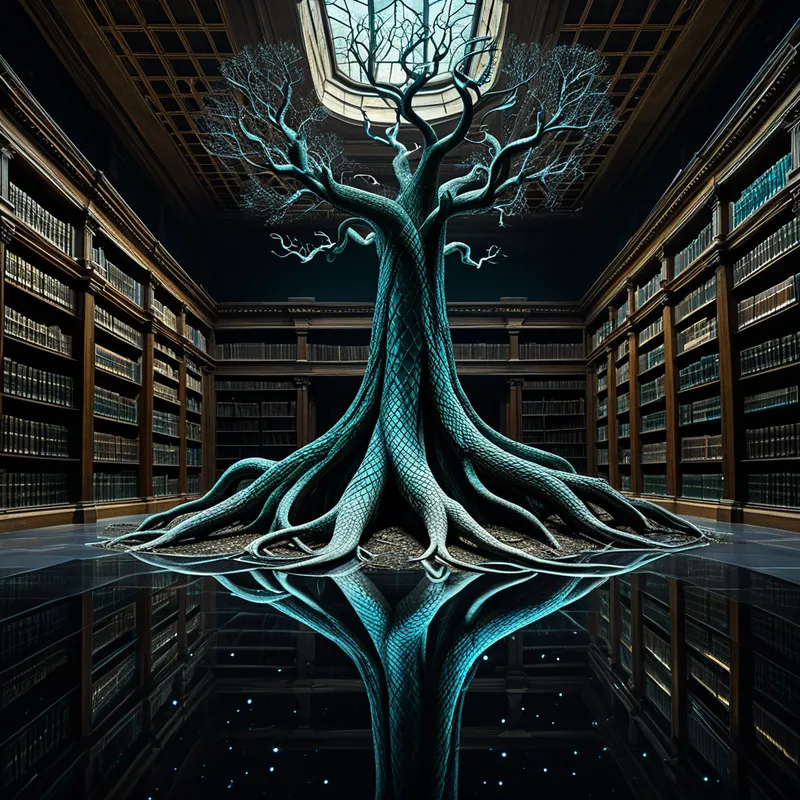
He is the serpent that sheds its skin in the darkness, and the tree that remains, steadfastly growing through the decay. One cannot exist without the other.
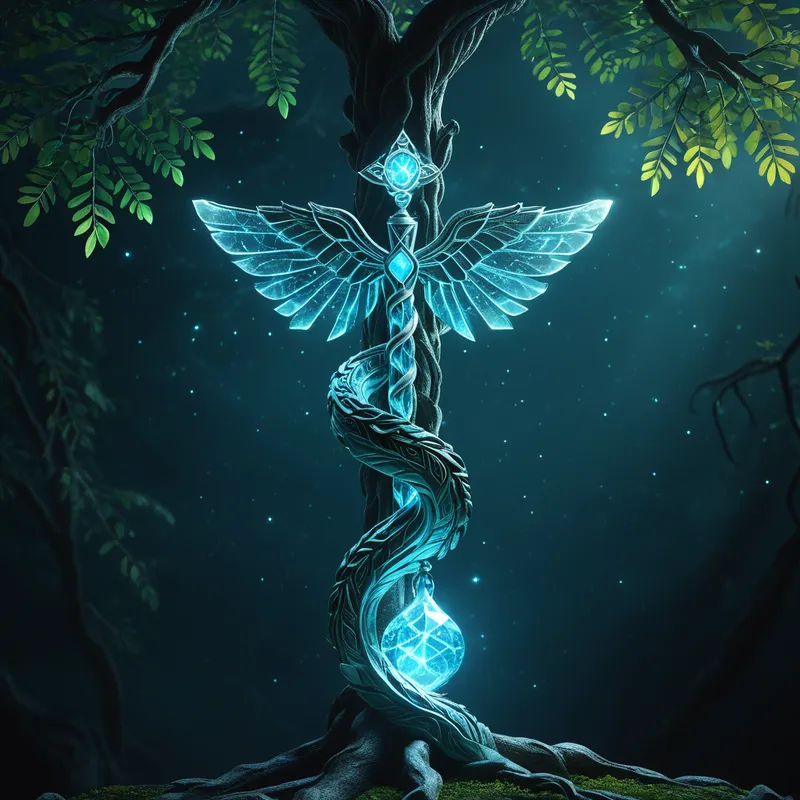
His primary symbol is the caduceus. This is not merely a staff of authority; it is a map of the psyche. The central axis is the spine of the world, the axis mundi connecting heaven, earth, and underworld—the individual’s connection between consciousness, lived experience, and the unconscious. The twin serpents represent the dynamic, often opposing, forces that must be reconciled: life and death, growth and decay, healing and poison, the conscious mind and the instinctual body. Their entwined ascent symbolizes the integration of these opposites, a helical path of awakening.
As a god who is both tree and serpent, he embodies the tension between stability and transformation. The tree represents the enduring structure of the Self, the core identity that persists through life’s changes. The serpent represents the necessary, often frightening, process of shedding that which is outgrown—old identities, traumas, and ego attachments—to make way for new life. Ningishzida presides over this sacred, subterranean process where the old self is composted to feed the roots of the new.
The Dreamer's Resonance
When the archetype of Ningishzida stirs in the modern dreamer’s psyche, it signals a profound encounter with the shadow and the call to navigate a personal underworld.
Dreams may feature coiled serpents in basements or roots breaking through floorboards, gnarled trees in fog-shrouded landscapes, or a solemn, guiding figure in a place of profound loss or transition. The somatic experience is one of gravity—a feeling of being pulled downward, of weight, of a necessary descent. This is not depression, but a numinous depression, a calling to attend to what has been buried: unresolved grief, abandoned creativity, old family wounds, or a life path that has reached its natural end.
Psychologically, this is the process of nekyia—the night sea journey. The dreamer is being asked to consciously enter their own Kur, to sit with what feels dead or ended within them. Ningishzida’s presence in the dreamscape is a profound reassurance. It suggests the psyche itself possesses an innate, guiding intelligence for this descent. The dream says: You must go into this darkness, but you will not be alone. Your own deepest nature knows the way.
Alchemical Translation
The myth of Ningishzida is a precise alchemical formula for the individuation process, the journey toward psychic wholeness. His descent to Ereshkigal mirrors the essential stage of nigredo—the blackening, the dissolution of the ego’s conscious attitudes in the murky waters of the unconscious.
The throne of the underworld is not a seat of punishment, but the crucible where the base metal of the persona is broken down to release its latent gold.
The modern individual undergoes this when a career fails, a relationship ends, or a long-held identity collapses. This is the “death” Ningishzida models. The key is his voluntary acceptance. He does not rage against the descent; he submits to its necessity. In our lives, this translates as surrendering resistance to a painful but transformative process—allowing the grief, the confusion, and the stillness to do their work.
His role as psychopomp is the stage of albedo—the whitening, the illuminating insight that follows dissolution. After the ego’s breakdown, the integrated Self begins to guide. One starts to find meaning in the suffering, to see the patterns and lessons in one’s “underworld” experience. The twin serpents of the caduceus now represent the conscious mind and the healed, integrated unconscious beginning to communicate, to spiral upward together.
Finally, as the guardian of the tree of life in the land of death, Ningishzida embodies the rubedo—the reddening, the embodiment of the achieved Philosopher’s Stone. The fruit of this alchemy is not an escape from life’s cycles of death and rebirth, but a profound peace within them. The individual no longer fears their own depths or life’s endings. They become, like Ningishzida, a grounded, rooted presence capable of guiding themselves and others through inevitable transitions. They realize the core truth of the myth: that the root of eternal life is not found by fleeing from death, but by descending, with conscious reverence, into its very heart.
Associated Symbols
Explore related symbols from the CaleaDream lexicon: