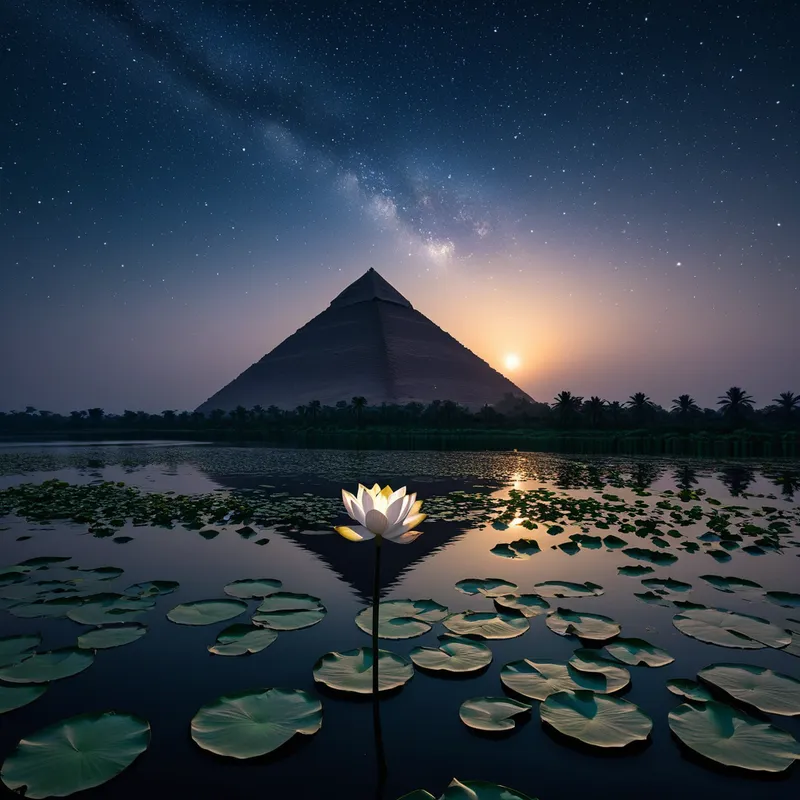
Nile riverbanks Myth Meaning & Symbolism
The myth of the primordial mound rising from Nun's waters, where life first sparked and divine order was established against the ever-present chaos.
The Tale of Nile riverbanks
Before the first word was spoken, before the first name was given, there was only Nun. An endless, silent, dark ocean, without shore, without sun, without time. It was the deep that contained all possibility and all nothingness, a cold and perfect stillness.
Then, a disturbance. A stirring in the heart of the infinite. Not a sound, but a will. From within the boundless Nun, a force gathered—a desire for distinction, for self. And from that desire, the first land was born. Not with a cataclysm, but with a slow, inevitable rising. A mound of dark, rich silt pushed upwards, breaching the surface of the waters. This was the First Place, the Benben. It was not yet Egypt; it was the idea of a place, the very concept of "here" as opposed to "everywhere."
Upon this tiny, damp island in the sea of chaos, the god Atum manifested. He stood alone, the only being in a universe of undifferentiated water. The air was thick and cool, smelling of wet earth and potential. He looked upon the endless Nun, and he knew isolation. To be the only thing that is, is a profound burden. So, from his own essence, he acted. He spat, or he sneezed—the stories vary—and from his breath and moisture came Shu, the dry air. And from his own hand, he masturbated, and from his seed came Tefnut, the moist air.
Shu and Tefnut departed into the gloom, and for a time, Atum was alone again, fearing his children lost to the encircling chaos. But they returned, bringing with them the Eye of Atum—his power, his perception. In his joy, Atum wept. And where his tears, hot and human, fell upon the dark silt of the primordial mound, they transformed. They became the first men and women, their bodies formed from the clay of the first land and the saltwater of divine emotion.
Thus, life flourished on the riverbank of the world. Shu lifted Tefnut above him, separating the waters below from the waters above, creating the sky. The mound grew, stretching north and south, becoming the Black Land, Kemet, cradled by the life-giving river that was the memory of Nun’s flow, now ordered and directed. But the story never ends. Every sunset, the forces of Nun threaten to reclaim the banks. Every sunrise is a re-enactment of that first victory, the mound re-emerging, the lotus blossom reopening, a promise whispered against the eternal, patient dark.
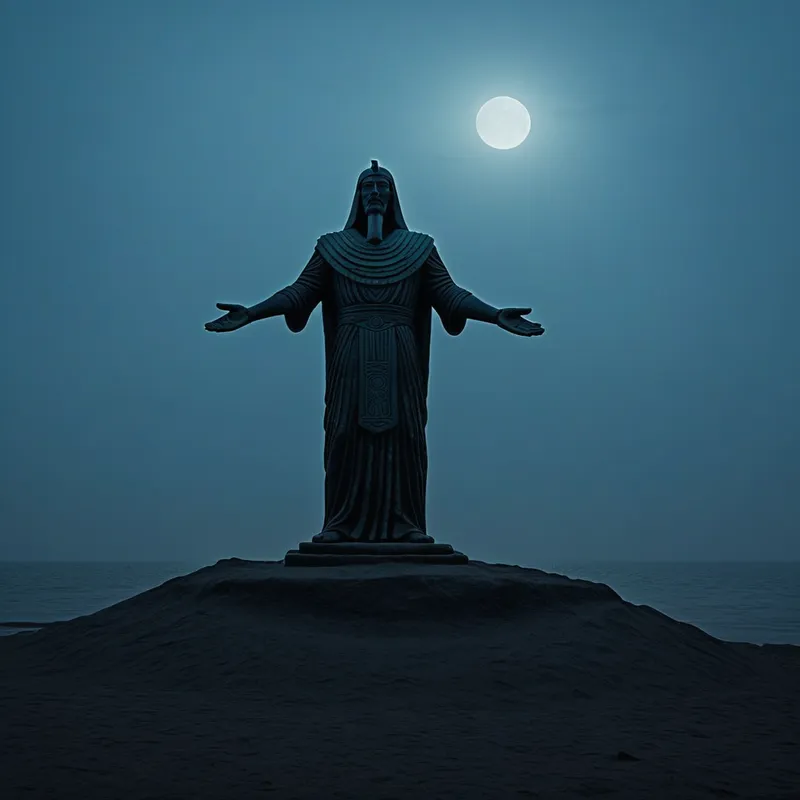
Cultural Origins & Context
This is not a single myth with one author, but the foundational substrate of Egyptian cosmology, repeated and elaborated in texts like the Pyramid Texts and the Coffin Texts. It was the sacred geography of the priests of Iunu (Heliopolis), where the original Benben stone was said to be housed. Its primary societal function was to explain and sanctify the Egyptian world. The annual inundation of the Nile was not a disaster, but a ritual return to this first moment—the waters of Nun covering the land, then receding to reveal the fertile, life-giving silt, the "new" primordial mound. Every temple's raised sanctuary was a symbolic Benben. Every pharaoh's ascension was a re-founding of order (Ma'at) upon the banks of chaos (Isfet). It was a myth told not for entertainment, but for survival—a magical, philosophical blueprint for maintaining reality itself.
Symbolic Architecture
The riverbank is the ultimate symbol of the liminal space, the razor's edge where being emerges from non-being. It is not the river, nor the deep ocean, but the fragile, fertile boundary between them.
The primordial mound is the first act of consciousness—the "I Am" that distinguishes itself from the undifferentiated waters of the unconscious.
Nun represents the unconscious in its totality: the fecund, creative, but also terrifying and annihilating potential that exists before the ego forms. The rising of the Benben is the birth of the conscious self, the ego, from this depths. Atum's act of creation from his own body is a profound symbol of self-begetting. The psyche does not require external salvation; it contains within itself the archetypal forces (Shu and Tefnut, order and moisture) needed to structure its world. The creation of humans from tears signifies that embodied, emotional life is born from a moment of divine pathos—separation, longing, and ultimately, joyful reunion.
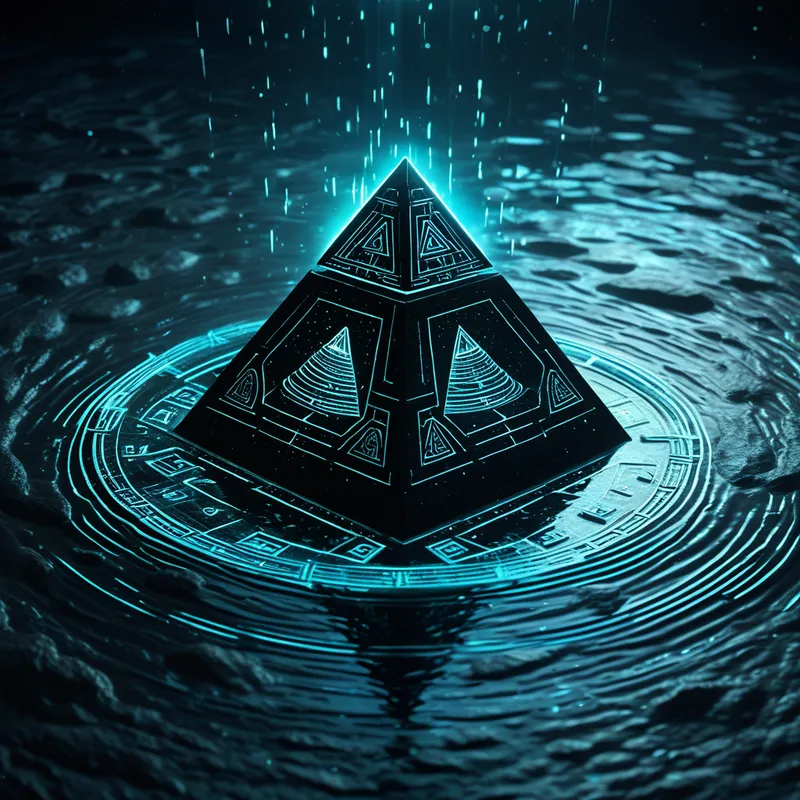
The Dreamer's Resonance
To dream of standing on a narrow bank, with dark waters lapping at your feet, is to stand at this primordial threshold in your own psyche. The somatic feeling is often one of acute vulnerability mixed with profound potential—the cool dampness of the air, the instability of the ground. This dream emerges during life transitions: the end of a relationship, the start of a new career, a period of depression or creative block. The unconscious (Nun) is rising, threatening to dissolve old structures of identity. The dream is not necessarily a warning, but a depiction of the process. Are you building up your mound, or are you being inundated? The dream asks you to identify what, in you, is the indestructible, rising silt—your core values, your will to form—and what is the chaotic water that must be both respected and held at bay.
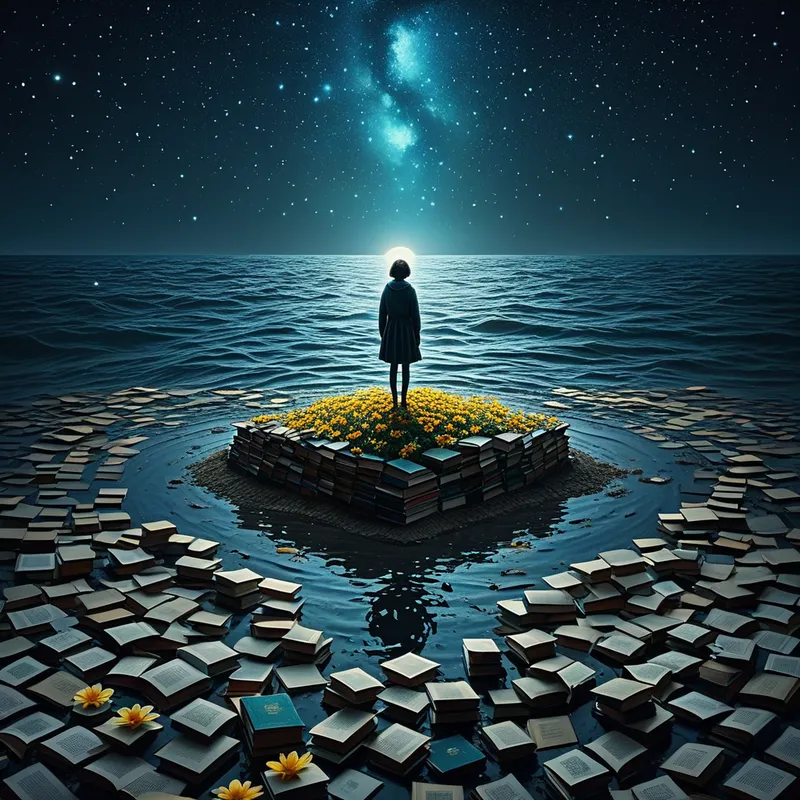
Alchemical Translation
The myth models the alchemical opus of individuation, which is never a one-time achievement but a daily ritual. The goal is not to defeat Nun, but to learn the sacred art of bank-building—to create a stable, fertile identity from the raw material of your experience, while maintaining a conscious relationship with the creative/destructive depths.
Individuation is the perpetual work of separating Shu from Tefnut—distinguishing the clear air of conscious insight from the moist fog of unconscious emotion—and then reuniting them to create a living, breathing psychic space.
First, one must descend into one's personal Nun—the unresolved past, the shadow, the repressed desires. This is the chaotic flood. From that immersion, the prima materia of the soul is gathered. The "mound" you build is your conscious attitude, your chosen life structure, your philosophy. Like Atum, you must generate your own creative pairs from within: thinking and feeling, sensation and intuition. The final stage, the creation of humanity from tears, is the ultimate alchemical translation: the redemption of your suffering. Your grief, your loneliness, your moments of despair are the very waters that, when touched by the divine spark of self-awareness, become the substance of your empathy, your humanity, and your connection to others. You are not just the builder of the bank. You are the bank, the river, and the first being standing in the dawn, all at once. Every day is a new inundation and a new emergence.
Associated Symbols
Explore related symbols from the CaleaDream lexicon: