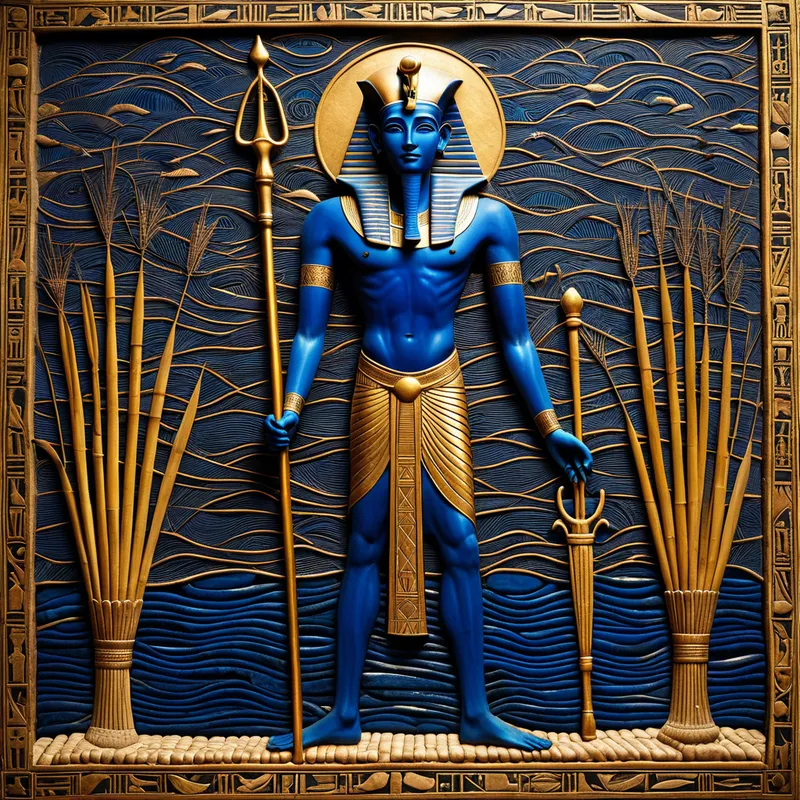
Nile Reed Boats & Mats Myth Meaning & Symbolism
A myth of primordial creation where the first god, emerging from chaos, weaves the world from reeds, embodying the birth of consciousness from the unconscious.
The Tale of Nile Reed Boats & Mats
In the time before time, there was only Nun. An endless, silent, dark ocean, without shore, without sun, without breath. It was the deep that contained all possibilities and none, a perfect, undifferentiated sleep. Then, a stirring. A disturbance in the infinite stillness. A will, a desire for something else.
From the heart of the dark waters, a mound emerged. Not of earth, for there was no earth, but of something pliant, resilient, and green. It was a clump of papyrus reeds, rising from the abyss. And upon this first, trembling island of matter, the One Who Came Into Being By Himself manifested. He was alone, a spark of consciousness adrift on a raft of reeds in a sea of unconsciousness.
The silence was a weight. The darkness was a pressure. The god looked upon the Nun and knew that to be alone with the All was a form of torment. He needed a stage, a ground, a separation from the swirling chaos. With a thought that was also an act, he reached down and grasped the very reeds that supported him. He began to weave.
His fingers, charged with the first creative impulse, took the sturdy stalks. He wove them not as a basket to hold things, but as a mat to define a space. Over and under, pull and tighten. Each crossing of reed over reed was a decision, a boundary drawn against the formless. The mat grew, a floating plane of order upon the chaotic waters. It was the first act of distinction, the first "here" as opposed to "there."
But a mat alone was a platform, not a purpose. The god saw that to navigate the vastness of Nun, to bring order to other parts of the limitless dark, he could not remain static. Again, he turned to the reeds. This time, he wove with intention for movement. He fashioned bundles, tying them with fibers drawn from his own divine essence, shaping the ends into curves that could part the waters. He built a boat—a slender, graceful vessel of bound papyrus.
This was no mere craft; it was the vessel of consciousness itself. The god placed the mat within the boat, his ground of being now mobile. He took up a pole, the first rudder, and pushed away from the primordial mound. As the reed boat slid into the black waters, it created the first ripple, the first wave, the first motion with direction. Where the boat traveled, the waters were calmed, defined, known. The journey of creation had begun, propelled by the sacrifice of the god's solitude and his relentless, weaving will to make a world from the raw materials of chaos.
Cultural Origins & Context
This foundational narrative is not a single, codified myth from a specific text like the Book of the Dead. Instead, it is a theological motif woven deeply into the fabric of Egyptian cosmology, emerging from their profound environmental reality. The Egyptians lived by the rhythm of the Nile and the life it sustained. The papyrus reed (Cyperus papyrus) was ubiquitous: it was the marsh where the protective goddess Taweret dwelt, the material for paper, sandals, baskets, and, crucially, the earliest boats.
The myth likely originated in the Predynastic and Early Dynastic periods, born from the practical observation of the natural world. Priests and temple scholars in centers like Hermopolis or Heliopolis would have elaborated upon this core image to explain the genesis of the cosmos. It was a myth passed down in temple liturgies and creation hymns, serving a vital societal function: it explained and sanctified the Egyptian world order (Maat). It demonstrated that their civilization, like the god's reed mat, was a sacred act of ordering the chaotic forces of nature (the Nun, represented by the annual Nile flood) into fertile, life-sustaining land.
Symbolic Architecture
At its heart, this myth is a masterclass in the psychology of emergence. The reed is the ultimate symbol of the liminal—it grows with its roots in the mud and water (the unconscious, chaotic Nun) and its stem reaching for the air and sun (consciousness, order). It is the living bridge between the two realms.
The first act of creation is not a loud command, but a quiet, persistent weaving. It is the ego constructing a stable platform of identity from the pliant yet resilient materials found at the edge of the unknown.
The primordial mound of reeds is the first point of focus, the initial "I am" that surfaces from the ocean of the unconscious. The weaving of the mat represents the establishment of the conscious mind—the complex, interwoven structure of perceptions, memories, and beliefs that gives us a sense of solid ground. The reed boat is the vehicle of the exploring psyche. It is the courage to leave the safety of the first, small island of selfhood and journey into the wider unconscious to map it, understand it, and ultimately, integrate its contents.
The god’s solitude and his subsequent creative act symbolize a fundamental truth: consciousness is born from a confrontation with the void. The creative impulse is the psyche's primary response to the terror and potential of undifferentiated existence.
The Dreamer's Resonance
When this myth pattern stirs in the modern dreamer, it often signals a profound process of psychic (re)construction. Dreaming of weaving reeds, or finding oneself on a fragile raft in dark waters, points to a somatic experience of building a new foundation of self. The dreamer may be emerging from a period of chaos, depression, or confusion (the Nun).
The somatic sensation is often one of careful, deliberate effort—the feeling of fingers working, of pulling strands together. It can also carry the anxiety of the vast, dark water all around the small, self-made platform. This is the psyche working to create internal order after a dissolution. Dreams of papyrus marshes, or of boats made of organic, perishable materials, suggest the dreamer is utilizing their most immediate, authentic, and perhaps vulnerable resources to navigate a transitional life phase. The dream asks: What are the reeds in your life? What raw, natural experiences can you weave into a new understanding? Are you brave enough to pole away from the familiar mound and journey?
Alchemical Translation
The alchemical process mirrored here is coagulatio—the making solid, the transition from the fluid, psychic state of the prima materia (the Nun) to a structured, embodied form. The individuation journey requires this exact movement: from the chaotic waters of the unconscious, we must raise our own mound of awareness and begin the patient, often tedious, work of weaving a coherent self.
The god does not conquer the chaos; he learns to sail upon it. He uses its very substance—the reeds growing from it—to craft his vessel. This is the alchemy of integration, not eradication.
For the modern individual, the "reed boat and mat" process manifests when we construct a personal philosophy after a crisis, when we build a new career from scattered skills and passions, or when we create art to make sense of inner turmoil. The myth teaches that our foundation and our vehicle must be crafted from what is at hand, from the experiences that have grown in the fertile mud of our own lives. The triumph is not in reaching a distant shore, for the Nun is endless. The triumph is in the ongoing act of weaving, navigating, and maintaining the vessel of consciousness, thereby transforming the chaotic waters of potential into the meaningful river of a lived journey. We are, each of us, the weaver-god, perpetually crafting our world from the reeds we find rising from the deep.
Associated Symbols
Explore related symbols from the CaleaDream lexicon: