Nile inundation Myth Meaning & Symbolism
The myth of the Nile's life-giving flood, born from the tears of the goddess Isis, symbolizing the necessary cycle of chaos, grief, and fertile renewal.
The Tale of the Inundation
In the time before time, when the sky was the belly of Nut and the earth was the back of Geb, the world was a place of thirst. The Black Land, Kemet, lay parched and waiting, its soil cracked like an old pot. The people watched the river, the great Hapy, shrink within its banks, its waters growing sluggish and warm. A silence fell, a silence thick with the scent of dust and the fear of famine. This was the time of the Low Water, when the sun god Ra seemed to blaze with a cruel, unyielding eye.
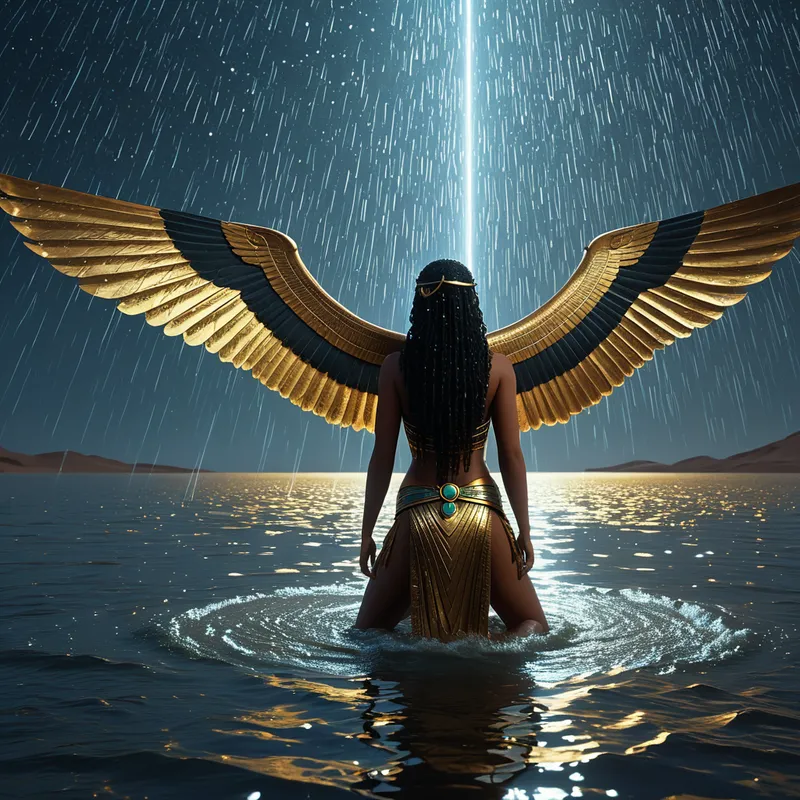
But in the silent palace of the gods, a deeper sorrow flowed. The goddess Isis, the Great of Magic, sat by the reeds. Her husband, the good king Osiris, lay slain and dismembered, his body scattered by the envy of Set. For her lost lord, for the fractured order of the world, Isis wept. She wept not with soft sobs, but with a grief as vast as the desert. She traversed the length of the land, searching for the pieces of her beloved, and where she knelt in her sorrow, her tears fell upon the barren earth.
These were no ordinary tears. They were the tears of a goddess whose love held the power of creation and whose magic could reassemble the broken. They fell, hot and heavy, from her kohl-rimmed eyes. They fell into the dust, and the dust drank them greedily. They fell into the shriveled riverbeds, tracing silver paths in the moonlight. They fell, and they gathered. A miraculous alchemy began where sorrow met the deep, hidden caverns of the underworld, where Hapy resided in his cavern near Elephantine.
The tears of Isis became a plea, a sacred summons that stirred the sleeping Hapy. Moved by her boundless devotion and profound loss, the fertile god stirred in his subterranean home. The earth itself began to tremble with a deep, resonant hum. Then, from the far south, from the mysterious land of Kush, a new sound arose—a distant roar, like a thousand cattle stampeding. The waters of Hapy, swollen with the divine tears of Isis and the life-force of Osiris’s resurrection, broke their bonds.
A wall of water, not violent but inexorable, thick and red with the fertile silt of the southern lands, poured forth. It was the Inundation, the Akhet. It did not destroy; it embraced. The waters crept over the banks, a gentle, deliberate conquest of the dry land. They filled the irrigation basins, they soaked the cracked soil, turning the red dust of <abbr title="The desert, the "Red Land"">Deshret into the rich, black promise of Kemet. The air changed, cooling, filling with the scent of wet earth, of renewal, of life returning from the land of the dead. The people did not flee; they rejoiced. They cast flowers and offerings into the rising tide, for they knew: the tears of the goddess had become the blood of the land. Osiris was risen in the grain, and the world was made whole again through the waters of sacred grief.
Cultural Origins & Context
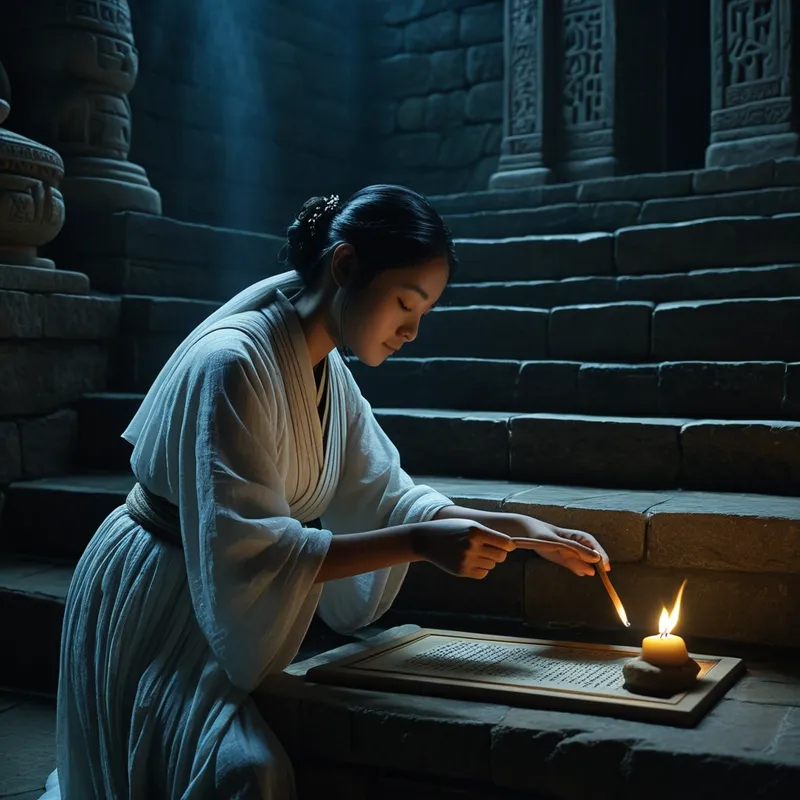
This was not a single story told around a fire, but the very rhythm of civilization itself, inscribed in the land and the calendar. The myth of the inundation was lived annually. It was recorded in the <abbr title="The "Book of the Dead," a collection of spells to guide the deceased">Pyramid Texts and the Coffin Texts, and sung in the great Hymn to Hapy. It was the central axis of Egyptian time, dividing the year into three seasons: Akhet (flood), Peret (growth), and Shemu (harvest).
The myth was performed by the Pharaoh, the living Horus-king, who acted as the intermediary between the gods and the people. At the start of Akhet, ceremonies were held to honor Hapy and Isis. The function was profoundly societal and cosmological: to explain the inexplicable, life-giving flood, to frame it not as random chaos but as a divine, ordered event rooted in a sacred drama of death and resurrection. It justified the Pharaoh's role as the guarantor of Maat, and it gave the people a narrative framework for their dependence on, and gratitude for, the river’s cycle. The story transformed anxiety into ritual, and the flood’s arrival was proof that Maat was upheld, that the gods were pleased, and that life would continue.
Symbolic Architecture
At its core, the inundation myth is a master symbol of the cycle that underpins all existence: dissolution, followed by fertile regeneration. It presents a cosmology where grief is not an end, but a vital, creative force.
The flood does not come from joy, but from profound, transformative sorrow. The most fertile ground is first softened by tears.
The parched land represents a state of psychic aridity, stagnation, or conscious ego-structure that has become too rigid and separated from the unconscious. Set's act of dismembering Osiris is the necessary chaos that shatters a outworn state of being. Isis’s tears are the emotion—the deep, feeling function—that must be fully experienced and poured out to activate the transformative process. They symbolize the conscious engagement with loss, pain, and shadow material.
Hapy, rising from his cavern, represents the unconscious itself, the deep, primal source of life and psychic energy that is summoned forth by genuine emotional engagement. The red, silt-laden water is the prima materia of the soul—the messy, chaotic, yet infinitely fertile contents of the unconscious now flooding into the conscious realm. The transformation of red desert (Deshret) into black soil (Kemet) is the alchemical nigredo turning into the fertile stage of new growth, the creation of a psychic substrate where new life can take root.

The Dreamer's Resonance
When this mythic pattern stirs in the modern dreamer, it often manifests as dreams of flooding. But these are not nightmares of tsunamis. They are dreams of water rising within a familiar, contained space: the living room slowly filling, the basement seeping, the garden becoming a gentle pond. The water is often dark, calm, and strangely peaceful, even as it submerges furniture and familiar landmarks.
Somatically, this can correlate with a feeling of being emotionally "flooded" or overwhelmed by a deep, perhaps previously buried, feeling—a grief, a longing, or a creative urge that can no longer be contained. Psychologically, it signals that the conscious ego-structure is being gently, inevitably inundated by contents from the unconscious. The dreamer is in the Akhet season of their psyche. The old, dry ways of being (the furniture of the ego) are being submerged not to be destroyed, but to be softened, re-arranged, and made fertile. The dream is an image of the psyche’s innate wisdom initiating a necessary dissolution to prevent spiritual drought. The key is the quality of the water: life-giving, not destructive.

Alchemical Translation
For the individual on the path of individuation, the inundation myth models the critical, non-linear phase of psychic transmutation. The conscious persona—the cultivated, dry land of our social self—must periodically be broken open and flooded by the unconscious for renewal to occur.
The first step is the "dismemberment" of Osiris: some life event, failure, loss, or inner realization that shatters our previous sense of identity and order. This is the Set-force of necessary chaos. The crucial alchemical work is embodied by Isis: the active, devoted gathering of the pieces. This is the conscious work of introspection, therapy, or artistic expression—collecting and acknowledging the scattered parts of ourselves. But the catalyst is her tears: the full, felt experience of the emotion attached to the brokenness. We must "weep the flood." Intellectual understanding is not enough; the heart must open the gates.
The alchemical vessel is the self that can hold the flood of sorrow without breaking, knowing it carries the silt of new life.
Then, the Hapy-force rises. The unconscious, activated by our genuine feeling, delivers its contents—memories, insights, creative impulses, archaic images. This is the inundation of the conscious mind. It feels chaotic, messy (the red silt), and overwhelming. Our carefully ordered inner landscape is submerged. The alchemical task here is the Egyptian response: trust and ritual observance. We must learn to float in the flood, to not panic, to observe the process as sacred. We allow the old structures to be softened. As the waters recede, they leave behind the rich, black soil of Kemet—a renewed psychic ground, fertilized with integrated shadow material and deeper self-knowledge. From this soil, the new grain of consciousness, the "re-membered" Osiris, can grow. The cycle teaches that wholeness is not a static state of perfection, but a rhythmic, eternal process of death by water and rebirth from the mud.
Associated Symbols
Explore related symbols from the CaleaDream lexicon: