
Nile Delta Myth Meaning & Symbolism
The story of how the primordial waters of chaos were tamed, sacrificed, and transformed into the fertile, life-giving triangle of the Delta.
The Tale of Nile Delta
Before the first sunrise, there was only Nun. A dark, endless ocean of potential, silent and cold, where time was not yet born. From this watery abyss, a mound of earth stirred—the first land, the Benben. Upon it, the sun god Khepri rolled his fiery ball into the sky, and light pierced the deep.
But the light revealed a stark world. The great river, the life-vein of Kemet, flowed in a single, powerful channel from the distant southern mountains, a blue serpent rushing with purpose. Yet where it met the embrace of the Great Green—the sea of Wadj-wer—it ended. It poured itself wholly into the salt, lost, its life-giving silt swallowed by the indifferent deep. The land was narrow, a ribbon of green clutched in the fist of the red desert. The people prayed for more.
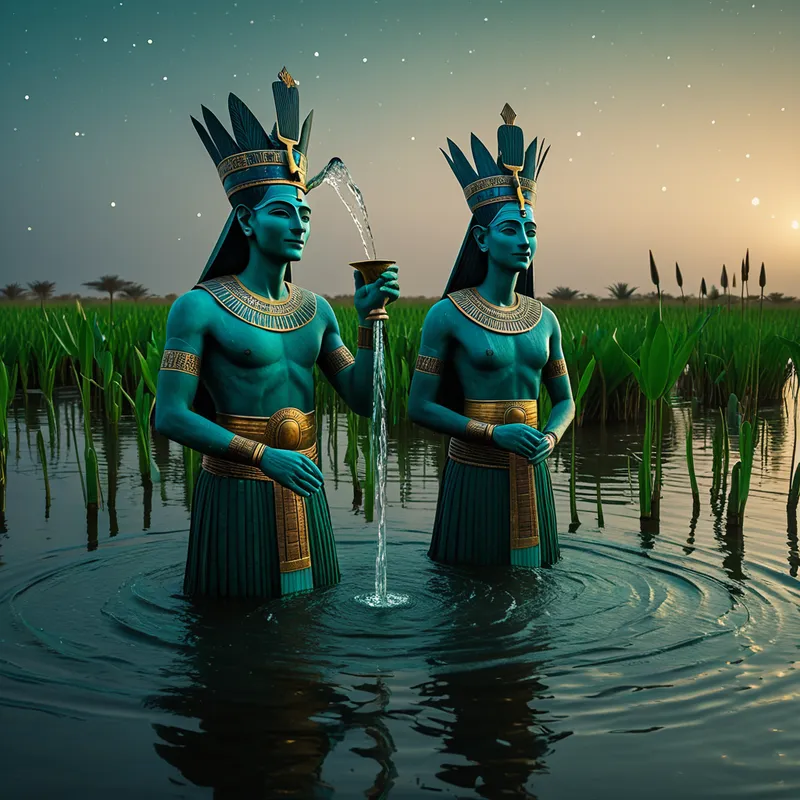
Then came Hapi, lord of the inundation. He was not a king of cities but a spirit of the river itself, with the rounded body of nourishment, skin the blue-green of deep water, and upon his head a crown of papyrus and lotus. He heard the whispers of the reeds, the thirst of the soil. He journeyed to the place where the river’s heart beat against the sea.
Standing at that final brink, Hapi did not command. He sacrificed. He took the single, powerful current of the river—its unified, singular will—and with a groan that shook the heavens, he split it. He tore his own essence asunder. The one became two, the two became four, the four became seven, and the seven became countless. The mighty serpent of water dissolved into a thousand smaller streams, each a silver thread in a grand, spreading tapestry.
The waters slowed. They hesitated, meandered, lost their urgent direction. In this slowing, in this deliberate confusion, a miracle occurred. The rich, black silt—the Kemet itself—no longer raced to the abyss. It settled. It dropped from the weary waters and began to build, grain by dark grain. A shape emerged from the sea: a triangle, wide and stable, a fan of pure potential. Marsh grasses whispered into being. Papyrus thickets rose like walls. Birds filled the sky with cries of discovery.
Where there was once a terminal, chaotic meeting, there was now a hand, open and giving, catching the gift of the river and offering it to the land. The Delta was born—not through conquest, but through a sacred, generative fragmentation. Hapi, now present in every channel and canal, smiled. He had not fought the chaos of Nun; he had invited it inland and made it fertile.
Cultural Origins & Context
The story of the Delta is not a single, codified myth from a papyrus scroll, but a living narrative woven into the very geography and ritual life of ancient Egypt. It was told in the contrast between the narrow, defined valley of Upper Egypt and the vast, marshy, unpredictable Delta of Lower Egypt. This duality was fundamental: the Pharaoh was "Lord of the Two Lands," and the sema-tawy symbol showed the papyrus and the lotus bound together.
The myth was enacted annually in the inundation. As the Nile rose, it was Hapi’s return, his re-enactment of that primordial sacrifice. Priests and farmers alike watched for the flood not with fear of destruction, but with awe at re-creation. The Delta, with its maze of waterways, was seen as a place of both abundance and mystery, a buffer between the ordered world of Kemet and the foreign chaos beyond. Its telling was practical theology, explaining why the land was shaped as it was—a divine compromise between river and sea, order and potential, that resulted in unparalleled fertility.
Symbolic Architecture
The Delta is the archetypal symbol of fertile dissolution. It represents the critical psychological process where a singular, concentrated force (the unified river of the ego, a focused identity, a singular goal) must be willingly dispersed to create something broader, richer, and more sustainable.
The greatest strength is not in holding the course, but in having the courage to lose it, to scatter one’s essence so that life may take root in the settling.
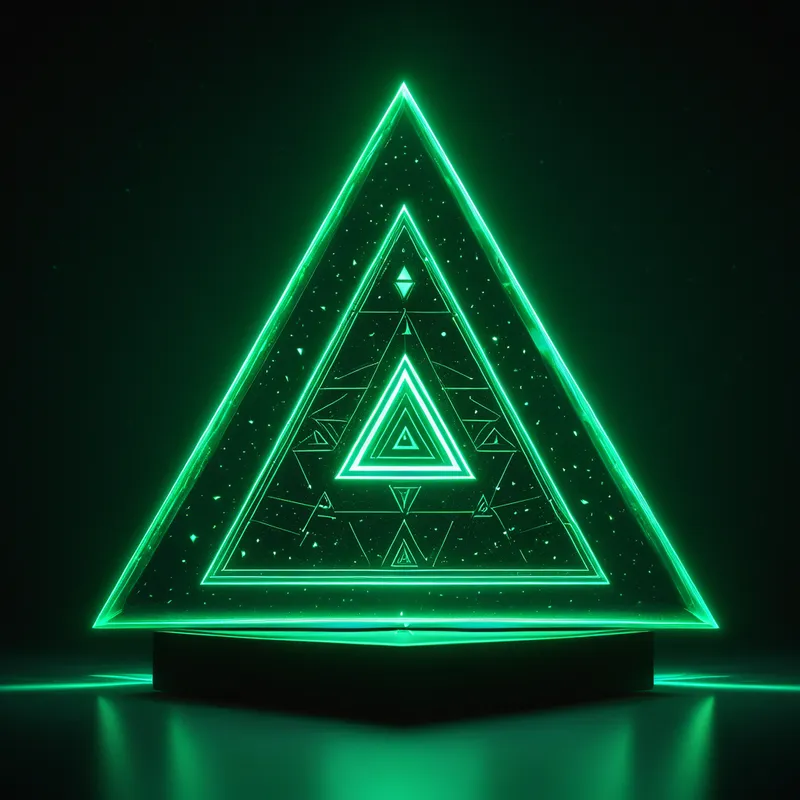
The single river is the heroic, linear journey—direct, powerful, but ultimately self-consuming as it pours into the oceanic unconscious (Nun/Wadj-wer) without leaving a lasting structure. Hapi’s act of splitting the river is the sacrifice of this heroic singularity. The resulting Delta is the networked psyche: a complex system of channels (thoughts, feelings, potentials) that allows for sedimentation. The "silt" that settles is embodied experience, integrated memory, and lasting character—the fertile soil from which the true self grows. The triangle, a stable geometric form, symbolizes the resulting psychic structure: broader at the base (the rich complexity of the unconscious and the world) and aiming toward an apex (the integrating consciousness).
The Dreamer's Resonance
To dream of a delta is to dream at the threshold of a major psychic transformation. Somaticly, one might feel a release of tension, a slowing of the heart, or a sense of spreading warmth—the dream-body experiencing the "slowing of the waters." Psychologically, this dream pattern emerges when a long-held, singular focus (a career path, a relationship identity, a core belief) is reaching its natural end, its "sea."
The dreamer may stand at the vertex, watching their life-force—imagined as a river—branch into confusing, multiple possibilities. This can feel like loss of purpose, ambiguity, or terrifying freedom. The marshiness of the delta in dreams speaks to a period of "fertile confusion," where old certainties dissolve and new potentials have not yet solidified. It is the psyche’s innate Hapi, performing the necessary act of self-dispersion to prevent a sterile, catastrophic culmination and to prepare for a new, more expansive phase of growth.

Alchemical Translation
In the alchemy of individuation, the Nile Delta myth models the solutio and coagulatio processes—dissolution and coagulation. The conscious personality (the unified river) must undergo a willing solutio: a dissolution of its rigid boundaries and compulsive direction. This is not a failure, but the sacred sacrifice Hapi performs.
Individuation is not the journey of the river to the sea, but the river’s transformation into the land itself.
The modern individual faces this at life’s major transitions. The driven careerist must learn to "delta"—to disperse energy into family, art, or service, finding richness in multiplicity. The individual with a fixed self-narrative must allow it to branch and meander, collecting the silt of shadow and anima/animus to build a broader, more resilient self. The coagulation occurs in the settling, in the patient integration of these dispersed experiences into a stable, triangular structure of being—wide, grounded, and oriented toward the light. The Delta teaches that our endpoint is not to be swallowed by the infinite, but to become the fertile ground where the infinite can manifest in finite, nourishing forms.
Associated Symbols
Explore related symbols from the CaleaDream lexicon: