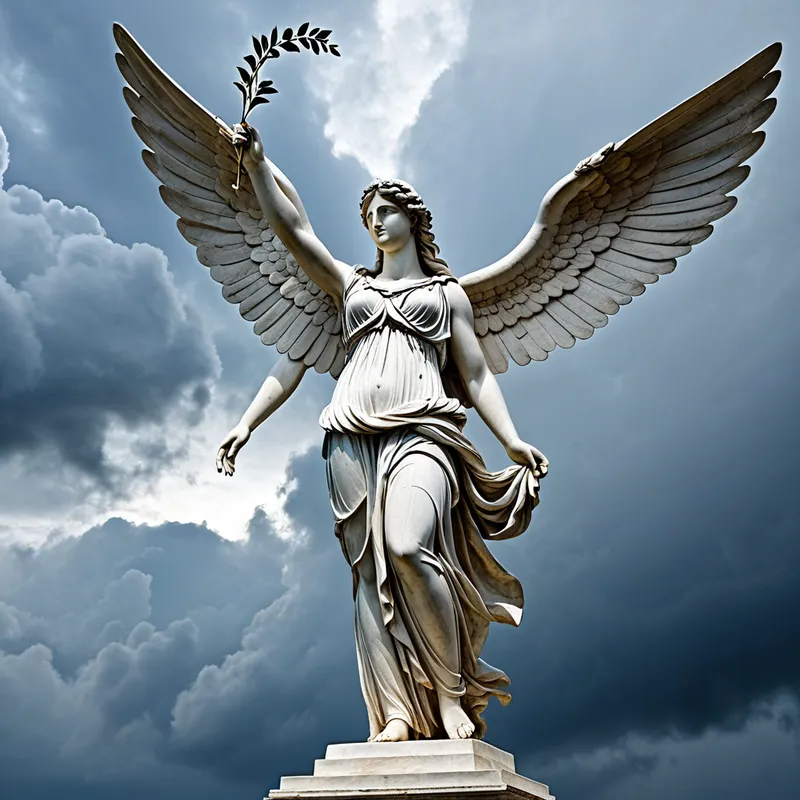
Nike Myth Meaning & Symbolism
The story of Nike, the winged goddess of victory, embodies the sacred moment of decisive triumph born from cosmic struggle and divine alliance.
The Tale of Nike
Hear now of the moment that splits eternity—the crack of thunder that is not sound, but fate being decided.
Before the world knew order, it knew chaos. The heavens groaned under the weight of the Titans, beings of mountain and tempest, who ruled with a grasp of stone. Their reign was the reign of inertia, of a cosmos held in a crushing, eternal stasis. And against this immovable weight rose a new force: the Olympians. Led by the thunder-wielder Zeus, they were not just rebellion, but the very principle of change, of dynamic will.
The war that shook the foundations of the world was not fought on any field you could walk. It was fought in the space between realms, in the churning Tartarus and the shuddering peaks of Olympus. For ten years, the cosmos was a cacophony of colliding powers—lightning against earthquake, divine fire against primordial night. The air itself was thick with the sweat of gods and the dust of shattered mountains.
And in this maelstrom, she was present. Not as a warrior with a sword, but as a presence, a breath held at the peak of exhalation. She was Nike, daughter of the Titan Pallas and the river Styx. When Zeus called all who would stand with him to the banks of that dark, sacred river, her mother was the first. She brought her children—Nike (Victory), Kratos (Strength), Bia (Force), and Zelos (Zeal). They pledged themselves to the new order.
So Nike stood not on the sidelines, but in the very current of destiny. She was the potential for triumph given form. In the final, cataclysmic clash, when Zeus raised his master-bolt, forged in the heart of the Cyclopes, the universe paused. In that pause, Nike’s wings—vast, feathered things that caught the light of nascent stars—beat once. It was not a sound, but a signal. A leaning. Her entire being became an arrow pointed toward resolution. She flew alongside the thunderbolt, not guiding it, but announcing it. Her movement was the universe tipping its hand.
When the bolt struck, and the reign of the Titans was shattered into imprisonment, it was Nike who descended. As the new gods stood panting amidst the settling cosmic dust, she alighted before Zeus. In her hands was not a weapon, but a wreath—a circle of laurel leaves, vibrant and eternal. She placed it upon his brow. The gesture was not reward, but recognition. The moment of decisive victory was complete. The struggle had crystallized into an outcome. And with that, the winged one took her place at the side of the sovereign, for where there is rightful power and decisive action, there she must be, the very embodiment of the triumph that follows.
Cultural Origins & Context
The figure of Nike emerges from the deep, formative strata of Greek mythopoetic thought, crystallizing around the 8th century BCE with the codifying works of Hesiod. Her story is inextricably linked to the Theogony, the foundational narrative of how the cosmos and its divine hierarchy came to be. This was not mere entertainment; it was a sacred map of reality. The myth of the Titanomachy explained the transition from chaotic, archaic forces to an ordered, sovereign cosmos. Nike’s role in this war positioned her as a fundamental principle of this new order—victory was not an accident, but a divine and necessary component of cosmic justice (dike).
She was worshipped not as a capricious granter of wishes, but as a serious and powerful daimon, a personified force. Her cult was often intertwined with that of Athena, the goddess of strategic intelligence, and Zeus, the embodiment of sovereignty. This association is telling: for the Greeks, victory was not merely about brute force (that was the domain of Ares). True, lasting victory—nike—required the alignment of might (kratos), strategic wisdom (metis), and righteous authority. She was depicted on countless votive offerings, coins, and most famously in sculpture, like the lost Nike of Samothrace, forever captured in the dynamic moment of descent. Her image served as a perpetual reminder that triumph is a divine visitation, earned through struggle and aligned with a greater order.
Symbolic Architecture
Nike is not the trophy at the end of the race; she is the decisive breaking of the tape. She symbolizes the critical, transformative moment where potential becomes actuality, where struggle crystallizes into an outcome. Her wings are her most potent symbol—they represent the swift, fleeting, and elevated nature of true victory. It descends from a higher plane (of effort, destiny, or divine favor) and can just as quickly take flight if not honored or consolidated.
Victory is not a permanent state, but a sacred event—a momentary alignment of will, action, and cosmos.
Her lineage is profoundly symbolic. Daughter of Pallas (Battle) and the Styx (the dread river of oath and hate), she is born from the raw materials of conflict and unbreakable commitment. Her siblings—Kratos, Bia, Zelos—are the necessary attendants of her manifestation. This reveals a deep psychological truth: triumph cannot manifest alone. It requires strength to endure, force to act, zeal to pursue, and finally, victory to crown the endeavor. She is the culminating point of a psychic constellation. Furthermore, her act of crowning Zeus signifies that ultimate victory serves and legitimizes a reigning consciousness or principle. It is not anarchic success, but success that establishes or affirms a rightful order.
The Dreamer's Resonance
When the archetype of Nike stirs in the modern unconscious, it often manifests in dreams of pivotal motion or imminent resolution. The dreamer may find themselves in a moment of suspension—poised on a ledge, at the starting blocks of a race, or with a crucial document in hand, awaiting a signature. There is a palpable somatic tension, a feeling of energy coiled and ready to spring.
Common motifs include sudden, powerful wings sprouting from the dreamer’s back, not for perpetual flight, but for one decisive, propulsive leap. There may be dreams of catching something in mid-air—a falling scroll, a key, a laurel leaf—in the nick of time. The landscape is often transitional: a narrow bridge over a chasm, a doorway between a dark room and a sunlit field, the crest of a hill. These are all liminal spaces where one state is about to become another.
Psychologically, these dreams signal that a long internal struggle—perhaps with a habit, a fear, a creative block, or a difficult decision—has reached its tipping point. The unconscious is presenting the image of the decisive moment itself. The somatic feeling is one of gathered potential, the body-mind preparing for a release of energy that will transform the situation. It is the dream of the arrow nocked and drawn, where the dreamer is both the archer and the arrow, sensing that the release is not only possible but imminent.

Alchemical Translation
In the alchemical vessel of the psyche, the myth of Nike models the crucial stage of coagulatio—the precipitation of spirit into matter, of intention into realized form. Our inner Titanomachy is the protracted struggle between archaic, inertial patterns (the inner Titans: old wounds, compulsive behaviors, outmoded self-concepts) and the emerging, more conscious ordering principle (the Olympian ego, or later, the Self). This war can feel endless, a cyclical battle with our own shadows.
Nike’s archetype enters when we move from battling to deciding. It is the moment we stop arguing with the inner critic and instead, with a surge of unified will, take the concrete action we’ve been avoiding. It is the signing of the resignation letter, the sending of the vulnerable manuscript, the uttering of the difficult truth. This is not the entire work of individuation, but its critical turning point.
The alchemy of victory lies in the sacred marriage of commitment (Styx) and directed strength (Pallas), which gives birth to the winged moment of decisive act.
The crowning of Zeus is the internal consequence: that decisive act consolidates a new, more authentic authority within the psyche. The old, chaotic reign is deposed; a new order, born of struggle and crowned by a moment of courageous clarity, takes its place. To integrate Nike is to honor these fleeting, powerful moments of conclusive choice in our lives. It is to recognize that victory is not a final destination, but the sacred punctuation mark in the ongoing sentence of becoming. We must build our temples—our stable lives and identities—not just to house her, but to invite her descent, again and again, whenever our inner cosmos requires a definitive turn toward greater wholeness.
Associated Symbols
Explore related symbols from the CaleaDream lexicon: