Niji Myth Meaning & Symbolism
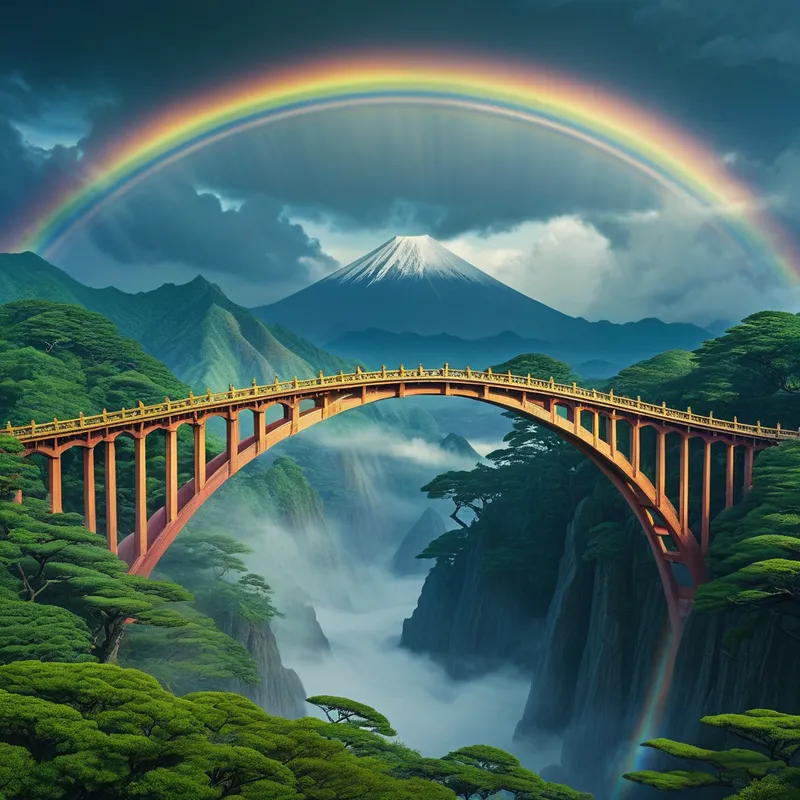
A celestial bridge woven by the gods, connecting heaven and earth, born from a promise of order and a moment of divine, heart-stopping beauty.
The Tale of Niji
In the time before time, when the world was a formless, churning brine, the Izanagi and Izanami stood upon the Ame-no-ukihashi. The air was thick with potential, a silent hum between the pale sea below and the star-dusted Takamagahara above. With a spear jeweled with celestial ore, they stirred the waters. The brine coiled and clung, and from its dripping tip, the first island—Onogoro—coagulated into being.
They descended. Their footsteps were the first to press into the newborn earth, which sighed with the weight of divinity. Here, they performed the ritual of union, circling the heavenly pillar. But in their youthful haste, Izanami, the female principle, spoke first. Their firstborn was Hiruko, a wretched thing they set adrift in a reed boat. The world felt the sting of this failure; creation itself seemed to hesitate.
Seeking counsel from the older gods, they learned the error: the male must initiate. They returned to the pillar. This time, Izanagi’s voice, deep as tectonic shift, rang out first. “Ah, what a fair and lovely maiden.” Then Izanami replied. From this correct order, the Oyashima were born, and then the myriad deities of rock, wind, leaf, and stream. The world blossomed under their sacred union.
But in bearing the fire god Kagutsuchi, Izanami was burned terribly. She descended to the land of Yomi, a place of eternal defilement. Grief-stricken, Izanagi pursued her. In the profound dark, he heard her voice, but she forbade him to look. Desperate, he lit a tooth of his comb. The flickering flame revealed not his beloved, but a form swollen and crawling with maggots, attended by the Yakusa no Ikazuchi.
Horrified, Izanagi fled. Humiliated and enraged, Izanami, now a goddess of death, gave chase. He blocked the pass to Yomi with a mighty boulder, severing the lands of the living and the dead forever. From the other side, she screamed her promise of vengeance: she would strangle a thousand of his living each day. He roared back his promise of creation: he would see fifteen hundred born.
Purifying himself in the river Tachibana, as he washed his left eye, the sun goddess Amaterasu was born. From his right eye, the moon god Tsukuyomi. From his nose, the impetuous storm god Susanoo.
And from the final, cleansing droplets that flew from his face into the sky, born not of strife or grief, but of a heart finally washed clean of horror and filled with a bittersweet resolve, a new wonder appeared. It was a bridge. Not of stone or wood, but of light itself, refracted through the tears of the world. It arched with impossible grace, a covenant of seven colors spanning the chasm between the sorrow of the earth and the purity of the heavens. This was Niji, the tangible echo of a promise, the visible sigh of a god who had seen the worst of creation and still chose to make something beautiful.

Cultural Origins & Context
The myth of Niji is not a standalone tale but the luminous culmination of narratives from Japan’s oldest chronicles, the Kojiki (712 CE) and the Nihon Shoki (720 CE). These texts, commissioned by the imperial court, sought to weave the origins of the islands, the gods (kami), and the imperial line into a sacred national history. The rainbow appears at the critical juncture following Izanagi’s return from Yomi and his purification.
Niji’s primary function was cosmological and political. As a bridge (hashi), it physically manifested the connection between Takamagahara and Ashihara no Nakatsukuni, legitimizing the descent of the heavenly lineage to rule the earth. It was a symbol of divine order restored after the chaos of death and separation. In Shinto, nature is the primary scripture, and Niji is one of its most awe-inspiring verses—a spontaneous, ephemeral kami-manifestation. It was observed, celebrated, and understood as a direct communication from the celestial realm, a sign of favor, a momentary thinning of the veil.
Symbolic Architecture
Niji is not merely a meteorological phenomenon mythologized; it is a profound symbol of synthesis born from profound rupture. Its architecture is built on paradox: it is both path and barrier, connection and boundary. It appears only when two opposing conditions are met—sunlight piercing through departing rain. It is the child of conflict between light and water, clarity and emotion.
The rainbow is the psyche’s answer to the unbridgeable gap; it does not deny the chasm, but paints a path of soul across it.
It represents the promise—not a sentimental hope, but a cosmic, binding declaration made in the face of annihilation. Izanagi’s promise to create life, even as death threatens it, is crystallized into this spectral arc. Psychologically, Niji symbolizes the transcendent function, the third thing that emerges from the tension of irreconcilable opposites (life/death, heaven/earth, male/female, order/chaos). Each of its seven colors can be seen as a stage of alchemical transformation, from the earthy red of the base material to the spiritual violet of the apex, charting a non-linear path to wholeness.
Furthermore, as a bridge, it is a liminal entity. It belongs neither fully to the sky nor the earth, existing in a fleeting, in-between state. It is the archetypal symbol of transition, threshold, and mediation. It does not promise a permanent union—one cannot live on the rainbow—but a momentary, glorious vision of what connection can be.
The Dreamer's Resonance
When Niji arches across the dreamscape, it signals a profound moment of potential synthesis within the dreamer’s psyche. It often appears after a period of inner turmoil, a “storm” of emotional conflict, confusion, or grief. The dreamer may feel stuck between two impossible choices, identities, or life stages.
To dream of standing beneath a magnificent Niji can evoke somatic feelings of awe, chest-opening expansion, and a lifting of weight. It is the unconscious affirming that a path forward exists, even if it is not yet walkable. The dream is presenting the vision of connection.
Conversely, to dream of a fading, distant, or inaccessible rainbow speaks to a sense of missed opportunity, a promise felt but not yet realized. The dreamer may be intellectually aware of a solution or a potential for healing but cannot yet feel the connection emotionally or somatically. The rainbow’s elusive end—the mythical pot of gold—mirrors the soul’s longing for a resolution that remains just out of reach, compelling continued inner work.

Alchemical Translation
The myth of Niji provides a powerful model for the modern individuation process. Our personal “Yomi” experiences—trauma, loss, betrayal, profound failure—seem to sever us from our own inner vitality and promise. We feel exiled, like Izanagi, stained by an experience we cannot unsee. The instinctual response is often to block the passage, to wall off the painful memory or complex.
The alchemical work begins with the purification. Izanagi does not ignore his defilement; he actively cleanses it. This is the difficult, often repetitive work of therapy, shadow-work, and honest self-confrontation. It is the washing away of the projections, the grief, and the horror to see what remains of the essential self.
From this purification, new psychic entities are born: the luminous consciousness (Amaterasu), the reflective unconscious (Tsukuyomi), and the chaotic, creative/destructive energy (Susanoo). These are not good or bad; they are the necessary faculties of a whole psyche.
The final and most crucial act is not in the birth of these great powers, but in what happens with the leftover, distilled essence of the entire ordeal.
Niji is that essence. It is the transcendent symbol that emerges after the hard work. It is the creative act born from grief, the new relationship pattern understood after old pain, the spiritual insight forged in doubt. It does not erase the chasm between who we were and who we are becoming; it acknowledges it utterly, and then, with the materials of our own transformed perception, builds a breathtaking, temporary bridge across it. We cannot live on the bridge. But having seen it, we can never see the landscape of our lives the same way again. We know the colors of connection are always there, latent in the interplay of our storms and our light, waiting for the moment of right alignment to blaze forth, a promise made visible.
Associated Symbols
Explore related symbols from the CaleaDream lexicon: