
Niheu and Kana Myth Meaning & Symbolism
A myth of two brothers, one a trickster and one a giant, who must rescue their mother from a vengeful father, embodying the struggle for wholeness.
The Tale of Niheu and Kana
Listen, and hear the story that the wind tells in the kapu groves, the tale the surf whispers on the black sand. It begins not with light, but with a shadow cast by a father’s rage.
Kūmokuhāliʻi, the great lizard god, took Hina as his wife. But his nature was one of possession and fury. When Hina dared to eat a sacred wauke bud, a food forbidden to her, his wrath erupted like Pele’s fire. He seized her, and with a power that shook the foundations of the sea, he spirited her away to the distant, mist-shrouded island of Kāʻula, imprisoning her there in a cave of sorrow.
Her sons, born of her spirit and strength, felt the severing in their bones. Niheu, the younger, was clever and quick, a master of the ma'a. Kana, the elder, was a being of another order—a giant whose legs could span channels and whose height could brush the clouds. Their mother’s absence was a hollow wind in their home.
Niheu’s mind, sharp as a pāhoa, conceived the quest. “We will bring her back,” he declared, his voice steady against the fear of confronting the god who was their sire. They gathered their warriors, their canoes cutting the waves toward the looming shape of Kāʻula. But the channel raged, a moat guarded by Kanaloa’s fury. No canoe could pass.
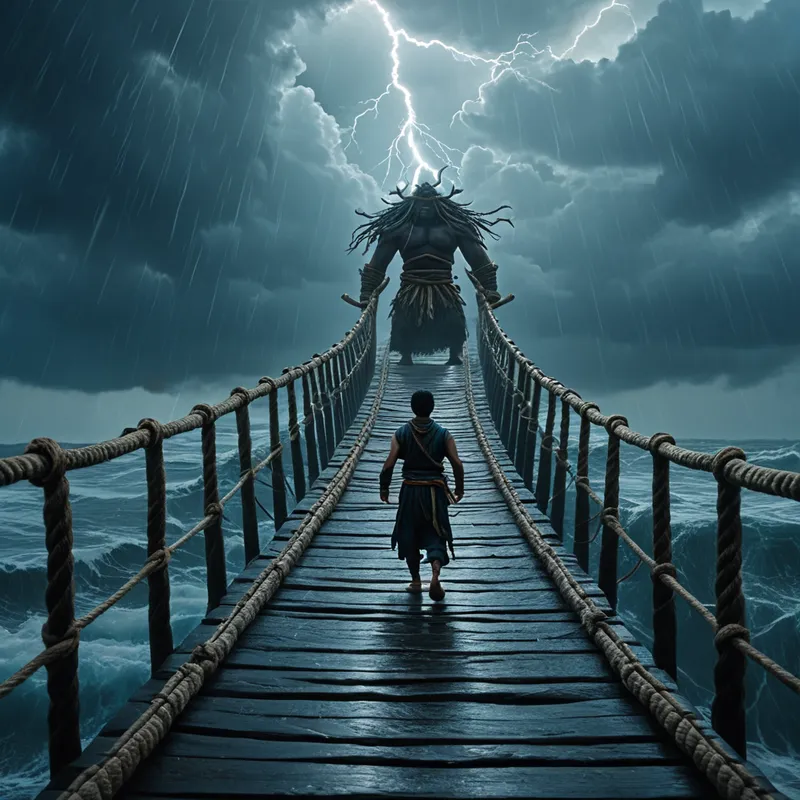
Then Kana spoke, his voice the rumble of distant earth. “I will be the bridge.” And he performed a wonder. He lay down upon the shore, and with a concentration of will that fused spirit with form, he stretched. His legs elongated, becoming a vast, living causeway of flesh and sinew across the tumultuous sea. Upon this bridge of his own body, Niheu and the warriors marched, their footsteps a prayer of gratitude on his back.
They reached Kāʻula and found Hina, not in chains of stone, but in chains of despair. The rescue was swift, but the escape was the true trial. As they fled, Kūmokuhāliʻi awoke. His rage took form—a colossal wave, a wall of water meant to crush them all. Kana, now their rear guard, turned. He did not fight the wave with force, but with sacred power, mana. He chanted, he called upon his lineage, and he transformed his own body into a great ipu, a vessel. He swallowed the terrifying wave whole, containing his father’s destructive fury within himself.
With the threat dissolved, the family returned. Kana resumed his natural form, and Hina was restored to her children and her home. The father’s shadow was not slain, but integrated; his chaotic power was captured, transformed, and rendered harmless by a son’s ultimate sacrifice of self.
Cultural Origins & Context
This myth belongs to the rich moʻolelo and koʻihonua of Hawaiʻi, passed down through generations by kāhuna and master storytellers. It is more than adventure; it is a foundational narrative encoding deep cultural values. The story exists within a cosmological framework where the natural world—channels, waves, islands—is alive with deity and mana.
Functionally, it served as a map for navigating profound familial and social ruptures. It addresses the tension between kapu (the father’s law) and necessary transgression (the mother’s act, the sons’ rebellion). It models the ideal of ʻohana—the unbreakable bond that demands courageous action for its preservation, even against patriarchal authority. The brothers’ complementary skills (cunning and colossal strength) illustrate the Hawaiian value of laulima (many hands working together), where different forms of power must cooperate to achieve the impossible.
Symbolic Architecture
At its heart, this is a myth of psychic re-integration. The family unit—Father (Kūmokuhāliʻi), Mother (Hina), and the differentiated Sons (Niheu and Kana)—represents a fractured totality. Hina’s “sin” is an act of nourishing the self from a forbidden source, a necessary step toward consciousness that provokes the tyrannical, possessive aspect of the masculine principle.
The hero’s journey is not to slay the father, but to contain his unbound chaos, to transform his raw, devouring energy into a structure that can be crossed.
Kana is the archetype of the Self as vessel. His stretching body is the ultimate symbol of adaptability and self-sacrifice for a higher connection. He becomes the Bridge between the isolated, wounded feminine (the captured mother/island) and the world of action and community. His swallowing of the wave is the critical alchemical act: he does not reflect aggression back at its source, but internalizes it, neutralizing it through containment. This is the ego surrendering to a greater psychic function for the salvation of the whole.
Niheu represents the conscious, strategic mind—the trickster energy that initiates the quest and navigates the path laid down by the immense, unconscious power of the brother. Together, they are a complete psyche in motion.
The Dreamer's Resonance
When this myth stirs in the modern dreamer, it often signals a profound process of re-parenting the internal landscape. Dreaming of a distant, captive figure (often a mother, a child, or an innocent aspect of oneself) points to a vital part of the psyche that has been seized by an old, punitive pattern—the inner critic, a legacy of shame, or a rigid, internalized “law.”
The impossible channel or abyss in the dream is the felt sense of the work required: “I cannot get from where I am to where I need to be.” The appearance of a “bridge” of unusual substance—a living road, a stretching light, a giant’s limb—is the dreaming Self offering its own transformative resource. It is the body-mind saying, “You have a capacity you are not acknowledging; you can become the means of your own crossing.”
The final, terrifying wave is the backlash fear: the anxiety that healing will unleash an even greater catastrophe. The dream may resolve with a sense of peaceful containment, a quieting after the storm, indicating the successful integration of this feared energy.
Alchemical Translation
The individuation process modeled here is not one of heroic conquest, but of heroic containment and connection. The “father” in our psyche is often the complex of inherited rules, traumas, and authoritarian voices that hold our softer, creative, or nurturing parts captive on an island of isolation.
The work is to stretch the self beyond its known limits, to form a bridge between the isolated soul and the community of the psyche, and to have the courage to walk upon your own transformed being.
First, we must have the “Niheu” consciousness to recognize the captivity and devise the quest. Then, we must allow the “Kana” aspect—our immense, often dormant somatic and spiritual resilience—to activate. This is the painful stretch: making ourselves vulnerable, extending into unknown emotional territories to reconnect what has been severed.
The culminating alchemy is in the swallowing of the wave. This is the act of holding the overwhelming affect—the rage, the grief, the fear of retribution—without being destroyed by it or projecting it back outward. We learn to be the ipu, the sacred container. By containing the father’s chaotic fury, Kana does not become it; he transmutes it. The rescued mother is then the restored capacity for inner nourishment, creativity, and compassion, now freed to participate in the conscious life of the individual. The family is whole again, not as it was, but as it must be—with the sons as active stewards of their own destiny.
Associated Symbols
Explore related symbols from the CaleaDream lexicon:
- Bridge — Kana’s transformed body is the ultimate bridge, a living sacrifice that connects the isolated self to wholeness, representing the psyche’s ability to create its own means of crossing impossible divides.
- Ocean — Represents the vast, unconscious realm of emotion and ancestral memory across which the quest must travel, both a barrier and the source of the father’s vengeful power.
- Giant — Symbolizes immense, often latent inner resources and the archetypal power of the Self that can be summoned in service of a profound psychic task.
- Father — Embodies the complex of law, authority, possession, and chaotic rage that must be confronted and contained, rather than destroyed, for liberation.
- Mother — Represents the captured feminine principle—nurturance, intuition, and soul—that must be rescued from the tyranny of the unconscious or patriarchal structures.
- Sacrifice — The core of the myth; Kana’s stretching and swallowing is not a loss but a transformative offering of the self to achieve a higher integration.
- Journey — The essential movement from fragmentation to wholeness, a voyage across both external sea and internal psychic channels to reclaim what was lost.
- Containment — The critical act of swallowing the wave; symbolizing the ability to hold and neutralize destructive energies within the vessel of the conscious self.
- Hero — Embodied by both brothers as a dyad; the archetype is split between conscious cunning (Niheu) and unconscious, transformative power (Kana), requiring both for success.
- Shadow — Kūmokuhāliʻi is the personified shadow of the father-god, the possessive and vengeful aspect that must be integrated through containment, not combat.
- Transformation — The central process of the myth, seen in Kana’s physical metamorphoses, which model the psyche’s capacity for radical change in service of healing.