Nigredo to Albedo Myth Meaning & Symbolism
The soul's descent into primal chaos and decay, followed by a purifying wash of celestial dew, forging a vessel of crystalline potential from the ashes of the self.
The Tale of Nigredo to Albedo
Listen, and I will tell you of the great work that is not a work of hands, but of the soul. In the beginning, there was the Prima Materia—a thing of all potential and no form, a sleeping dragon coiled in the dark earth of being. The Artifex, the seeker, took this raw soul-stuff and placed it within the sealed vessel of their own life.
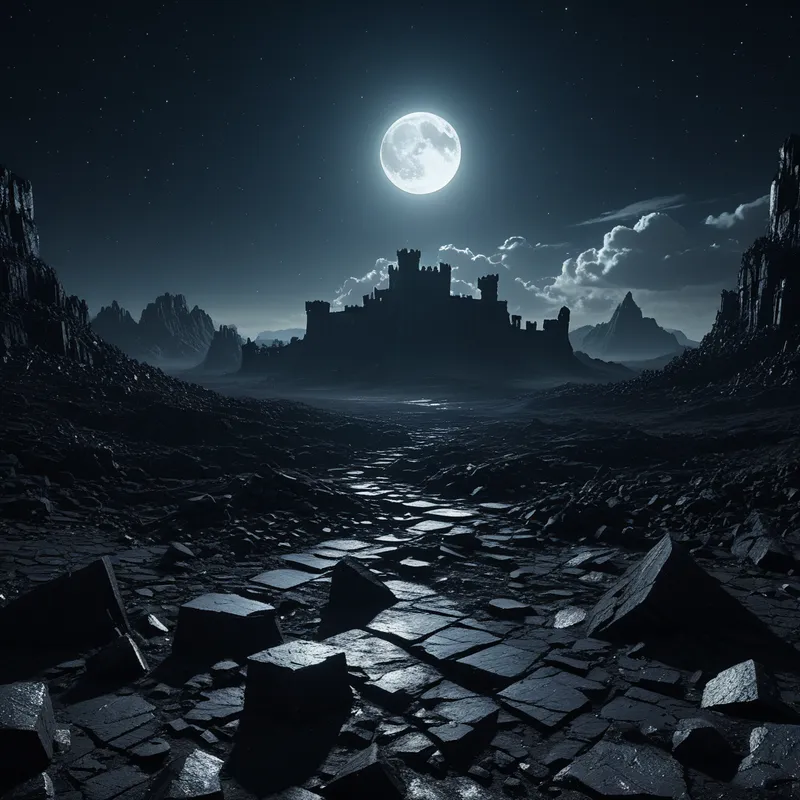
Then began the Nigredo. The fire was lit. Not a gentle warmth, but the heat of a buried sun, the forge-fire of anguish. Within the vessel, the unified matter began to writhe and scream. It cracked, it soured, it putrefied. Colors fled, leaving only a profound and absolute blackness—the black of a moonless midnight, the black of a crow’s wing, the black of a forgotten tomb. This was the death of all that was known. The Caput Corvi, the Raven’s Head, appeared, a specter of despair cawing of futility. The world within the vessel was a kingdom of ash, a landscape of shattered towers and salted earth. The seeker knew only the taste of dust and the weight of a leaden heart.
For an age, it seemed, the blackness reigned. The fire did not cease. It cooked the substance into a uniform, hopeless mass. This was the Solve, the great dissolution. All distinctions—king and beggar, love and hate, self and other—melted into a single, inky pool of negation.
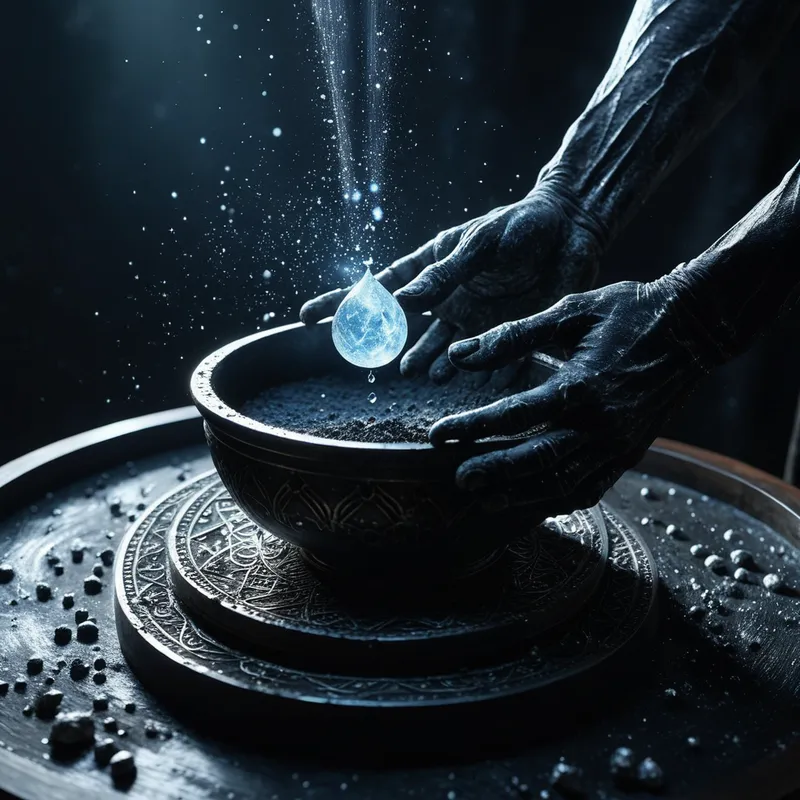
But in the deepest heart of that blackness, a secret was kept. A longing. A memory of light. And from the unseen heavens, a response began. A gentle weeping. Not a storm, but a distillation. The celestial dew, the Aqua Vitae, began to fall. Drop by silvery drop, it penetrated the sealed vessel. It was the tears of the moon, the milk of the stars, a baptism from a source beyond the soot-stained sky.
Where it touched the blackened mass, a miracle of silence occurred. The dew did not fight the blackness; it washed it. It lifted the soot, not by force, but by a patient, relentless embrace. The chaotic mass began to settle. The inky pool clarified. And from its center, a whiteness emerged. It was not a painted white, but a luminous white, a white that shone with its own inner light—the Albedo.
The black kingdom was not destroyed, but transfigured. The ashes became the foundation for a white, crystalline earth. The shattered towers were revealed as raw quartz, now gleaming. The Raven’s Head fell silent, its form dissolving into a single, white feather drifting on a zephyr. The substance in the vessel was now the White Queen, serene, cold, and radiant as the full moon on a winter’s night. The great work was not complete, but the soul had been scrubbed clean by starlight and sorrow, made ready for what was to come.
Cultural Origins & Context
The myth of Nigredo to Albedo is not a tale from a single culture, but the core narrative of Western alchemy, a spiritual and proto-scientific tradition spanning from Hellenistic Egypt through the Islamic Golden Age to the Renaissance courts of Europe. It was passed down not by bards, but in cryptic manuscripts, encoded in dazzling illustrations of dragons, kings, and celestial unions. Practitioners like Hermes Trismegistus, Carl Jung would later note, saw these texts as maps of the opus internum—the inner work.
Its societal function was dual. Exoterically, it provided a framework for early chemistry, describing literal processes like calcination and distillation. Esoterically, and more profoundly, it served as a guide for spiritual transformation for a select few—often scholars, monks, or court magicians—operating at the fraught intersection of sanctioned religion and forbidden knowledge. The myth was a container for experiences too terrifying or sublime for orthodox doctrine: the necessity of a personal, visceral encounter with the divine through the darkness of one’s own nature.
Symbolic Architecture
Psychologically, this myth charts the non-negotiable first steps of individuation—the process of becoming a whole, integrated Self. The Prima Materia is the unexamined psyche, brimming with potential but burdened by inherited complexes and unconscious content.
The Nigredo is the confrontation with the Shadow. It is the descent into everything we have denied, repressed, or deemed unacceptable within ourselves.
The sealed vessel is the conscious ego, the crucible of our lived experience where this confrontation must occur. The fire is the heat of conflict, crisis, depression, or any life event that “cooks” us, breaking down our comfortable personas. The resulting blackness is not evil, but the fertile void, the state of utter hopelessness and disorientation where old identities die. The Caput Corvi is the Shadow made manifest, a personification of our deepest self-loathing and despair.
The Aqua Vitae, the celestial dew, symbolizes the reconciling function of the unconscious itself—not just its terrifying depths, but its nourishing, healing depths. It represents a grace that comes from beyond the ego, often experienced as intuition, synchronicity, or a sudden inflow of meaning. The Albedo, then, is the dawn of self-awareness and inner clarity. The ego, having survived its dissolution, is now purified, humbled, and receptive—the White Queen. It is a state of lunar consciousness: reflective, cool, and aware of the vast darkness from which it emerged, now illuminated from within.

The Dreamer’s Resonance
When this myth stirs in the modern dreamer, it signals a profound somatic and psychological initiation. The dreams are often stark and visceral. One may dream of being trapped in a collapsing, blackened building; of washing endless piles of soot-stained laundry in a dim light; of finding a single white flower growing in a field of ash; or of standing under a gentle shower that feels like liquid moonlight.
Somnatically, this process can feel like a heavy depression, a “dark night of the soul,” where the body feels leaden and the world loses its color. It is a mortificatio—a symbolic death. The psyche is forcing a Solve, breaking down outdated structures of personality, relationship, or belief to its base components. The dream imagery provides the crucial, mythic context: this is not merely random suffering, but a purposeful, if agonizing, stage in a sacred process. The appearance of cleansing water or emerging light in the dream confirms the presence of the unconscious’s own healing Aqua Vitae, working even when the conscious mind feels utterly blackened.

Alchemical Translation
For the modern individual, the myth models the path of psychic transmutation by insisting that wholeness is born not from bypassing darkness, but from its full integration. Our culture champions the pursuit of the Albedo—purity, positivity, enlightenment—while demonizing the Nigredo as failure or pathology. This myth corrects that fatal error.
You cannot become who you are meant to be without first ceasing to be who you are not. The Nigredo is that necessary cessation.
The “work” is to consciously submit one’s complex-ridden psyche to the inner fire of honest self-reflection and to endure the resulting dissolution without fleeing into distraction or old narratives. It is to say “yes” to the depression, the grief, the rage, and to let it cook, trusting that this blackness is the materia of transformation. The transmutation occurs when we stop resisting and allow the unconscious to send its reconciling dew—perhaps through therapy, art, nature, or simply a moment of surrendered acceptance.
The triumph of the myth is not an escape from black to white, but the revelation that the white is the black, purified and understood. The crystalline self of the Albedo is forged in the ashes of the old identity. It is a self that knows its own darkness intimately and, because of that knowledge, can now reflect a truer, steadier light. The journey from Nigredo to Albedo is thus the soul learning to become its own alchemist, turning the lead of suffering into the silver of wisdom.
Associated Symbols
Explore related symbols from the CaleaDream lexicon: