Nigredo Phase Myth Meaning & Symbolism
The primal myth of the blackening, where the soul's raw matter dissolves in darkness, a necessary putrefaction before the dawn of the Self.
The Tale of Nigredo Phase
Listen. In the beginning, before the gold, there is only the Massa Confusa—the formless, leaden lump of all that is and could be. It is not a thing of beauty. It is dense, heavy, and mute, holding within its cold grasp the sun and the moon, the eagle and the toad, the king and the beggar, all tangled in a slumbering, chaotic embrace.
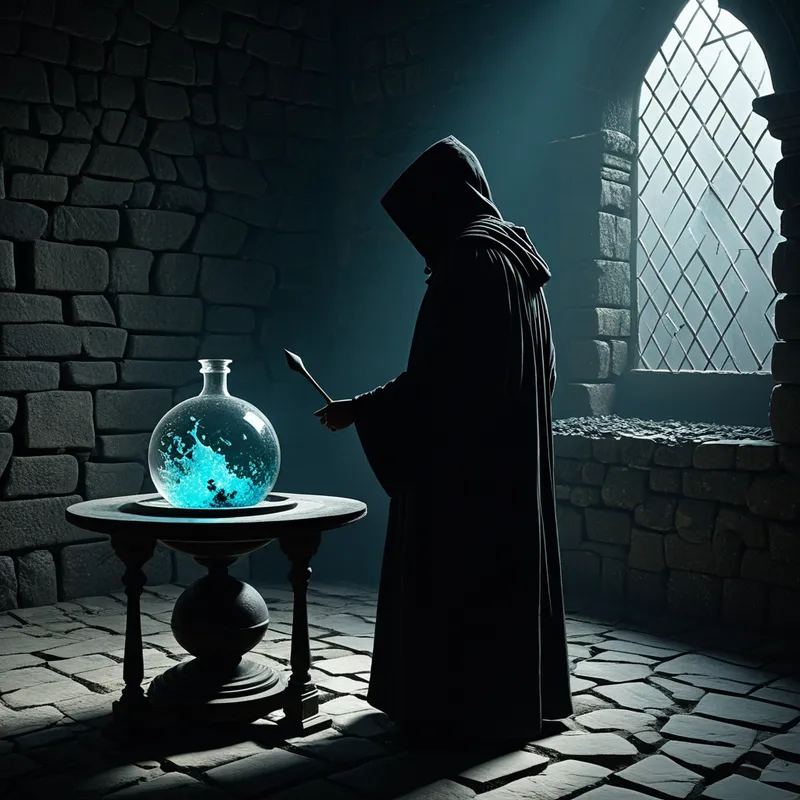
The Artifex receives this base matter not as a gift, but as a sentence. Their task is not to polish it, but to break it. With a resolve that feels like despair, they seal the confused mass within the belly of the athanor, the egg-shaped furnace of the world. The fire is lit not with jubilation, but with a solemn oath to the process itself, an oath whispered to shadows.
Then begins the long descent. The heat does not refine; it corrupts. The unified mass does not glow; it blackens. A foul, acrid smoke rises—the smoke of burning vanities, of calcified identities, of every lie the soul ever told itself to feel whole. The matter within weeps a black, tarry sweat. It bubbles and seethes, a miniature cosmos in revolt. This is the Nigredo. The sun is swallowed. The moon is extinguished. All color flees, leaving only the profound, absolute black of the tomb, the womb, the unformed abyss.
In this darkness, the Mercurius Duplex stirs. Not as a savior, but as a trickster of decay. It is the spirit of the matter itself, now turned venomous, a psychic acid that eats away at every bond. The Artifex watches, aghast, as the work turns utterly foul. The beautiful ideals rot. The cherished self-image putrefies. All that was solid melts into a stinking, uniform blackness. This is the Putrefactio, the death within the death. The goal is forgotten. Only the black remains.
The night is long. The Artifex is certain they have failed, that they have created only a monument to ruin. They are alone with the blackness, which now feels less like a substance and more like a presence—a cold, starless void staring back from within the glass. They must hold the vessel. They must tend the fire, even as it seems to burn only ash. This is the ordeal: to not flee from the product of one’s own sacred work, to consent to the annihilation.
And then, in the deepest hour, when the black is so complete it becomes a kind of silence… a change. Not a light, but a shift in the quality of the dark. From the very heart of the corruption, a single, cold, clear knowing arises. It is the knowledge of the blackness itself. The matter is no longer confused. It is uniformly, perfectly, absolutely black. It has achieved a terrible purity. The dissolution is complete. The work is not over. It has only just truly begun. The Nigredo has done its work. The stage is set, in utter darkness, for the first impossible white ray of the Albedo.
Cultural Origins & Context
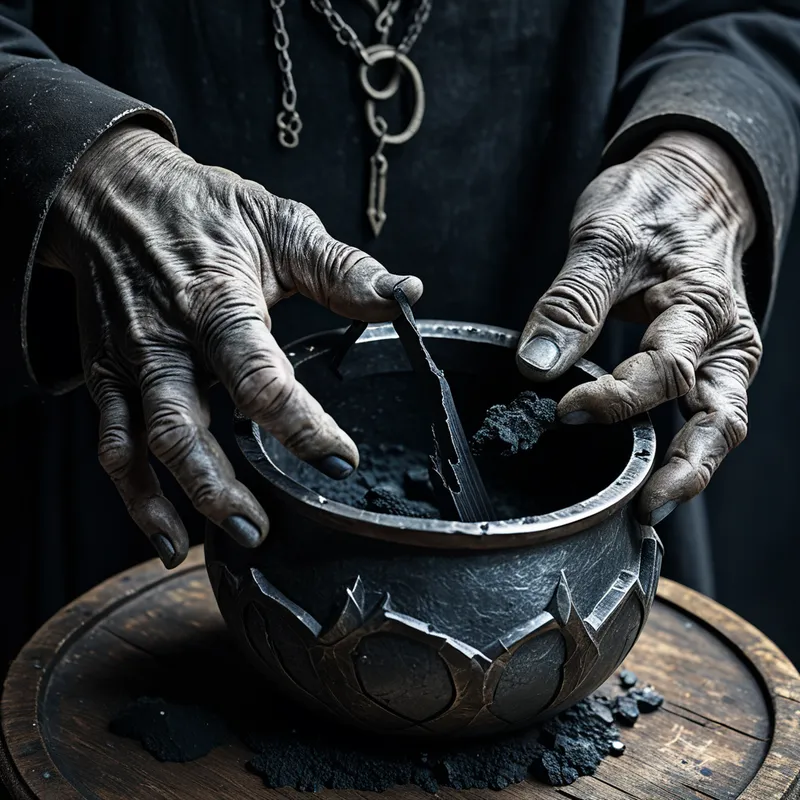
The myth of the Nigredo is not a story told around fires, but one encoded in cryptic manuscripts, hidden behind the veil of Decknamen (cover names), and passed from master to apprentice in the silent laboratories of medieval and Renaissance Europe. Its primary “culture” is the clandestine world of Western alchemy, a pursuit that was equal parts practical chemistry, spiritual philosophy, and psychological art.
The myth was transmitted through a rich tapestry of symbolic images: the black sun, the raven’s head, the rotting king in his coffin, the dragon consuming itself. These were not mere illustrations but experiential maps for the practitioner. The telling of the myth was the enactment of the process itself in the laboratory. As the alchemist worked with literal substances—lead, antimony, mercury—watching them blacken and decompose, they were simultaneously engaging in an opus contra naturam, a work against their own fallen nature. The societal function was deeply subversive and individualistic. It offered a path to spiritual liberation outside the rigid dogmas of the Church, modeling a direct, experiential confrontation with the divine hidden within the depths of matter and the self.
Symbolic Architecture
At its core, the Nigredo symbolizes the unavoidable confrontation with the shadow. It is the psychological “dark night of the soul,” where the conscious ego’s structures—its persona, its ambitions, its prized self-conception—are systematically dissolved by contact with the unconscious.
The gold cannot be found by building a brighter tower, but only by descending into the mine of the self, where the first and only tool is the willingness to be blackened.
The Massa Confusa represents the unexamined life, the psychic raw material filled with potential but also with contradiction and unresolved conflict. The athanor is the crucible of conscious attention and suffering—the contained, focused heat of introspection that forces a crisis. The blackening and putrefaction are not evils, but necessary phases of decomposition. Psychologically, this is the breakdown of neurotic patterns, the painful acknowledgment of repressed wounds, envy, aggression, and fear. The Mercurius Duplex active in this phase is the trickster aspect of the psyche, the unconscious force that mercilessly undermines our pretenses, leading us into chaos for the ultimate purpose of reorganization at a higher level.
The Dreamer’s Resonance
When the Nigredo pattern stirs in the modern dreamer, it announces a profound somatic and psychological initiation. Dreams become landscapes of decay: teeth falling out, houses flooding with black water, familiar cities in ruins, or the dreamer being buried in earth or trapped in a dark, confined space. The body may echo this in feelings of heaviness, fatigue, or illness—a literal “weight of the world.”
This is not a descent into pathology, but the psyche’s innate drive toward wholeness initiating a purge. The ego feels attacked, lost, and hopeless. The dreamer is experiencing the mortificatio—the symbolic death required for renewal. The psychological process is one of radical de-identification. The dream ego is being stripped of its familiar anchors. The resonance is in the feeling tone: a potent mixture of terror, profound sadness, and a strange, quiet awe at the sheer scale of the inner demolition. The psyche is clearing the ground, and the dreamer is both the Artifex tending the fire and the blackening mass within the vessel.

Alchemical Translation
For the modern individual, the myth of the Nigredo provides a sacred map for navigating life’s most devastating transitions: the end of a career, the collapse of a relationship, a crisis of faith, or a deep depression. It models the process of psychic transmutation by reframing utter breakdown as the first, non-negotiable stage of breakthrough.
The alchemical translation teaches us to contain the process. Like the athanor, we must learn to hold the heat of our suffering without acting out or repressing it—to “stew in our own juice.” It validates the necessity of the shadow work, the conscious engagement with all we have deemed ugly, shameful, or worthless within ourselves.
The promise of the Nigredo is that only from the uniform blackness, where all false colors are burned away, can the authentic, individual white light of consciousness emerge.
This phase of individuation demands a surrender of the ego’s control and its heroic narratives. We are asked to play the role of the orphan, acknowledging our fundamental lostness. The triumph is not in escaping the black, but in enduring it, in finding the courage to not abandon oneself in the midst of the inner ruin. By consenting to this dissolution, we allow the psyche to shed an outworn skin. The blackness, in the end, is revealed not as an enemy, but as the fertile, humus-rich soil from which the true and more resilient Self can finally germinate. The goal is not to avoid the Nigredo, but to pass through it with conscious humility, trusting that the darkness itself is the first, and most profound, act of creation.
Associated Symbols
Explore related symbols from the CaleaDream lexicon: