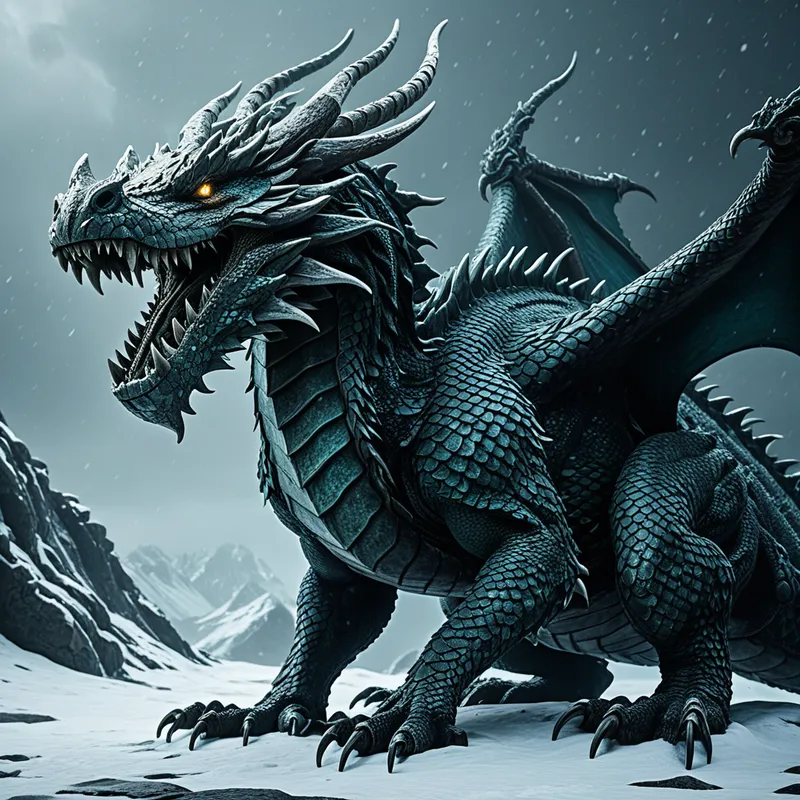
Nidhogg Myth Meaning & Symbolism
A cosmic dragon eternally gnaws the roots of the World Tree, embodying the necessary decay that sustains the cycle of existence.
The Tale of Nidhogg
Listen, and hear the sound that holds the worlds together. It is not the song of the gods in their golden halls, nor the wind in the high branches. It is a sound from below. A grinding, relentless, tooth-on-bone rasp, deep in the cold and the dark where no sun has ever shone.
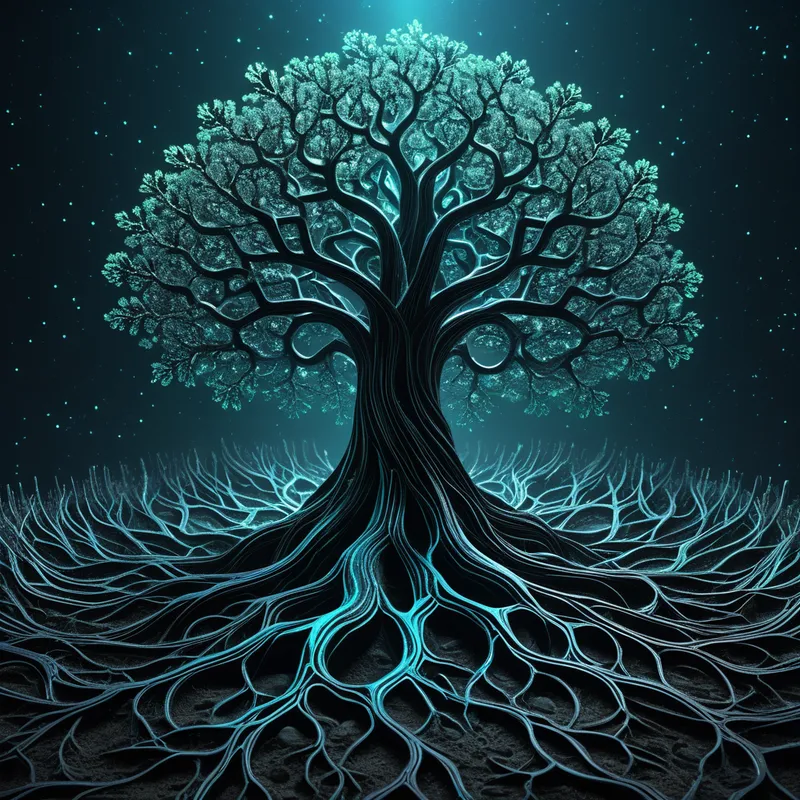
This is the domain of Niflheim, a place of fog and freezing rivers that flow from the well Hvergelmir. Here, the greatest of roots of the Yggdrasil digs deep, seeking anchor in the primordial ooze. And here, coiled about that root, is He-Who-Strikes-with-Malice: Nidhogg.
His body is a mountain range of scales, dark as a starless midnight, cold as the grave. His breath is not fire, but a deeper cold that stills the very air. And his work is eternal. With teeth like splintered mountains, he gnaws. He gnaws at the root of the World Tree itself. The sound is the heartbeat of the underworld. With every scrape of enamel on divine wood, a shudder runs up the great trunk, a tremor felt in Asgard and Midgard alike.
But Nidhogg is not alone in his grim vigil. Above him, in the high branches, an eagle sits, wise and watching. Between them, running up and down the vast trunk, scurries the squirrel culture.") Ratatoskr, the Drill-Tooth. He is a bearer of poison words. He climbs to the eagle to whisper the insults and hatreds Nidhogg sends from below. He descends to the dragon to shriek the eagle’s scorn and contempt from above. He fans the flames of an ancient, cosmic feud, ensuring the tension never slackens.
And below, in the murky waters that seep from Hvergelmir, lies Nastrond, the Corpse-Shore. Its walls are woven of writhing serpents, their venom dripping in rivers. Here, the worst of the dead wade through icy streams, their forms pale and broken. And Nidhogg is their warden and their final consumer. He does not just gnaw wood. He chews on the corpses of the damned, his jaws a grinding mill of final judgment.
This is the order of things, the great balance. The gnawing below, the watching above, the messenger of malice between. It is a system of tension, of perpetual, necessary corrosion. The story does not end with a hero slaying the dragon. For if Nidhogg were to cease his work, the root would grow unchecked, the balance would shatter, and the tree itself would become rigid and die. His malice is a part of the structure. His endless hunger is a thread in the tapestry. He gnaws, and the worlds tremble, and in that trembling, they live.

Cultural Origins & Context
The myth of Nidhogg is preserved primarily in the Poetic Edda, specifically in the poems Grímnismál and Völuspá, and is elaborated upon in the Prose Edda. These texts are our windows into a worldview that was already ancient and fading when they were recorded in 13th-century Iceland. The myth was not a children's fable but a piece of a complex cosmological model, recited by skalds and perhaps by seeresses (völvas) during rituals or gatherings.
Its societal function was profound. In a culture that understood existence as a cyclical struggle against entropy—epitomized by the inevitable Ragnarök—Nidhogg served as a constant reminder of the foundational decay within the system. He represented the inescapable shadow side of creation. For a warrior society, the idea of a specific, gruesome punishment for oath-breakers and murderers (being chewed by Nidhogg in Nastrond) reinforced the sacredness of social bonds and the dire consequences of their violation. The myth taught that order (örlög) is not a static perfection, but a dynamic state maintained in relation to chaos and dissolution.
Symbolic Architecture
Nidhogg is not a villain to be defeated; he is a fundamental principle to be integrated. He is the archetypal force of entropy, decay, and the dissolution of form. His position at the root of Yggdrasil is critical: the root is the foundation, the connection to the source, the unconscious underpinning of the conscious world.
The shadow is not what is evil, but what is necessary. The tree cannot grow without the root decaying into the soil from which it feeds.
Nidhogg’s gnawing symbolizes the psychological truth that our deepest foundations—our core beliefs, traumas, and inherited patterns—are under constant, subtle erosion by repressed material (the shadow). The squirrel Ratatoskr represents the internal narrative that amplifies this tension, the self-talk that turns simple tension into seething hatred between our lofty ideals (the eagle) and our base instincts (the dragon). This internal feud is not a flaw; it is the engine of psychic life.
Furthermore, Nidhogg as the consumer of the corpses in Nastrond represents the function of the unconscious to process and break down the "dead" aspects of the psyche—outworn identities, un-lived lives, and moral failures. He is the recycler in the depths, ensuring that nothing, not even our worst deeds, is wasted but is instead ground back into the raw material of the soul.
The Dreamer's Resonance
When Nidhogg stirs in the modern dreamscape, he rarely appears as a literal dragon. His presence is felt somatically and symbolically. The dreamer may experience:
- Recurring dreams of foundational decay: The basement of one's childhood home is flooding with black water; the foundation of a familiar building has deep, spreading cracks; teeth are crumbling or falling out.
- Encounters with formless, consuming darkness: A black sludge, an oil spill in a dream landscape, a void that slowly absorbs everything around it. This is not a predatory monster, but an inevitable, slow process.
- The sense of being "gnawed at" from below: Anxiety that has no clear object, a persistent, grinding worry that feels foundational, as if something essential is being subtly undermined.
Psychologically, this signals a profound encounter with the personal and collective shadow. The psyche is initiating a process of breaking down an old, rigid structure—a long-held self-image, a foundational belief, or a complex of trauma. It is an uncomfortable, often frightening process that feels like disintegration. The dreamer is in their own Niflheim, where the frozen forms of the past are beginning to thaw and be consumed by a force they cannot control.
Alchemical Translation
The alchemical journey, or the path of individuation, is not one of ascending to purity, but of descending to integrate the prima materia—the base, chaotic matter. Nidhogg is that prima materia at the root of the Self. The modern individual's "alchemical translation" of this myth involves a radical shift in perspective: from seeking to slay one's demons to understanding their necessary function.
The goal is not to stop the gnawing, but to consciously relate to it. To hear the message in the grind.
The first step is Acknowledgment of the Gnawing: To cease resisting the feeling of foundational anxiety or decay, and instead turn toward it. What rigid structure in my life (a career, a relationship, an identity) is being subtly undermined? This is not a failure, but the beginning of a necessary death.
The second is Disidentifying from Ratatoskr: To quiet the internal messenger that amplifies the conflict between our "higher" and "lower" selves. This means observing self-critical or catastrophic thoughts without believing they are the final truth. They are just squirrel-chatter on the trunk of the psyche.
The final, ongoing stage is Sacralizing the Process: To understand that the breakdown is in service of renewal. Just as a forest needs decomposers to thrive, the psyche needs Nidhogg to break down deadwood so new growth can emerge from the rich compost. This is the ultimate transmutation: looking into the face of what seems purely destructive and seeing, within its maw, the mechanics of sacred sustenance. We do not become the dragon, but we make peace with its eternal work at our roots, recognizing that our wholeness depends on its relentless, shadowy hunger.
Associated Symbols
Explore related symbols from the CaleaDream lexicon: