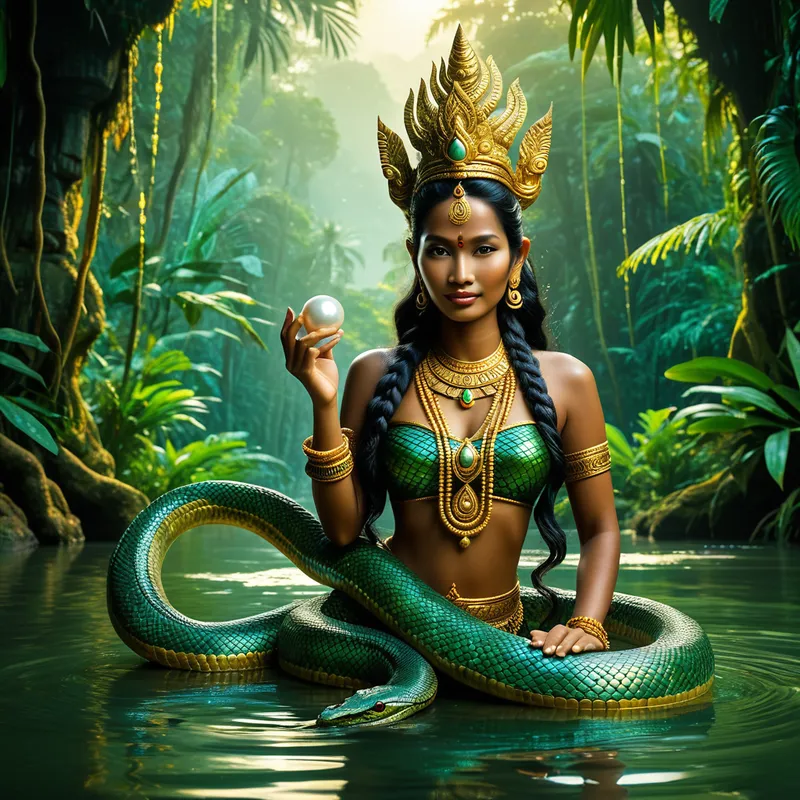
Nāgī Myth Meaning & Symbolism
The myth of the Nāgī, a serpent goddess, embodies the union of opposites, the power of the deep psyche, and the sacred source of life and sovereignty.
The Tale of Nāgī
Listen, and let the mists of time part over the ancient land of Kambujadeśa. Before the first stone of Angkor was laid, the world was a conversation between earth and water. And from the deepest, most secret pools of the Tonlé Sap, from the swirling currents of the Mekong, they arose: the Nāgī.
They were the sovereigns of the liquid realm, beings of profound grace and terrifying power. Their lower bodies were great, coiled serpents, scales shimmering like a thousand captured moons. Their upper forms were of breathtaking beauty, with eyes holding the patience of the deep and hands that could cradle life or summon cataclysm. They were the guardians of the life-giving waters, the keepers of subterranean treasures, and the very pulse of the land's fertility.
The tale sings of a time when a great human king, a ruler of the sun-baked earth, wandered to the river's edge at twilight. He was a man of order, of walls and laws, but his heart was parched, his kingdom brittle. There, in the silvery light, he saw her—a Nāginī princess, rising from the dark water like a dream given form. Her hair flowed like the river itself, and in her palm, she held a luminous pearl, the concentrated essence of her watery domain.
Their eyes met across the elemental divide: his world of firmament and fire, hers of fluidity and mystery. No words were spoken in the tongue of men, but a pact was woven in the silent language of longing and recognition. He, the king, offered the stability of the land, the promise of lineage and temple. She, the Nāginī, offered the wisdom of the depths, the promise of rain, abundance, and a connection to the primal source of all things.
In a sacred union that shook the foundations of both worlds, they joined. The Nāginī, in an act of profound transformation, willed her serpentine tail to split, forming human legs, so she might walk upon his earth. But this was no surrender; it was a sacred alchemy. The king, in turn, was forever changed, his sovereignty now flowing with the sacred waters of her origin. From this union sprang a dynasty blessed by both realms, a people whose kings would forever after be called "Kambu," the children of the serpent.

Cultural Origins & Context
The myth of the Nāgī is not merely a story in Cambodian culture; it is a foundational cosmology etched into the land itself. Originating from broader Indic traditions, the Nāgī was wholly adopted and adapted by the Khmer people, becoming the bedrock of their identity. The myth served as the divine charter for kingship, legitimizing the ruler's authority as deriving directly from the autochthonous, animistic powers of the land—the water spirits—rather than solely from foreign, Indic concepts of divinity.
This story was passed down through carvings on temple walls—the balustrades of Angkor Wat famously form the bodies of a seven-headed Nāgī, representing the rainbow bridge between heaven and earth—and through oral tradition, dance, and ritual. It was told to explain the origin of the Khmer people, to sanctify the critical importance of water management (the basis of the Angkorian empire's power), and to model the ideal relationship between humanity and the natural world: one of respectful union, not domination. The Nāgī was the guardian spirit of the land, and every king was, in essence, her consort, responsible for maintaining that sacred covenant to ensure prosperity.
Symbolic Architecture
At its heart, the myth of the Nāgī is a profound symbol of the conjunctio oppositorum—the sacred marriage of opposites. The king represents consciousness: structured, solar, masculine, and oriented toward the external world of order and civilization. The Nāgī represents the unconscious: fluid, lunar, feminine, and oriented toward the internal world of instinct, emotion, and primordial wisdom.
The serpent does not crawl; it flows. It is the living glyph of the unconscious itself—winding, deep, connected to the earth, and capable of shedding the past to reveal new life.
Her transformation—the splitting of her tail into legs—is not a loss of power but an act of conscious adaptation. It symbolizes the necessary "incarnation" of deep, unconscious content into a form that can be integrated into conscious life. The luminous pearl she holds is the lapis philosophorum, the treasure hard to attain, which is the wholeness and transformative potential found only in the depths. The resulting dynasty signifies the birth of a new, more complete psychic reality, where the ego is no longer a lonely ruler but a partner to the vast, nourishing powers of the soul.
The Dreamer's Resonance
When this myth stirs in the modern dreamer, it often signals a profound encounter with the animating, instinctual layer of the psyche—what Jung termed the anima or animus. To dream of a serpent in water, of a beautiful yet awe-inspiring figure from a deep pool, or of a transformative union between land and river, points to a process of emotional and psychic fertilization.
Somatically, one might feel a pull toward water, a restlessness in the body, or a sense of being "parched" in life despite external success—a direct echo of the king's condition. Psychologically, the dreamer is being invited to acknowledge and engage with the "sovereign" but neglected aspects of their own nature: their deep emotions, intuitive wisdom, and creative life force. The conflict in the dream is the tension between a rigid, perhaps over-controlled conscious attitude (the kingdom) and the urgent, life-giving call from the unconscious (the Nāgī). The resolution lies not in one conquering the other, but in a respectful, awe-filled courtship that leads to transformation.

Alchemical Translation
The alchemical journey modeled by the Nāgī myth is the core of individuation. It begins with the nigredo—the king's sense of barrenness, his recognition that his conscious world, however ordered, is incomplete. His journey to the riverbank is the solutio, the dissolution of ego certainty, willingly entering the ambiguous, emotional waters of the unknown.
The encounter with the Nāgī is the pivotal moment of coniunctio, the sacred marriage. This is not a literal union with another, but the internal marriage of the ego with the contents of the collective unconscious.
To gain her pearl, he must offer his kingdom. To receive his stability, she must transform her form. This is the psychic bargain of wholeness: consciousness must make space, and the unconscious must become relatable.
Her transformation is the albedo, the whitening, where the integrated content begins to take a recognizable, livable form within the personality. The final stage, the birth of the blessed dynasty, is the rubedo, the reddening. It is the manifestation of this inner union as a new, creative, and sovereign way of being in the world. The individual is no longer ruled solely by conscious will or drowned by unconscious impulse but becomes a vessel through which the wisdom of the depths and the action of the surface flow together, creating a life that is both authentically one's own and deeply connected to the primordial source of all life.
Associated Symbols
Explore related symbols from the CaleaDream lexicon: