New Orleans Jazz Funeral Myth Meaning & Symbolism
A ritual where a slow dirge for the dead erupts into ecstatic jazz, transforming collective grief into a defiant, life-affirming celebration of the spirit's journey.
The Tale of the New Orleans Jazz Funeral
Listen, child, and let the story settle in your bones. This is not a tale of a single hero, but of a whole people becoming a single, breathing heart. It begins in the heavy, honeyed air of a city built on a swamp, where the ground is soft and remembers everything.
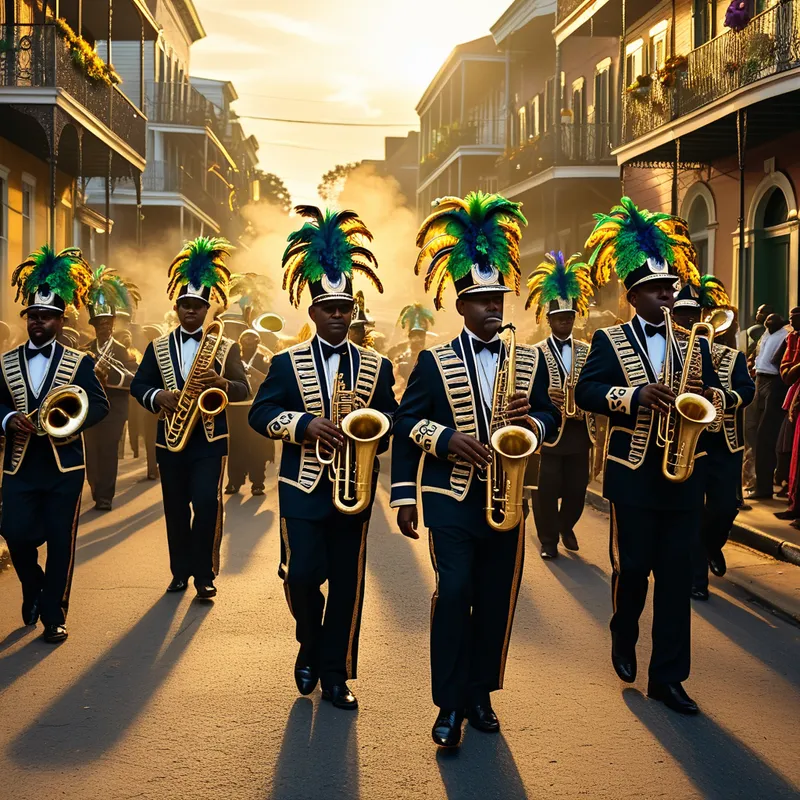
First, you hear it: a sound like the earth itself sighing. A slow, dragging beat, a trumpet crying a melody that bends under the weight of the world. This is the Dirge. It walks ahead of the box that carries the body, a wall of sound holding back the silence of the abyss. The people move as one slow, dark river behind it, clad in their Sunday best, faces etched with the map of their loss. They are the Second Line, though for now, they walk as a first line of grief, each step a punctuation mark in a sentence of sorrow. The Grand Marshal, a figure of solemn authority, cuts a path through the streets, his feathered staff a beacon in the gloom.
This is the descent. The march into the underworld of feeling, where every memory of the departed is a stone in the pocket. The music is a Spiritual, a ladder of notes trying to reach a heaven that feels too far away. The sun beats down, the humidity clings, and for a long, stretched moment, it seems the sadness will never end. The conflict is not against a monster, but against the finality of the grave, against the theft of a voice, a laugh, a presence.
But listen closer. Beneath the groaning tuba and the weeping clarinet, a tension builds. A simmer. A memory of sweat and sugarcane fields, of chains and coded songs. A memory of a wisdom older than the city: that the spirit cannot be caged, not by death, not by sorrow. The procession reaches the gates of the cemetery—the point of no return, the mouth of the earth.
And then… the crack.
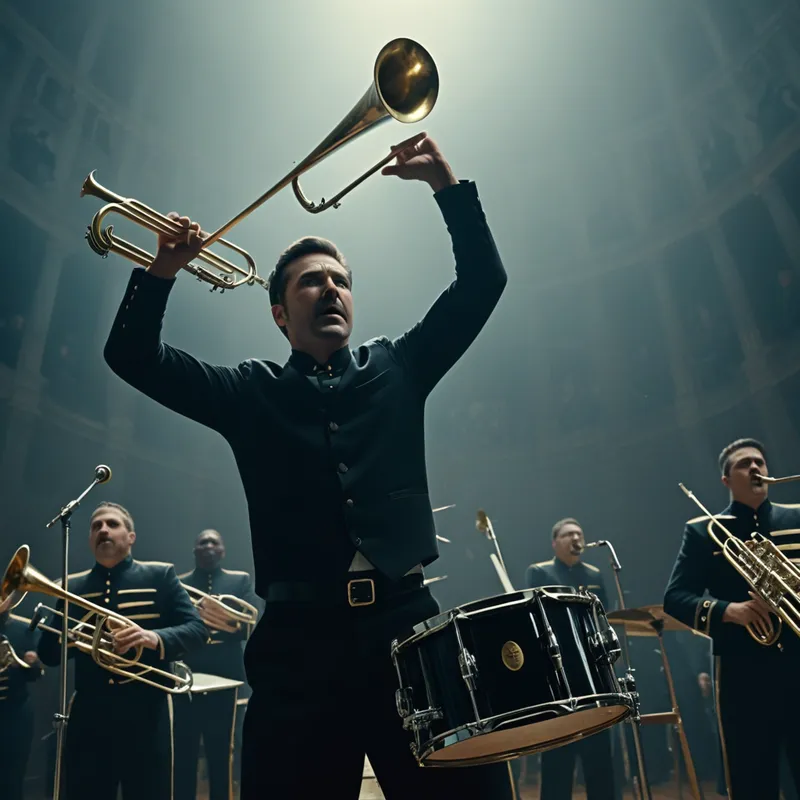
A snare drum strikes, sharp as a bone breaking open. The trumpet player catches the eye of the Grand Marshal, who gives a nearly imperceptible nod. It is the signal. The dirge stumbles, halts for a single, breathless heartbeat.
Then, the horn blasts a note of pure, golden light. The tuba player shakes off the weight and finds a bouncing, joyful rhythm deep in his belly. The clarinet spirals upwards, laughing. The mournful hymn shatters and reassembles itself into the riotous, swinging anthem of "When the Saints Go Marching In."
This is the explosion. The resurrection. The Grand Marshal throws his staff high, his face transformed from a mask of grief into a beacon of ecstatic release. He begins to dance, a complex, shuffling, joyous step. The Second Line erupts. Umbrellas, tasseled and bright, snap open and spin like suns. Handkerchiefs wave like flags of a new, liberated nation. The river of people is no longer walking to a grave; they are dancing the spirit home. They are shaking the dust of mortality from their feet, celebrating the soul’s release, shouting back at death with a rhythm that says, "We are still here. We remember. We rejoice." The procession turns away from the cemetery, leading the spirit not into the ground, but back into the heart of the living community, back into the streets, back into life itself. The music becomes a shield, a celebration, a testament written in trumpet blasts and dancing feet.
Cultural Origins & Context
This ritual is not merely a funeral; it is a profound act of cultural memory and psychic survival, born from the crucible of the African Diaspora. Its roots dig deep into West African traditions, particularly from nations like Ghana and Nigeria, where music and dance were integral to rites of passage, believing sound could guide the spirit to the ancestral realm. Enslaved Africans brought these cosmologies to the shores of Louisiana, where they syncretized with European military band traditions and the Catholic practice of funeral processions.
In the oppressive landscape of slavery and later, segregation, the jazz funeral became a clandestine language of resilience. The dirge expressed the collective grief of a people—for lost homelands, stolen lives, and daily injustices. The "hot" second line was a defiant, coded declaration of personhood and liberation. It said that while the body of a community member might be lost, their spirit—and the spirit of the community itself—was unbreakable and would be celebrated with an authenticity that no oppressor could understand or control. It was passed down not in books, but in the body—in the shuffle of the Grand Marshal’s feet, the specific bend of a trumpet note, the way a handkerchief was flicked. Societally, it functioned as a pressure valve, a communal therapy session, and a powerful reaffirmation of identity and continuity in the face of relentless existential threat.
Symbolic Architecture
At its core, the jazz funeral is a masterful symbolic map of the soul’s journey through the valley of loss. It architecturally rejects a linear progression from grief to closure, instead presenting a alchemical model where opposites are held in dynamic, transformative tension.
The dirge is not the opposite of the celebration; it is its necessary womb. The profound sadness makes the subsequent joy not a denial, but a conquest.
The body in the box represents the fixed, mortal, historical self—what is left behind. The spirit in the music represents the eternal, liberated essence—what moves on. The procession itself is the liminal space, the psychic bardo, where this transmutation occurs. The Grand Marshal is the psychopomp, guiding not just the dead, but the living through this emotional terrain.
The pivotal "turn" from dirge to jazz is the myth’s central symbol. It is the moment of metanoia—a revolutionary change of heart and mind. It models the conscious decision to not be drowned by grief, but to use its energy to fuel a reaffirmation of life. The waving umbrellas (parasols) are not just for show; they symbolically shield the celebrants from the "rain" of sorrow and mark a sacred, celebratory space.
The Dreamer's Resonance
When this mythic pattern stirs in the modern dreamer, it signals a profound somatic and psychological process underway. To dream of a slow, mournful procession where you are both observer and participant suggests a part of your psyche—a relationship, an identity, a dream—is being laid to rest. You are in the Dirge phase. The heaviness in the dream is real; it is the weight of legitimate grief, of ending.
The critical dream sign is the anticipation or the occurrence of the turn. You may dream of a drummer raising his sticks, a feeling of collective breath being held, or a sudden, overwhelming urge to move your feet. This is the psyche’s innate intelligence initiating its own "hot" second line. It signifies that the unconscious is ready to transmute the raw material of loss into something new. The dancing in the dream is not frivolous; it is somatic liberation—the body literally shaking off the paralysis of depression or stuck grief. Dreaming of waving a cloth or spinning an umbrella indicates a nascent, emerging desire to actively participate in your own healing, to declare your spirit’s resilience even amidst pain.
Alchemical Translation
For the individual on the path of individuation, the jazz funeral is a perfect model of psychic transmutation. Our personal "deaths"—failures, betrayals, the end of eras—often trigger an inner Dirge. We dwell in the minor key, identified with the loss. The alchemical error is to get stuck there, to believe the dirge is the whole song.
The work is not to skip the sorrow, but to march fully into its depths, trusting that within its core is buried the seed of the rhythm that will liberate you.
The "Grand Marshal" within is our observing Ego, which must first solemnly lead the procession of grief (conscious engagement with pain). The "turn" is the active, courageous intervention of the Self. It is the moment we choose to reframe the narrative, to find the lesson in the loss, to celebrate the love that existed rather than only mourn its absence. The ensuing "second line" is the integrated personality dancing its new wisdom. It is the creative project born from heartbreak, the deeper compassion forged in suffering, the lighter step we gain after putting down a heavy burden.
The myth teaches that true wholeness comes from holding the entire score—the lament and the jubilee. It is not about achieving a state of perpetual joy, but about mastering the sacred rhythm of the human soul: the courageous descent into feeling, and the triumphant, communal uprising back into life, transformed. We do not leave our dead in the ground; we learn their rhythms, and we carry them forward in our dance.
Associated Symbols
Explore related symbols from the CaleaDream lexicon: