New Jerusalem Myth Meaning & Symbolism
A divine vision of a celestial city descending, a sacred marriage of heaven and earth, and the promise of a world made whole, without tears.
The Tale of New Jerusalem
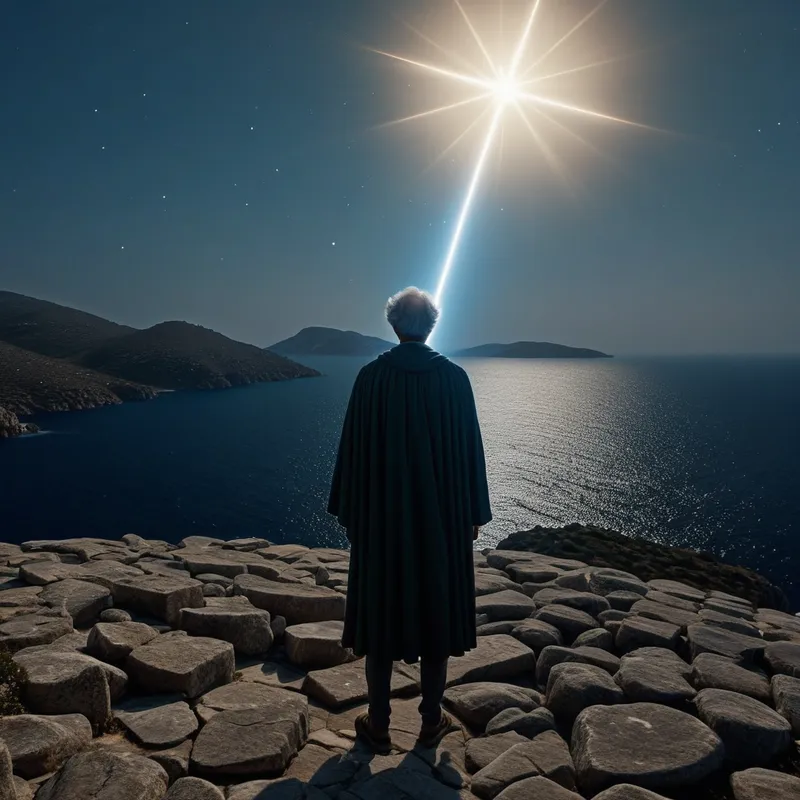
Hear now a vision from the edge of the world, whispered by the sea-wind to a man in exile. On the barren rock of Patmos, under a sky torn by prophecy, the veil of the world grew thin. The exile, named John, felt the very air change, becoming charged like the moment before lightning strikes. A voice, like the sound of many waters, called him, and he was carried in spirit to a great and high mountain.
And there, the future descended.
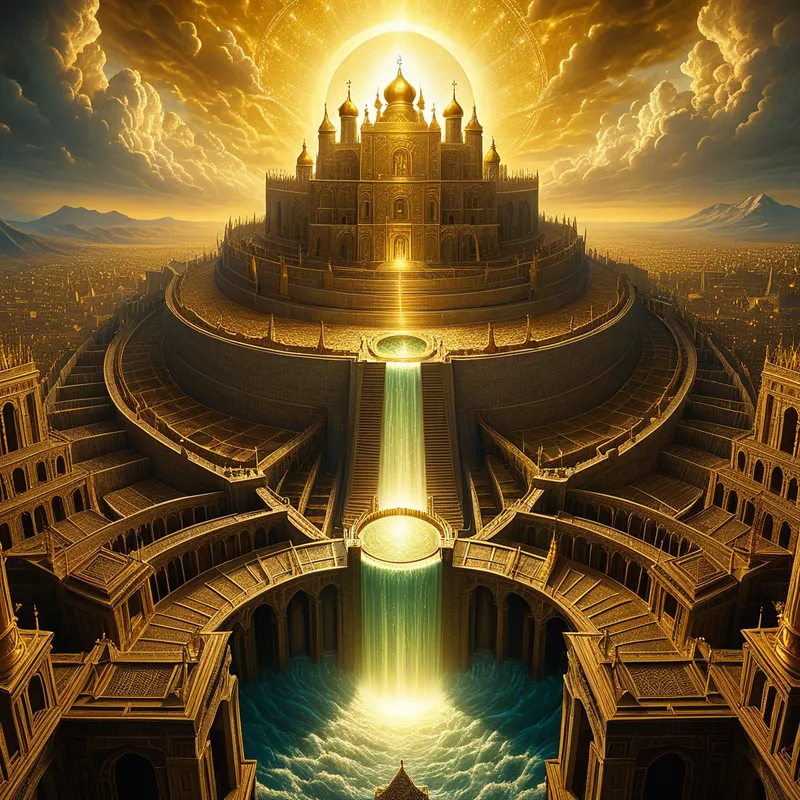
It was not built by human hands, this city. It came down out of heaven from God, prepared as a bride adorned for her husband. Its radiance was like a most precious jasper stone, clear as crystal. A wall, great and high, encircled it, with twelve gates guarded by twelve angels, and names written upon them: the names of the twelve tribes of the children of Jacob. The wall itself had twelve foundations, and on them were the names of the twelve apostles of the Lamb.
The city was pure gold, like clear glass. The foundations of the wall were adorned with every kind of precious stone: jasper, sapphire, chalcedony, emerald, sardonyx, carnelian, chrysolite, beryl, topaz, chrysoprase, jacinth, and amethyst. Each gate was a single, immense pearl. And the street of the city was pure gold, transparent as glass.
But there was no temple in it, for the Lord God Almighty and the Lamb are its temple. And the city had no need of the sun or of the moon to shine on it, for the glory of God illuminated it, and its lamp was the Lamb. The nations will walk by its light.
Then the voice showed him a river, clear as crystal, proceeding from the throne of God and of the Lamb. In the middle of its street, and on either side of the river, was the tree of life, bearing twelve kinds of fruit, yielding its fruit every month. And the leaves of the tree were for the healing of the nations.
And a great voice thundered from the throne, saying, “Behold, the dwelling place of God is with man. He will dwell with them, and they will be his people, and God himself will be with them as their God. He will wipe away every tear from their eyes, and death shall be no more, neither shall there be mourning, nor crying, nor pain anymore, for the former things have passed away.”
The vision sealed itself upon his heart, a promise etched in light. The exile returned to his rocky prison, but the scent of that golden air, the sound of that healing river, remained—a secret certainty in a world of shadows.
Cultural Origins & Context
This culminating vision is recorded in the final book of the Christian New Testament, the Book of Revelation (or Apocalypse), attributed to John of Patmos around the end of the 1st century CE. It emerged from a cultural crucible of persecution, political oppression under the Roman Empire, and profound apocalyptic expectation. This was not a myth of a distant, forgotten past, but a urgent, coded narrative for a community under threat. The New Jerusalem stands in stark contrast to the “great city” of Babylon, a symbol of Rome’s corrupt and oppressive power. The myth functioned as a theodicy—a vindication of divine justice—and a powerful symbol of hope, assuring believers that their suffering was not the final word. It was a subversive text, envisioning the ultimate overthrow of earthly empires by a divine, architectural order of perfect justice and peace. Passed down through liturgical readings and artistic depictions, it became the archetypal image of the Christian eschatological hope, the promised end of the sacred story that began in a garden.
Symbolic Architecture
The New Jerusalem is not merely a place, but a state of being; it is the psyche in its condition of ultimate integration. It represents the final reconciliation of all opposites.
The sacred city descending signifies that wholeness is not a human construction to be achieved, but a divine reality to be received. It is grace made manifest in form.
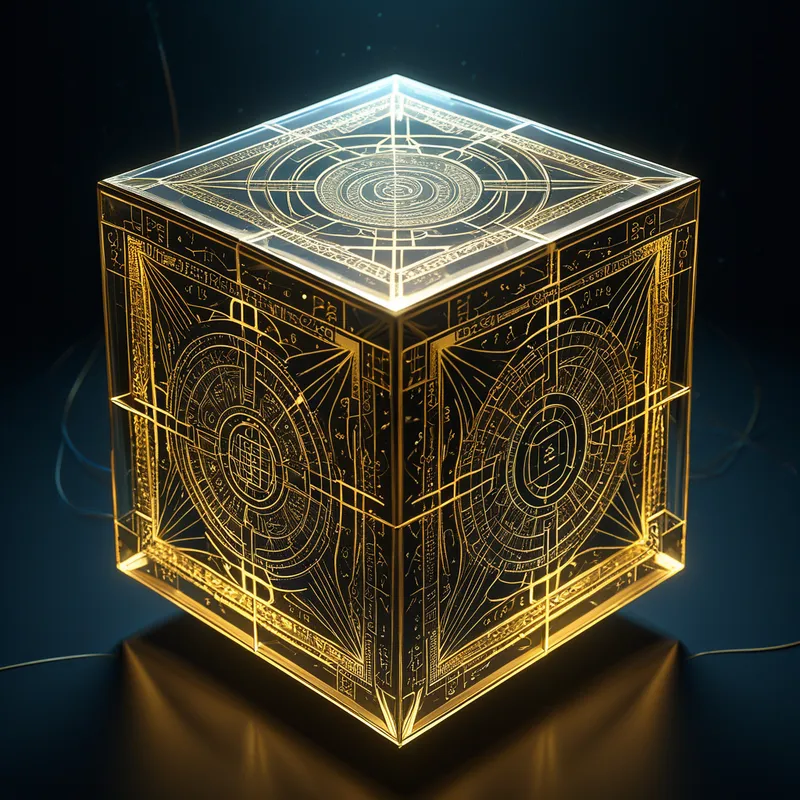
Every element is symbolic numerology and perfected substance. The twelve gates and foundations unite the old covenant (the tribes) and the new (the apostles), symbolizing the complete, foundational structure of spiritual tradition and community. The cube-shaped city (its length, width, and height are equal) is the Holy of Holies made universal, the most sacred inner chamber expanded to contain all of creation. The absence of a temple signifies the end of separation; the divine is immanent, directly accessible everywhere. The river of life and the tree of life are direct echoes of Eden, but now in an urban, communal setting, suggesting that the innocence of the garden is recovered not in primitive retreat, but through a sophisticated, communal consciousness. The healing of the nations points to the integration of the collective “other,” the foreign and the estranged, into a unified whole.
The Dreamer’s Resonance
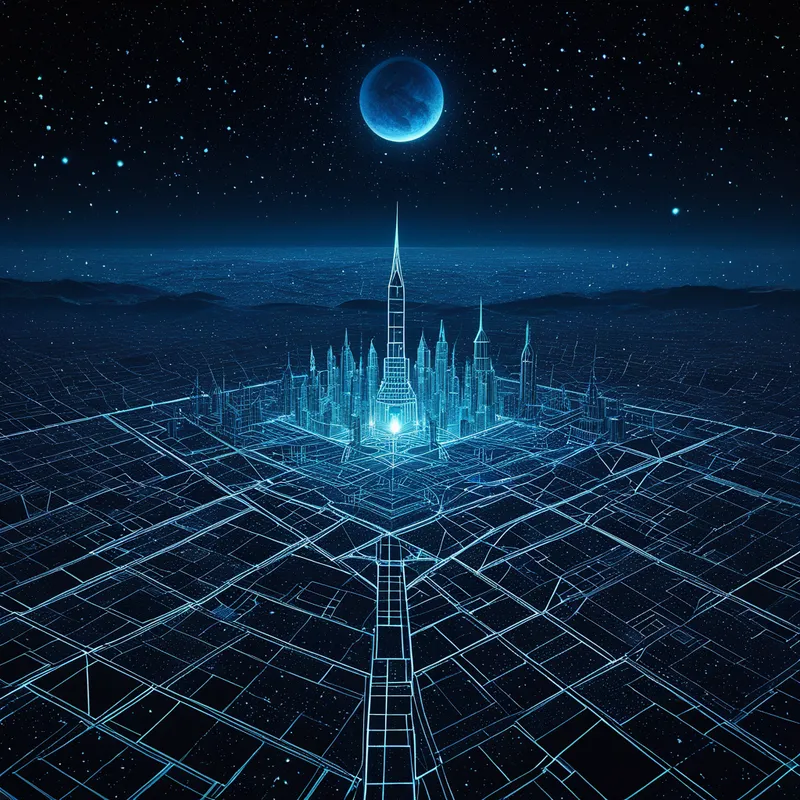
When this myth stirs in the modern unconscious, it often surfaces in dreams of astonishing architecture, of finding a secret, perfectly ordered room in one’s own house, or of a radiant cityscape on the horizon. One may dream of a cube of light, a geometrically perfect garden, or a fountain whose waters bring profound peace.
These are dreams of the Self announcing its presence. The somatic process is one of release and profound relief—the feeling of a burden lifted, a long-held tension dissolving. Psychologically, it marks a point where the ego’s frantic efforts at self-improvement and defense have exhausted themselves. The dreamer is undergoing a process of surrender to a larger, ordering pattern within. The dream of New Jerusalem is an experience of the psyche’s own blueprint for wholeness becoming perceptible, often after a period of great turmoil or “apocalypse” in one’s personal life. It is the unconscious affirming that a coherent, beautiful, and durable structure exists beneath the rubble of one’s personal crises.
Alchemical Translation
The alchemical process mirrored here is the opus contra naturam—the work against nature—which culminates in the lapis philosophorum, the philosopher’s stone, often depicted as a perfect, incorruptible crystal or cube. The personal “apocalypse” is the necessary nigredo, the blackening and dissolution of the old, rigid ego-structures (the “former things” that pass away).
The descent of the city is the albedo and rubedo combined: the whitening of purification and the reddening of sacred marriage, where spirit and matter, heaven and earth, consciousness and the unconscious, are united in a stable, golden state.
For the modern individual, the myth models the goal of individuation. We begin exiled on our own Patmos, isolated in our suffering and complexity. The conflict is the tension between our fragmented, earthly experience and the intuition of an inner unity. The rising action is the often-painful process of confronting our personal “Babylon”—our inner corruptions, addictions, and prideful structures. The resolution is not an aggressive victory, but a receptive unveiling. We do not build the New Jerusalem; we consent to its descent. We allow the divine pattern (the Self) to reconstitute our inner world. The gates are always open, meaning all aspects of the personality are welcomed, but ordered. The river of life flows from the throne, meaning vitality and creativity now source from the central, ruling principle of the integrated psyche, not from the ego’s fleeting desires. The work is the courageous endurance of one’s personal revelation until, at last, one can dwell in that unshakable inner city where God wipes away every tear.
Associated Symbols
Explore related symbols from the CaleaDream lexicon: