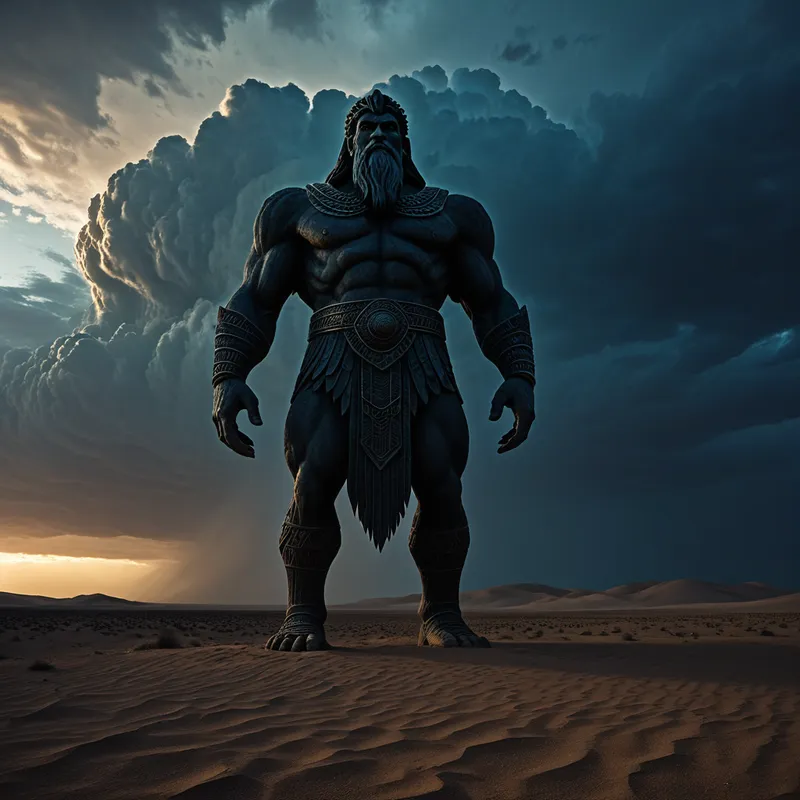
Nephilim Traces Myth Meaning & Symbolism
A cryptic tale of giants born from divine beings and human women, leaving a trace of the primordial in the human soul, a memory of a fractured world.
The Tale of Nephilim Traces
Listen. There is a memory in the blood, older than kingdoms, older than law. It whispers from a time when the veil between realms was thin as a moth's wing.
In those ancient days, when humanity was few and the earth was vast and unnamed, the sons of God looked upon the daughters of men. They saw that they were fair, and a longing awoke in them—a longing not for worship, but for the warmth of mortal flesh, for the taste of time-bound life, for the scent of soil in human hair. They descended. They took wives from among the women, choosing whomever they pleased.
From these unions, children were born. But they were not like other children. They were the Nephilim. They were the mighty men of old, the men of renown. Their bones were like pillars of basalt, their voices like the rumble from deep caverns. They walked the earth and it trembled; they cast shadows that swallowed villages. They were a new thing, a mingling of the unbounded divine spark and the grounded clay of mortality. They were hybrids, and the world had no law for them.
Their presence filled the land. Their strength was a legend and a terror. But the weaving of heaven and earth is a delicate, sacred pattern, and this was a violent stitch. The Lord saw that the wickedness of humankind was great on the earth, and that every inclination of the thoughts of their hearts was only evil continually. The boundary had been breached, and the corruption was not just of action, but of essence. The divine lineage was scattered, muddied.
Thus came the Great Unweaving: the Flood. The fountains of the great deep burst forth, and the windows of the heavens were opened. The waters rose to scour the earth clean, to wash away the corruption, to sink the giants beneath the waves of oblivion. The ark floated above the silence of a drowned world.
Yet… traces remain. Whispers in the text say the Nephilim were on the earth in those days, and also afterward. When the spies enter the land of Canaan, they report back in fear: “We saw the Nephilim there… and we seemed to ourselves like grasshoppers.” The trace persists. The memory of the hybrid lingers in the land, in the stories, in the deep fear and fascination of the human heart. They are gone, and yet not gone. A footprint fossilized in stone. A whisper in a dry wind.
Cultural Origins & Context
The fragments of the Nephilim narrative are found in the most archaic layers of the Book of Genesis (6:1-4) and in echoes within the Book of Numbers (13:33). These are not clean, priestly histories but raw, pre-Israelite lore, likely absorbed from the mythic milieu of Canaan and Mesopotamia. They are glimpses into a worldview where the cosmos was populated by various orders of beings—gods, divine council members (Bene Elohim), heroes, and monsters.
This story was likely told not in temples first, but around fires, a warning and a wonder tale. Its societal function was profound: it established a cosmic moral order. It explained why the world is flawed, why there is a pervasive sense of ancient, colossal evil, and why a radical cleansing (the Flood) was necessary. It served as a mythic etiology for the fearsome inhabitants of Canaan, justifying their displacement. Most crucially, it policed the ultimate boundary: that between the divine and the human. The message was clear: certain unions unravel creation itself.
Symbolic Architecture
The Nephilim are not merely monsters. They are the symbolic embodiment of a catastrophic, yet fascinating, hybridization. They represent the psyche’s encounter with contents too vast to be integrated gracefully.
The Nephilim are the shadow of aspiration itself—the catastrophic success of reaching for the gods without the container to hold their fire.
Psychologically, they symbolize the inflation that occurs when unconscious, archetypal energies (the "sons of God") overwhelm and possess the conscious, earthly personality (the "daughters of men"). The result is not enlightenment, but a monstrous, unbalanced ego—the "mighty man of renown" who is ultimately destructive because he is not truly human, nor truly divine. He is a god-complex walking the earth, a force of nature without a moral compass. The Flood, then, becomes a necessary, if traumatic, act of psychic hygiene—the overwhelming deluge of the unconscious that sweeps away a corrupted ego-structure so that a new covenant, a new relationship between consciousness and the divine, can be established.

The Dreamer's Resonance
When this myth stirs in the modern dreamer, it rarely appears as a literal giant. Instead, one may dream of being of impossible size, bursting through the roof of one’s childhood home. Or of discovering a hidden, colossal skeleton in the basement—a family secret too big to acknowledge. One might dream of a terrifying yet awe-inspiring figure that is both self and other, or of a romantic partner who feels profoundly alien, divine, and ultimately destabilizing.
Somatically, this can feel like a pressure in the bones, a sense of being too much for a room, or a deep, ancestral shame/ pride. Psychologically, it is the process of confronting one’s own "giant" aspects—the talents, drives, or traumas that feel superhuman and unmanageable. It is the dread and fascination of realizing that within you lies something that does not fit the neat categories of your personal history, something primordial and demanding recognition. The dream is the psyche’s Canaan, and you are the spy afraid of the giants within.
Alchemical Translation
The alchemical journey modeled here is not of slaying the giant, but of integrating its trace. The Nephilim were purged, but their trace remained. This is the key. Individuation is not about achieving a pure, angelic state. It is about consciously acknowledging and weaving together the hybrid nature of the psyche—the divine spark and the mortal clay.
The goal is not to become a son of God, but to become a conscious vessel where the dialogue between heaven and earth can occur without catastrophic possession.
The first step is the descent: acknowledging the "sons of God" within—those numinous, compelling complexes and aspirations. The second is the conjunction: consciously relating to them, not being possessed by them. The third is facing the Nephilim offspring: the often-messy, oversized, and shadowy results of those inner unions—our grandiosities, our overwhelming passions, our "too-muchness." The Flood is the necessary dissolution, the dark night where these inflated structures are humbled and washed away. The final, ongoing work is the resettlement of the land: building a conscious life (the new covenant) in a world where you know the traces of those giants are still in the soil. You learn to live with the memory of that hybrid power, respecting it, drawing wisdom from its legacy, but never letting it rule you again. You become the ark and the gardener, preserving the spark while tending the reclaimed earth.
Associated Symbols
Explore related symbols from the CaleaDream lexicon: