Nenets Creation Myth Myth Meaning & Symbolism
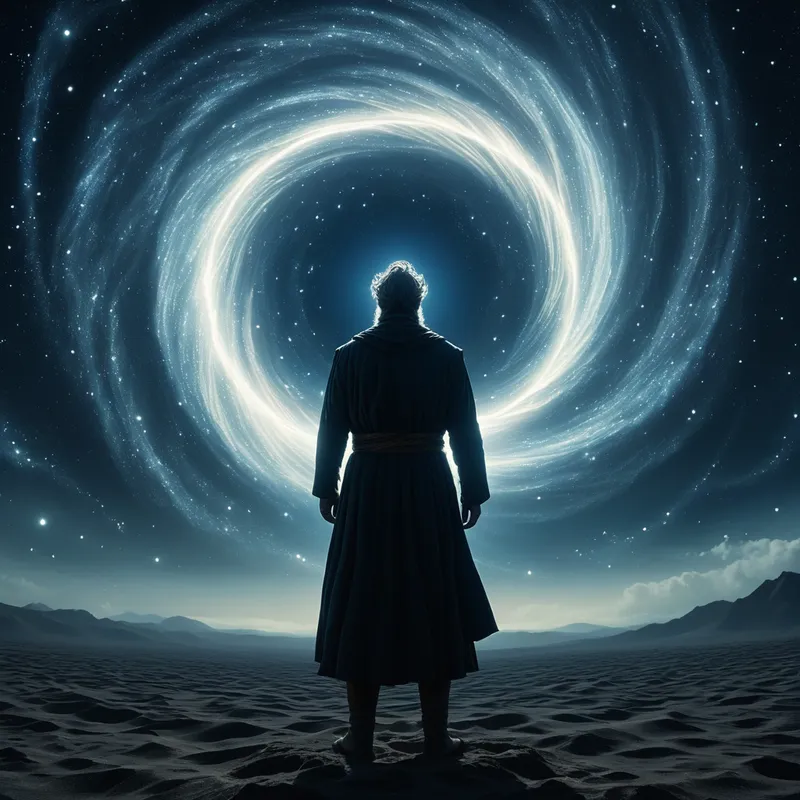
In the beginning, the sky god Num and the underworld spirit Nga fought. From their struggle, the world and its dualities were born.
The Tale of Nenets Creation Myth
In the time before time, there was no earth beneath, no sky above. There was only the endless, silent, dark water. And in that water, there was a thought. The thought was Num. He was not yet a form, but a presence, a gathering intention of light and warmth. He floated in the primordial sea, and his longing for a world was the first wind that ever stirred.
From the depths of that same dark water, another presence awoke. It was not a thought of light, but a force of raw potential, of churning chaos and boundless matter. This was Nga. Where Num dreamed of form and order, Nga was the formless stuff from which form must be carved.
Num spoke, and his voice was the first crack of light. “I will make a world,” he declared to the watery void. “A world of living things, of sun and breath.”
From the abyss, Nga replied, a gurgling, grinding sound like shifting stones. “You have no clay. You have no bone. All substance is mine. To make your world, you must wrest it from me.”
And so the first struggle began. It was not a battle of swords, but of wills and essences. Num, the spirit of the sky, reached down into the dark waters where Nga dwelled. He sought to pull up land, to create a foundation. But Nga clung to the substance, dragging it back into the formless deep. For ages unseen, they wrestled—light against dark, spirit against matter, order against chaos.
Num grew weary. His luminous essence was being swallowed by the endless, clinging dark of Nga’s realm. He knew he could not win by force alone. He needed an ally, a being born of both their natures. With a final, concentrated effort, Num took a piece of his own celestial light and a fragment of the chaotic matter he held from Nga. He breathed upon them, and from this mingling, the first shaman was born. This being was of the sky and the underworld, a bridge between the two gods.
The shaman, seeing the struggle, took action. He dove deep into the waters, to the very realm of Nga. There, he did not fight, but pleaded and bargained. He spoke of the beauty of the light, of the songs that could be sung in a world above. Some say he tricked Nga; others say he made a sacred pact. But from that encounter, the shaman returned with a gift—or a stolen prize: a handful of solid earth.
He gave this earth to Num. The sky god took it and placed it upon the surface of the waters. But it was too small, just an island. So Num sent a water bird—a loon or a diver—to fetch more. The bird dove, again and again, into Nga’s domain, each time bringing up a beakful of mud. Num spread this mud upon the waters, and it grew. He breathed upon it, and it solidified. He warmed it with his gaze, and grass sprouted. The earth was born from the stolen substance of the underworld, shaped by the spirit of the sky.
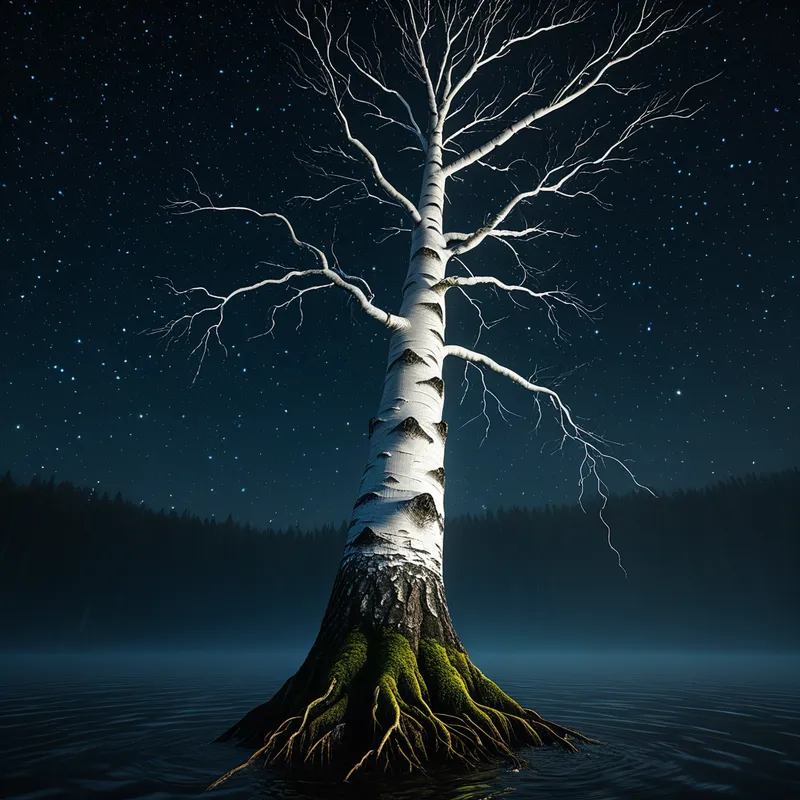
Yet Nga was not defeated. His essence was now woven into the very fabric of the world. He became the lord of the world below this one, the master of death, illness, and the dark season. And so the world was made: a fragile, beautiful layer of life, suspended between the luminous sky of Num and the churning, necessary darkness of Nga, forever connected by the sacred tree whose roots tap the underworld and whose branches touch the heavens.
Cultural Origins & Context
This myth comes from the Nenets people, whose homeland stretches across the Yamal Peninsula and the northwest Siberian tundra. In this world of extreme cold, vast silence, and stark seasonal duality, the myth was not merely a story but a cosmological map. It was transmitted orally by shamans (tadibya) across generations, often during rituals or in the intimate space of the chum.
Its societal function was profound. It explained the fundamental nature of reality: a world born from struggle, where opposing forces (sky/underworld, light/dark, summer/winter) are not enemies to be eradicated but necessary, co-existing principles. It established the sacred role of the shaman as the essential intermediary who can navigate both realms, healing illnesses (caused by Nga’s influence) by journeying to negotiate with spirits, much like the first shaman negotiated for the earth. The myth validated the Nenets' nomadic way of life, reminding them that the very ground they traversed was a sacred, contested gift, requiring respect and ritual observance to maintain balance between Num and Nga.
Symbolic Architecture
The myth presents a non-dualistic cosmology. Num and Nga are not good and evil in a simplistic sense. They are complementary archetypal forces. Num represents consciousness, order, light, and the upward-striving spirit. Nga represents the unconscious, chaos, matter, and the grounding, often difficult, reality of the body and death.
Creation is not an act of solitary genius, but a sacred theft from the realm of the unformed, a negotiation between spirit and substance.
The sacred tree is the central symbol of this integrated cosmos. Its roots in Nga’s realm acknowledge that our conscious life is nourished by and built upon the dark, rich soil of the unconscious and the reality of mortality. Its branches reaching for Num signify our spiritual aspirations. The shaman’s journey—diving into the depths to retrieve something of value—models the psychological process of delving into the unconscious (the personal and collective Nga) to retrieve vital energy, insight, or healing, and integrating it into the conscious self (the realm of Num).
The Dreamer's Resonance
When this mythic pattern stirs in the modern dreamer, it often manifests as dreams of profound struggle between opposing forces: light and dark masses, being pulled underwater or soaring into the sky, or encountering a formidable, earthy presence. One may dream of trying to build something on unstable ground, or of making a perilous bargain with a shadowy figure for a crucial piece of something.
Somatically, this can feel like a deep, grinding tension—a feeling of being torn between aspiration and limitation, between a desired identity and a stubborn, foundational reality (be it the body, family history, or past trauma). The psyche is enacting its own primordial drama: the conscious ego (Num) is attempting to create a coherent “world” of the self, but it must confront and engage with the powerful, often chaotic, material of the unconscious (Nga). The dream is the shamanic space where this negotiation occurs. The anxiety or awe in the dream signals the high stakes of this internal creation myth.
Alchemical Translation
The individuation process, the journey toward psychic wholeness, is mirrored perfectly in this myth. We begin in a state of unconscious unity (the dark waters), where our potential is undifferentiated. The emergence of the ego (Num) is the first light, the desire for a distinct, ordered self. But this ego soon discovers it cannot create itself ex nihilo. It is confronted by the Shadow—the personal Nga—comprising all the rejected, instinctual, and “earthy” parts of ourselves we have tried to ignore.
Individuation is the sacred theft of one’s own soul from the grip of the unlived life, forging a self from both light and shadow.
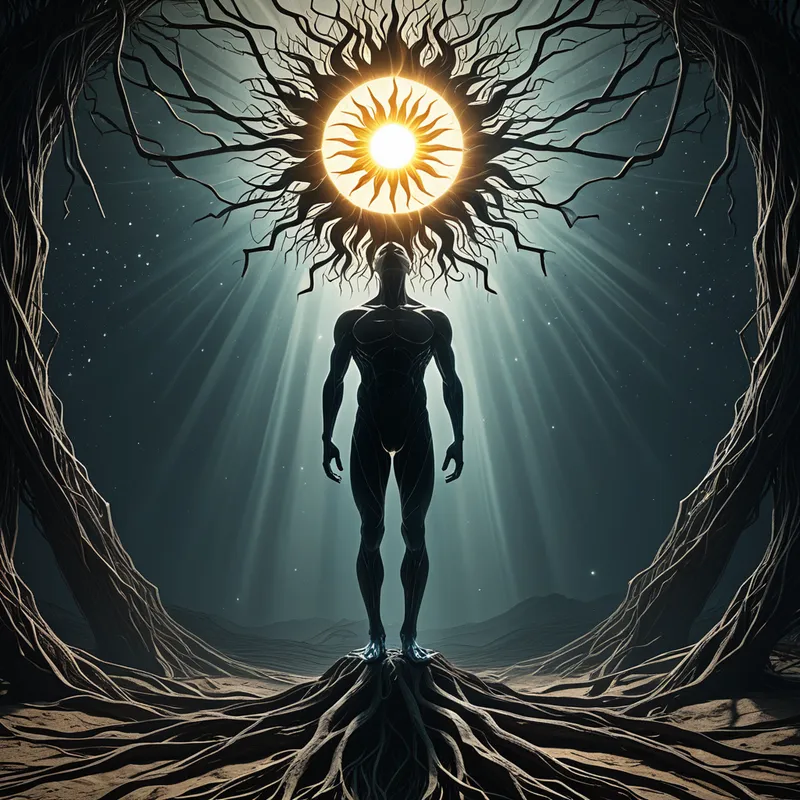
The struggle is inevitable and necessary. We cannot simply vanquish our shadow; it is the very substance of our being. The alchemical work is the shaman’s dive: the courageous descent into the unconscious (through introspection, therapy, creative work, or confronting fears). There, we do not fight, but we learn, bargain, and ultimately retrieve something precious—a lost talent, a buried emotion, an accepted flaw. This retrieved “earth” is then integrated by the conscious mind. We build our stable ground, our authentic self, from this amalgam of spirit and shadow, order and chaos. The sacred tree becomes the symbol of the individuated Self, no longer at war with its foundations, but rooted in them and reaching toward its highest potential. We become the living axis where Num and Nga find their destined, creative balance.
Associated Symbols
Explore related symbols from the CaleaDream lexicon:
- Earth — The world itself, born from the stolen substance of Nga, representing the foundational, material reality that is both a gift and a contested ground between opposing forces.
- Sky — The realm of Num, representing consciousness, order, spirit, and the aspirational dimension of existence that seeks to shape and illuminate the world below.
- Tree — The world axis, its roots in the underworld of Nga and branches in the sky of Num, symbolizing the interconnectedness of all realms and the structure of a balanced cosmos.
- Water — The primordial, chaotic substance from which all form emerges, representing the unconscious, potential, and the formless state before differentiation.
- Journey — The shaman's dive into the underworld, modeling the necessary descent into the unknown or the unconscious to retrieve what is needed for creation and healing.
- Sacrifice — Num's expenditure of his own essence to create the first shaman, and the shaman's risky negotiation, representing the necessary cost of bringing something new into being.
- Spirit — The essence of Num and the animating force he seeks to impart to the world, representing the non-material principle of life and consciousness.
- Shadow — The realm and essence of Nga, representing the unconscious, chaotic, and often rejected aspects of reality that are nonetheless fundamental to existence.
- Bird — The diver who retrieves the earth, often a loon, acting as a messenger and helper who traverses the boundary between the watery depths and the air, facilitating creation.
- Root — The part of the world tree that delves into Nga's domain, symbolizing our deep, often hidden connection to the foundational, chaotic, and material sources of life.
- Light — The emanation of Num and the first element of creation, representing consciousness, clarity, warmth, and the principle of order emerging from darkness.
- Chaos — The inherent state of Nga's realm, not as mere disorder but as the fertile, boundless potential from which all specific forms are temporarily shaped.