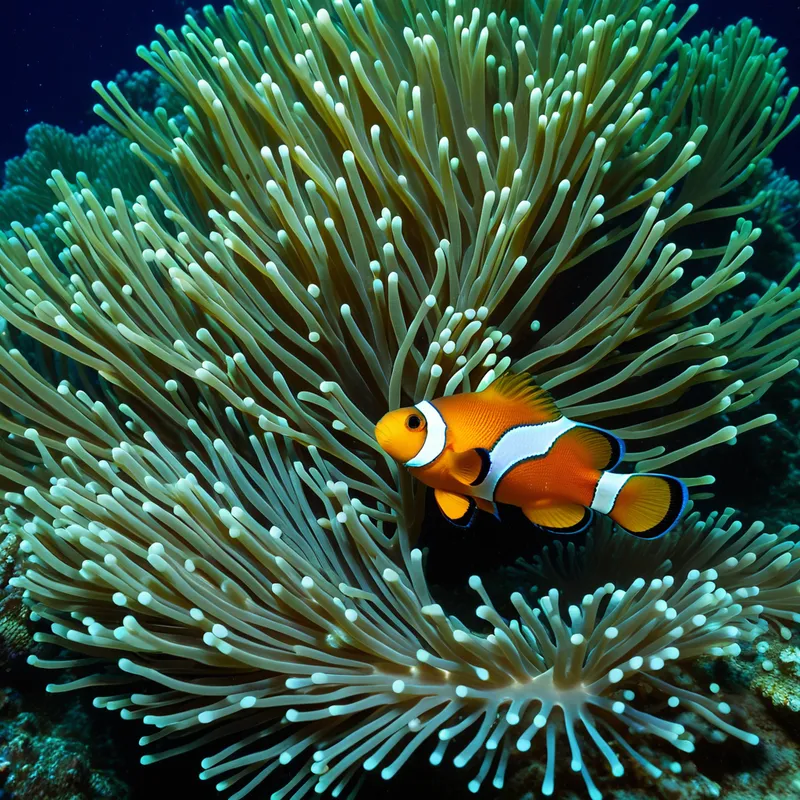
Nemo Myth Meaning & Symbolism
A small, marked child is taken into the abyss, compelling his overprotective father to descend into the unknown to reclaim him, forging a new bond.
The Tale of Nemo
Listen, and I will tell you of the Great Ocean, and of the small, bright spark born into its sunlit shallows. His name was Nemo, and he carried upon his side a mark of fate—a fin smaller than its twin, a badge of perceived limitation given to him by the jaws of the unseen. His father, Marlin, whose heart was scarred by a great and terrible loss, built a world of fearful walls around his son: the safe borders of their Anemone Home.
But the heart of a child yearns for the horizon. On the day of his first journey to the Edge of the Drop-Off, defiance sparked. To prove his courage, Nemo touched the hull of a Shadow Vessel. In an instant, a net of cold light snatched him from the warm waters. His father witnessed the abduction, a scream of bubbles lost in the deep blue silence. The Shadow Vessel ascended and vanished, taking the bright spark into the realm of air and mystery.
Thus began the great descent. Marlin, armed with nothing but a terror greater than the ocean itself, plunged into the abyss. His guide was Dory, a blue tang whose memory was a shifting current, yet whose spirit was an unwavering light. Together, they navigated the terrors of the deep: the valley of the Anglerfish, the swirling madness of the East Australian Current, and the clutches of a Bloom of Jellyfish.
Meanwhile, Nemo found himself in a strange, circular prison of clear stone: a Healer's Vessel in the realm of a Trembling Collector. There, he met the Tank Gang, who had turned their prison into a society of elaborate escape rituals. Nemo learned of his fate—to be a gift to the Collector’s destructive niece—and his small fin was labeled not as a mark of weakness, but as a lucky fin by a wise elder, Gill.
The paths of father and son converged in the harbor of the surface-dwellers. Through a daring plan involving a Filter's Stone, Nemo feigned death to escape his prison, tumbling through the pipes of the world above and back into the open sea. But the reunion was shattered as Dory was caught in a fishing net. It was Nemo, the small, marked child, who now taught his father the true meaning of courage, instructing him to tell all the fish to swim down together. In a moment of transcendent unity, the school swam as one, breaking the net. The spark was reunited with his protector, but both were now transformed. They returned not to the old, fearful anemone, but to a community, with Dory as family. The small fin was no longer a mark of limitation, but a badge of a journey completed.

Cultural Origins & Context
This myth emerged not from ancient oral tradition, but from the modern Disney culture in the early 21st century. It was transmitted not by bards around a fire, but through the sacred, glowing screens of the Cine-Temples. The myth-makers, Stanton and his circle, channeled a universal anxiety of the age: the terror of losing a child in an increasingly vast and interconnected, yet strangely impersonal, world.
Its societal function was dual. For the young, it was a tale of adventure and rebellion against parental confines. For the adults, it was a profound meditation on anxiety, grief, and the necessity of letting go. It served as a communal ritual for processing the core familial drama of attachment and separation, rendered in a palette so vibrant it could hold the terror of the abyss without breaking the viewer’s spirit. It became a foundational story, passed from parent to child, a shared language for speaking about fear, difference, and love.
Symbolic Architecture
At its heart, the myth of Nemo is a dual journey of the Innocent and the Protector into the Oceanic Unconscious.
The marked fin is not a curse, but a sigil of destiny. It is the flaw that makes the hero unique, the vulnerability that necessitates the journey and invites the aid of allies.
Nemo represents the nascent Self, curious and defiant, whose necessary rebellion against the suffocating security of the parental complex (Marlin) initiates the entire alchemical process. His captivity in the Healer's Vessel symbolizes the ego’s entrapment in a foreign system of value—seen as a decorative object, his essence misunderstood.
Marlin’s journey is the arduous path of the Wounded Parent. His guiding principle is not wisdom, but trauma. Dory, with her short-term memory loss, is the perfect psychopomp for him; she is the principle of Divine Forgetfulness. She forces him to live in the present moment, the only place where healing can occur. The terrifying creatures they meet are the projected Shadows of Marlin’s own anxiety.

The Dreamer's Resonance
When this myth stirs in the modern dreamer, it signals a profound somatic and psychological process of separation and retrieval. To dream of a small, bright fish being swept away often touches the dreamer’s own sense of a precious, vulnerable part of the self—creativity, innocence, joy—that has been lost or captured by the demands of the outer world (the Shadow Vessel).
Conversely, to dream of desperately searching through a vast, dark ocean speaks to the ego’s frantic attempt to reclaim a lost connection to vitality or to integrate a forgotten trauma. The recurring motif of the “lucky fin” in a dream is a powerful message from the unconscious: the quality you perceive as your greatest weakness or difference is, in fact, the key to your unique destiny and your point of connection with others. The dream is initiating a re-framing of personal wounding into personal myth.
Alchemical Translation
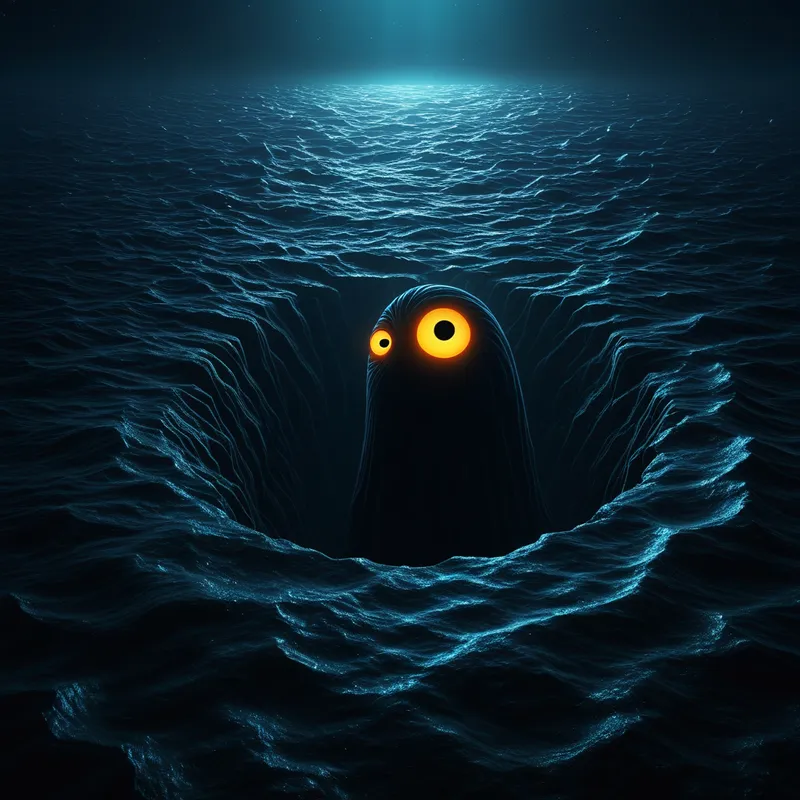
The myth models the process of Individuation as a perilous oceanic journey. The starting point is the nigredo, the blackening: the traumatic loss that scars Marlin and the violent abduction of Nemo. This is the necessary descent into darkness and despair.
The reunion does not occur until both father and son have been broken by the deep. The old self must drown so the new, more resilient self can breathe.
The albedo, the whitening, is represented by the guidance of Dory (the irrational, intuitive function) and the cleansing trials, like the escape from the jellyfish. It is the purification of perception. The final rubedo, the reddening, is the triumphant, communal act of saving Dory from the net. Here, the transformed father (Marlin, who has learned to trust) and the transformed son (Nemo, who has learned courageous action) synergize. They enact a new pattern: not fearful control, but coordinated, trusting action within a community.
The return home is not a regression. The Anemone Home is now part of a wider, welcoming reef that includes the once-outsider Dory. The psychic transmutation is complete. The Protector has integrated his shadow (his cowardice) and found courage. The Innocent has integrated his flaw and found agency. Together, they have redeemed the past trauma by not repeating its pattern of isolation, but by forging a new, more expansive and loving whole. The myth teaches that wholeness is not found in safety, but in the sacred, terrifying, and ultimately unifying journey through the deep.
Associated Symbols
Explore related symbols from the CaleaDream lexicon: