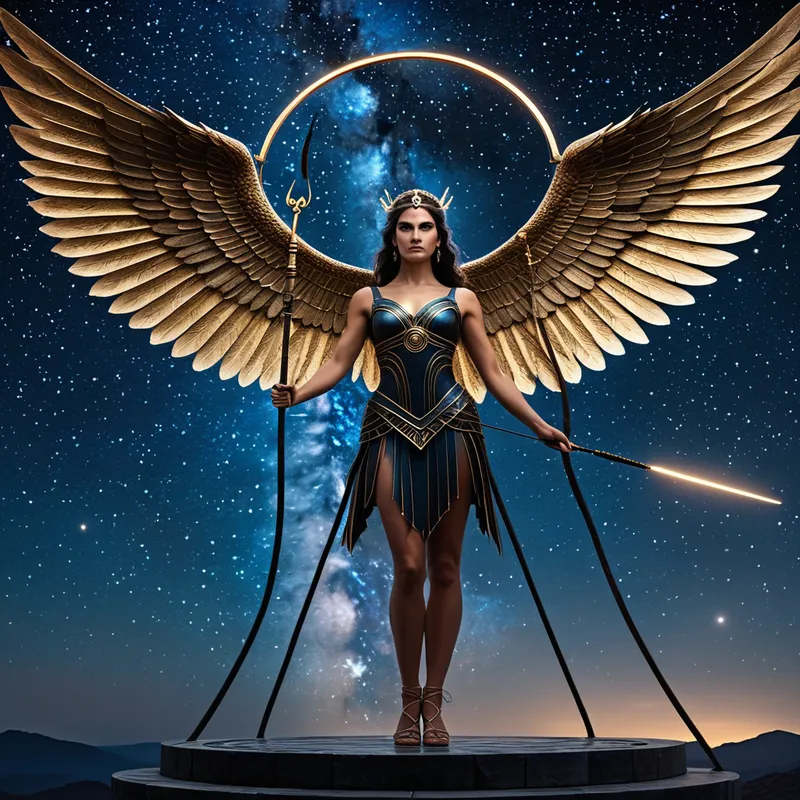
Nemesis Myth Meaning & Symbolism
The ancient story of the goddess who enforces cosmic balance, ensuring that no mortal, no matter how powerful, escapes the consequences of hubris.
The Tale of Nemesis
Listen, and hear the tale that is not told in the sunlit halls of Zeus, but whispered in the sacred groves where the cypress trees grow thick and the waters run deep and dark. It is the story of Nemesis, the Inescapable, she whose name means “to give what is due.”
In the beginning, there was only balance. From the primordial void of Chaos, she arose, a daughter of the night, a sister to Nyx. She was not cruel, but she was inexorable. Her domain was the sacred equilibrium of the cosmos, the law that for every action, there is an answering reaction. She measured the thread of fortune with her rod, and when it grew too long, when mortal hearts swelled with a pride that scraped the heavens, she would appear.
Her most famous reckoning came for a queen of Sparta, a woman of such surpassing beauty that she believed even the gods would kneel. Her name was Leda. Blinded by her own radiance, Leda spurned the humble altars and forgot the libations due to the unseen powers. She walked the earth as if she were its only goddess. The imbalance grew, a silent, gathering storm.
Nemesis, from her watchful place at the edge of the world, saw the distortion. She felt the cosmic scales tremble. Donning a form of terrible gentleness, she descended. She found Leda not in her palace, but by a secluded, mirror-still lake in a grove sacred to Artemis. There, Nemesis took the shape of a swan, a creature of both earth and sky, of purity and profound mystery. She glided upon the dark water, a vision of serene, alien beauty.
Leda, drawn to the shore, beheld the magnificent bird. In her hubris, she saw only a prize, a thing to be possessed, a testament to her own allure. She reached out. And in that moment of grasping, of believing the world existed only for her touch, the balance was restored with a force that would echo through eternity. For the swan was also Zeus, who had pursued Nemesis herself. From that fateful union, forced by divine necessity upon the proud queen, an egg was laid. From it hatched Helen—a face that would launch a thousand ships, and a war that would burn a mighty city to the ground. The pride of one woman became the downfall of nations. Such is the measure Nemesis applies; the consequence always fits the cause, often in ways the mortal mind cannot foresee. She turned, her wings casting a long shadow, and vanished back into the fabric of fate, her work complete. The wheel had turned.

Cultural Origins & Context
The figure of Nemesis is ancient, her roots stretching back into the pre-Olympian chthonic powers. She was worshipped not as a capricious Olympian, but as a fundamental, impersonal force—akin to Moira (Fate) or Dike (Justice). Her primary cult center was at Rhamnous in Attica, where a majestic temple housed a statue by the sculptor Phidias, showing her as a stern, winged goddess.
Her myth was not a simple bedtime story but a vital societal and religious mechanism. In a culture deeply concerned with hubris—the overweening pride that invites destruction—Nemesis personified the inevitable corrective. She was the answer to the question, “What happens when a king, a hero, or a city believes itself beyond the limits?” Poets like Hesiod and tragedians like Aeschylus wove her into their works as the ultimate guarantor of cosmic order. She was the check on mortal excess, ensuring that no happiness was too great, no power too absolute, to escape the balancing turn of her wheel. To acknowledge Nemesis was to practice a form of ancient wisdom: humility in the face of fortune’s gifts.
Symbolic Architecture
Nemesis is not vengeance; she is consequence. She is the embodiment of a universal psychological and physical law: energy must balance. Her symbols reveal her essence.
Her wheel represents the cyclical nature of fortune and the inescapable turning of fate. What goes up, must come down. Her wings signify her omnipresence; no one can outrun the repercussions of their actions. The measuring rod (gnomon) and the scales speak to her impartiality and precision. She does not punish out of malice, but restores equilibrium with mathematical certainty.
Nemesis is the shadow of success, the silent partner to every triumph. She is the law that whispers: to whom much is given, much is expected, and from whom much is taken, much will be restored in time.
Psychologically, she represents the autonomous functioning of the conscience and the Self-regulating principle of the psyche. When the ego inflates, identifying entirely with its persona of success, power, or beauty, the Self (the total, regulating center of the psyche) must act to correct the imbalance. This correction often feels like a cruel, external fate—a sudden loss, a downfall, a humiliation—but it serves the vital purpose of reconnecting the individual with reality. She is the archetype of necessary suffering, the pain that forces growth and reorientation towards wholeness.
The Dreamer's Resonance
When the pattern of Nemesis stirs in the modern unconscious, it often manifests in dreams of profound reckoning. You may dream of being pursued by an implacable, faceless figure. You may find yourself in a courtroom where you are both the accused and the judge, with the evidence overwhelmingly stacked against you. Dreams of natural disasters—a rising flood that washes away your carefully built home, a sudden storm that grounds your flight—can embody her force.
Somatically, this process can feel like a crushing weight on the chest, a sense of being “found out,” or a deep, anxious trembling—the body’s recognition that a long-ignored debt is coming due. Psychologically, it is the moment when repressed guilt, ignored responsibilities, or inflated self-image can no longer be contained. The dreamer is going through a psychic correction. The ego is being confronted with the aspects of life or self it has arrogantly dismissed or trampled in its ascent. This is not punishment, but a brutal, loving call back to the ground of being, a demand for authenticity over image.

Alchemical Translation
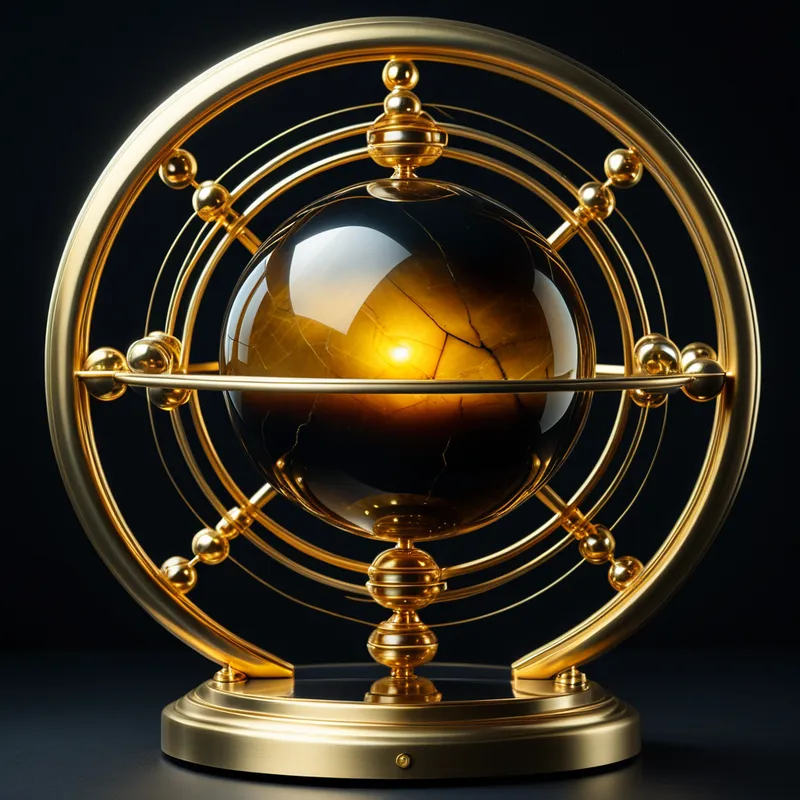
The alchemical journey is one of transmutation: turning leaden, unconscious existence into golden consciousness. The Nemesis archetype is the crucial, dreaded stage of mortificatio or nigredo—the blackening, the dissolution, the “death” of the old, inflated king.
The individual who has achieved worldly success (the hubris of Leda) must, for true individuation, encounter their Nemesis. This is the collapse of the carefully constructed persona. The job is lost, the relationship fails, the health declines, the reputation is tarnished. In the alchemical vessel of the soul, this feels like utter ruin.
The sting of Nemesis is the first touch of the Philosopher’s Stone. It is the heat that cracks the shell of the ego, allowing the essence within—the authentic self—to begin its slow coagulation.
This process models psychic transmutation by forcing a sacrifice of inflation. The individual must surrender their identification with their success, beauty, or power. This is agonizing, a divine humiliation. Yet, from this ashes, something new is born. Just as the egg of Helen contained both divine beauty and devastating war, the outcome of our personal encounter with Nemesis contains the seed of our future consciousness. We integrate our shadow—the ignored, the arrogant, the denied parts of ourselves. We learn humility not as weakness, but as strength, as alignment with a larger order. We exchange a small, tyrannical kingship over a fragile domain for a humble citizenship in the vast, mysterious cosmos. The wheel turns, not to crush us, but to bring us, humbled and whole, back to the center. This is her ultimate gift: the restoration of balance, which is the foundation of true, enduring selfhood.
Associated Symbols
Explore related symbols from the CaleaDream lexicon: