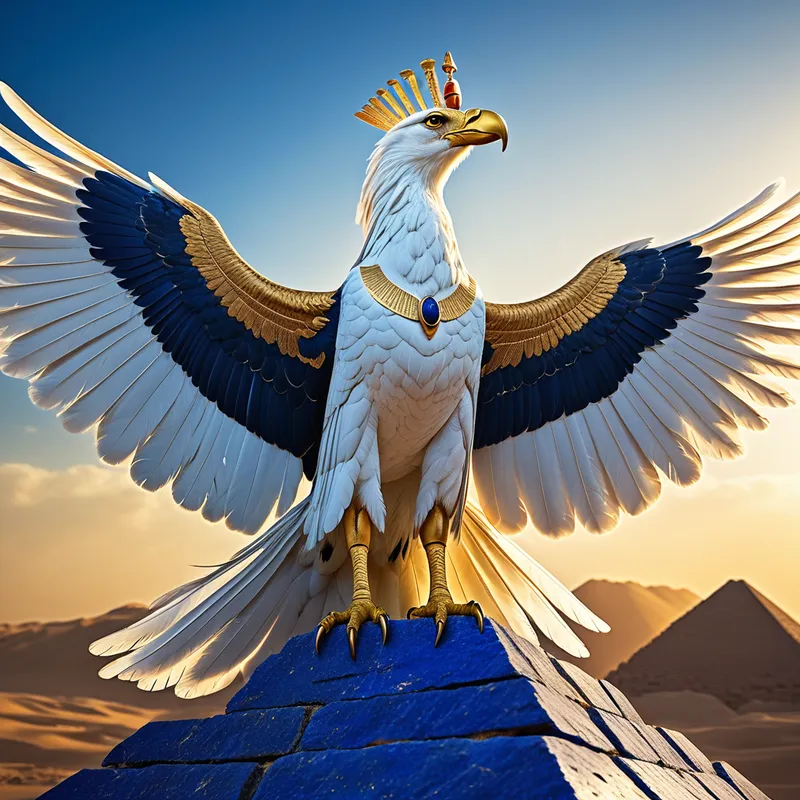
Nekhbet Myth Meaning & Symbolism
The story of the celestial vulture, Nekhbet, whose vast wings shield the pharaoh and whose gaze transforms decay into enduring sovereignty.
The Tale of Nekhbet
Hear now the whisper of the hot wind over the red land. Feel the sun, Ra, a blazing disk of hammered gold, pressing upon the twin crowns of the earth. In the south, where the cliffs rise like the ribs of the world and the river carves its life-giving path, there is a silence that is not empty, but watchful.
It is the silence before the wingbeat.
From the blinding heart of the sun, she descends. Not with the fury of a storm, but with the terrible, slow certainty of a destiny fulfilled. She is Nekhbet, the White One of Nekheb. Her feathers are not merely white; they are the white of bleached bone under a millennium of stars, the white of the midday sun that scours all shadow, the white of the sacred crown of the South. Her eyes are chips of flint, seeing the curve of the horizon, the tremor in the sand, the thread of a single life against the tapestry of eternity.
She does not hunt the living gazelle. Her domain is the threshold. She circles the places where life has ended, where the body becomes a mystery. To the fearful, she is a sign of ending. But to the one who knows the sacred patterns, her descent is a promise. Where she lands, a profound alchemy begins. That which is forsaken, that which is in decay, is not forgotten. Under her gaze, it is gathered. It is transformed. The flesh returns to the cycle, but the essence—the ka, the ba—is purified, protected.
And so she came to the first king, when the Two Lands were one in his person. He stood on the pinnacle of his palace, the weight of the red and white crowns heavy upon him, a solitary figure between the river and the desert, between order and chaos. The shadow of her wings fell upon him, not as a threat, but as a canopy. She did not speak in words of men, but in the language of presence: a rustle of primaries like the shifting of sands, a glint in her eye like the flash of a royal scepter. In that moment, he was no longer just a man ruling men. He was the protected one. Her talons, which could strip a carcass to its truth, became the gentle, unshakeable grip that lifted his sovereignty into the realm of the divine. She was his mother in the sky, her wings the walls of his celestial citadel. To threaten him was to enter her circle. To challenge his rule was to feel the wind of her descent.
Cultural Origins & Context
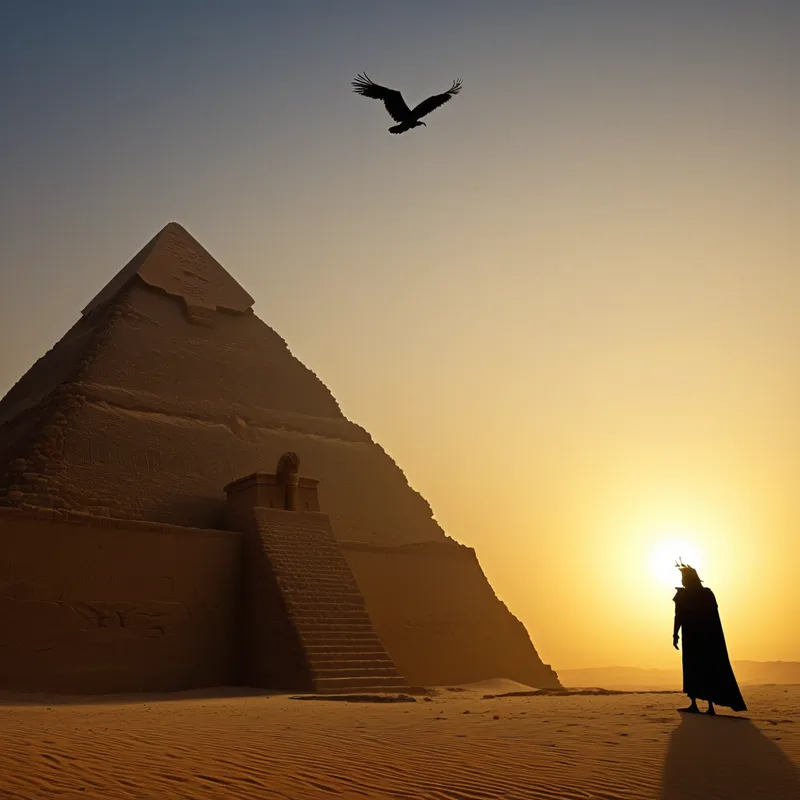
Nekhbet’s origins are as ancient as the Egyptian state itself, emerging from the predynastic cultures of Upper Egypt. Her city, Nekheb, across the river from the royal city of Nekhen, was a powerhouse of early kingship. She was not a goddess of the cosmic deep or the abstract heavens, but a deity of tangible, earthly power and territory. Her myth was not a single narrative poem but a living ideology woven into the very fabric of kingship.
Her story was passed down not by bards in taverns, but by priests in temple sanctuaries and artisans in royal workshops. It was told in the ritual wrapping of the mummy, where her image on amulets guarded the body’s transformation. It was proclaimed in the titulary of the pharaoh, who was “He of the Sedge and Bee,” with Nekhbet as the sedge plant’s divine patron of the South. Her function was unequivocal: she was the divine legitimizer and protector of the royal person. In a world where the pharaoh was the linchpin holding cosmic order (Maat) against chaos (Isfet), Nekhbet was the fierce, unwavering force that ensured that linchpin held firm.
Symbolic Architecture
Nekhbet’s symbolism is a profound study in the reconciliation of opposites, a core tenet of Egyptian thought. She is the vulture, a creature associated with death and decay, who becomes the ultimate symbol of life-giving protection for the king—and by extension, the state. This is not a contradiction but a deep alchemical truth.
The protector must first understand what is truly threatened; she must gaze unflinchingly upon the reality of dissolution to safeguard the principle of enduring form.
Her whiteness symbolizes purity, but not an innocent purity. It is the purity of the desert sun, sterilizing and absolute. It is the purity of the funerary linen, the clean bone after the flesh’s work is done. She represents the necessary, unsentimental aspect of sovereignty: the power that must sometimes confront death and decay to preserve the greater whole. Psychologically, she embodies the Self in its protective, ordering function. She is that inner authority which does not shy away from the shadowy, difficult, or “unclean” aspects of existence but integrates them into a higher, protective order. Her extended wings symbolize the all-encompassing, non-negotiable boundary of the psyche’s sacred center—the king within—that must be defended for integrity to exist.

The Dreamer's Resonance
When the image of Nekhbet arises in the modern dreamscape, she rarely appears as a literal vulture. She may manifest as a vast, shadowy canopy, an overwhelming sense of being watched from above, or a sudden, clean clarity in a situation of moral or emotional “decay.” She appears when the dreamer’s psychological sovereignty is at stake.
To dream of her protective wings might indicate a process of establishing healthy, fierce boundaries. It can signal that the dreamer is learning to protect a vulnerable, nascent sense of self or a creative project (their “inner kingdom”) from external chaos or internal doubt. Conversely, to dream of her circling overhead can feel ominous, pointing to an area of life—a relationship, a career, a habit—that has reached its natural end and requires the “vulture’s” attention. It is the psyche’s way of insisting on a necessary ending, a stripping away of what is no longer viable, so that the essential core can be identified and safeguarded. The somatic sensation is often one of a chilling clarity, a wind from a high, cold place, followed by a paradoxical feeling of profound safety.

Alchemical Translation
The individuation process modeled by Nekhbet is not one of heroic questing, but of fierce, loyal guardianship and transformative reclamation. It is the alchemy of the nigredo—the blackening, the confrontation with decay and shadow—performed in service of the rubedo, the enduring, sovereign self.
The myth teaches that true authority is not taken, but received by those willing to stand in the place of greatest responsibility and undergo the transformation it demands.
For the modern individual, this translates to the difficult work of “sovereign making.” First, one must courageously circle the areas of one’s own life that are in a state of decay—outmoded beliefs, unresolved grief, toxic patterns—and allow Nekhbet’s gaze to fall upon them. This is the descent into honest self-appraisal. The second stage is her protective embrace: from the clarity of what must end, one identifies the indestructible core of one’s values, purpose, and identity—the “inner pharaoh.” This core is then placed under protection. It becomes non-negotiable. One learns to extend the “wings” of healthy boundaries, discerning action, and loyal self-defense. The ultimate triumph is not conquest, but the establishment of a stable, resilient center of being that can oversee the full cycle of life and death within the psyche, transforming the raw material of experience into the gold of authentic, enduring character.
Associated Symbols
Explore related symbols from the CaleaDream lexicon: