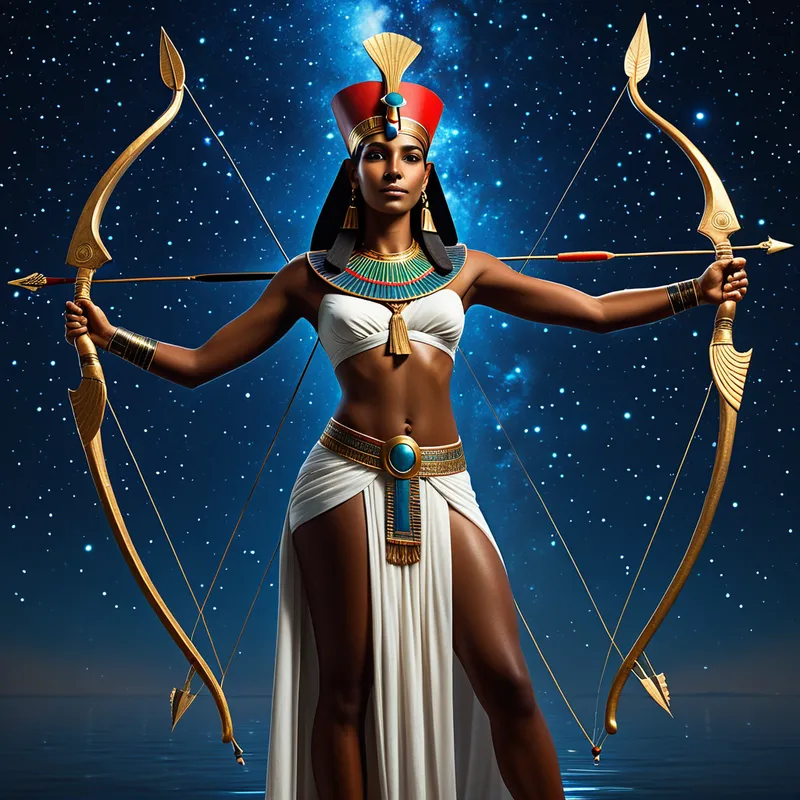
Neith Myth Meaning & Symbolism
The self-begotten goddess who wove the cosmos from her own being, embodying the primal unity of creation, destruction, and sovereign wisdom.
The Tale of Neith
Before the first name was spoken, before the first god drew breath, there was the silence of the deep. Not an empty silence, but a pregnant, humming silence—the silence of potential. And within that silence, she stirred.
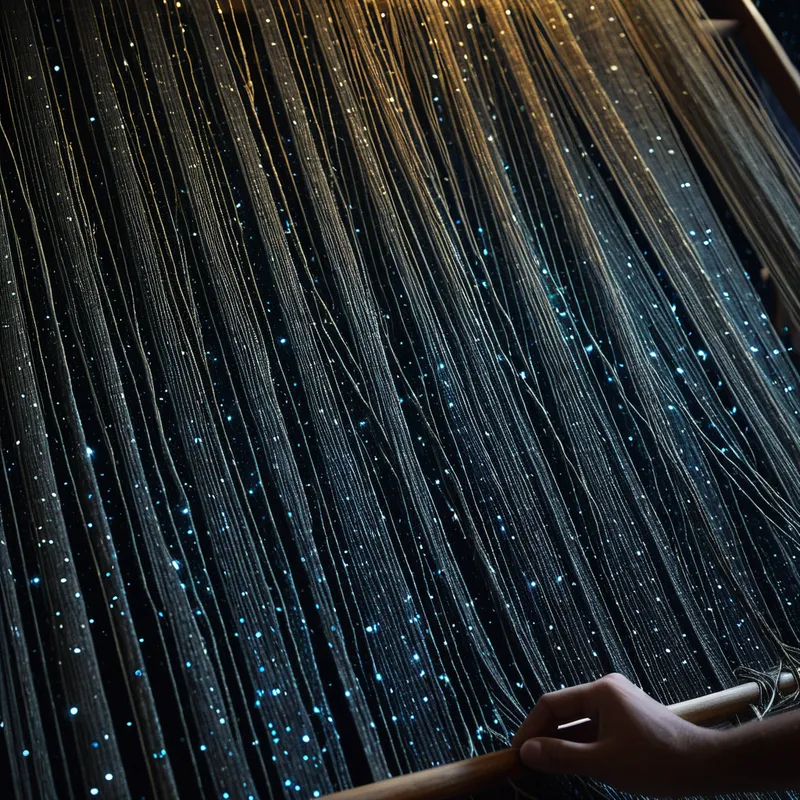
She was the first movement in the still waters of Nun. No father called her forth. No mother bore her. She was Iut, the great "I Am." From the core of her own boundless being, she spoke the world into existence. Her voice was not a sound, but a vibration—a shuttle passing through the loom of the void. With each pass, a star was knotted into place. With each turn, a law of reality was set into the weave.
They called her Neith, and her city was Sais. Here, her priests would whisper the secret kept from the younger gods: "I am all that has been, that is, and that will be. No mortal has yet lifted my veil."
Yet, the gods, her children in spirit if not in blood, knew her as the unshakable arbiter. When the great conflict erupted between Horus and Set, a feud that tore the fabric of Ma'at itself, they raged and schemed for decades. The Ennead was divided, heaven itself trembled with their discord. Finally, in desperation, they turned to the primordial source. They journeyed to the edge of the known, to where the waters of Nun lapped against the pillars of her temple.
They found her not on a throne, but at her loom. The click-clack of the shuttle was the only sound. She did not look up as they presented their grievances—the tale of murder, of usurped eyes, of unending vendetta. She listened, her hands never ceasing their work. Finally, as the last plea faded into the temple's gloom, she spoke. Her verdict was not a compromise, but a revelation of fundamental law. It was a judgment that recognized the complex tapestry of justice, where right was not always simple, and order sometimes required acknowledging the wildness of the desert. Her words, written on a celestial papyrus and sent to the Ennead, carried the weight of the first dawn. The gods, humbled by the authority of the one who wove them, accepted her decree.
And so, she returns to her weaving. The tapestry she creates is the cosmos itself—the rise and fall of kingdoms, the path of the sun barque, the destiny of every soul that drinks from the Nile. She is the weaver, and the woven. The huntress, and the hunted truth. The mother, and the self-created child.
Cultural Origins & Context
The veneration of Neith is ancient, stretching back to the dawn of Egyptian dynastic history, where she was a patron deity of the earliest kings. Her cult center at Sais in the Nile Delta remained a profound seat of theological mystery for millennia. The famous inscription reported by the Greek historian Plutarch—"I am all that has been, that is, and that will be"—echoed in her sanctuary, hinting at a monotheistic or pantheistic layer within the polytheistic framework. This was not a popular myth recited in marketplaces, but a deep, esoteric understanding preserved by priestly castes and royalty.
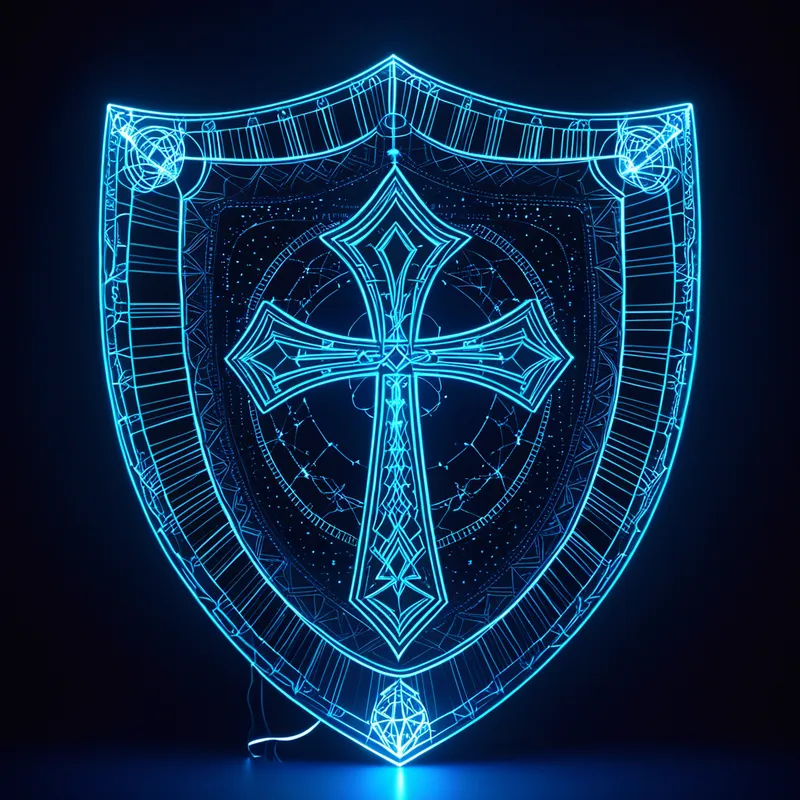
Her societal function was multifaceted. As a warrior goddess, she was invoked for protection, her emblem—the crossed arrows and shield—adorning military equipment. As a funerary goddess, she guarded the canopic jars and the viscera of the deceased, a weaver of the soul's final shroud. Most significantly, she represented the ultimate, self-sufficient creative principle. In a culture obsessed with cycles of birth and rebirth, Neith stood prior to the cycle itself—the unmoved mover, the uncreated creator. Her myths were not mere stories but cosmological maps, teaching that all duality (male/female, order/chaos, life/death) emerges from a prior, unified field of consciousness.
Symbolic Architecture
Neith embodies the archetype of the prima materia—the original, undifferentiated substance from which all forms are shaped. She is not just a creator goddess; she is creation as an act of self-conception.
To be self-created is to hold your own origin within you, making every end a potential new beginning authored by the same hand.
Her primary symbols form a powerful triad. The loom represents the structured, intelligent matrix of reality—the laws of physics, fate, and Ma'at—into which the raw threads of possibility are woven. The shield and crossed arrows signify the dynamic tension necessary for creation: the protective, containing boundary (the shield) and the active, penetrating force that defines and discriminates (the arrows). Finally, the waters of Nun from which she emerges are the symbolic unconscious—the formless, potential-filled void that precedes and undergirds all conscious structure.
Psychologically, Neith represents the Self in its most primordial Jungian sense—the totality of the psyche that pre-exists and orchestrates the dance between the ego, the persona, and the shadow. She is the psyche's innate capacity for autopoiesis, self-creation and self-maintenance.
The Dreamer's Resonance
When the pattern of Neith stirs in the modern dreamer, it often manifests not as a literal figure, but as an experience of profound, self-contained creativity or arbitration. One might dream of weaving a vast, complex tapestry alone in a silent room, feeling both immense responsibility and perfect peace. Or of standing as a judge in a courtroom where the opposing parties are warring aspects of oneself, and knowing, with absolute certainty, the verdict that will bring inner peace.
Somatically, this can feel like a deep, central core of calm within a storm of life's conflicts—a steady hum in the solar plexus. Psychologically, it signals a process where the individual is moving from being subject to their internal and external dramas to becoming the author and weaver of them. It is the dream of sovereignty emerging from chaos. The shadow aspect appears when this archetype is repressed: dreams of being tangled in others' webs, of having one's voice silenced in a council, or of a loom broken and abandoned, speaking to a disconnection from one's own creative and judicial authority.

Alchemical Translation
The alchemical journey modeled by Neith is the opus contra naturam in its purest form: the work of creating the Self from the Self. For the modern individual, the "waters of Nun" are the undifferentiated mass of our unlived life, our potentials, traumas, and unexpressed passions—the chaotic inner universe.
The first act of soul-making is not to journey outward, but to turn inward and declare, from the core of your chaos, "I Am."
The Nigredo, the blackening, is the recognition of this inner chaos and the conflicts (the Horus-Set war within us) that rage from it. The Albedo, the whitening, is Neith's verdict—the moment of sober, non-partisan self-reflection where we apply our own inner authority to these conflicts, not taking sides but seeking the deeper pattern that resolves them. The Rubedo, the reddening, is the act of conscious weaving—taking the threads of our resolved conflicts, acknowledged talents, and hard-won truths, and actively crafting them into the tapestry of our lived identity.
This is individuation as an act of sovereign creativity. We are not merely discovering who we are; we are, like Neith, perpetually weaving who we are from the raw material of our experience. Her myth teaches that the ultimate authority, the final court of appeal, and the most profound creative force does not reside in the gods, the parents, the culture, or the external world. It resides in the silent, humming loom at the center of our own being, where the weaver and the woven are one.
Associated Symbols
Explore related symbols from the CaleaDream lexicon: