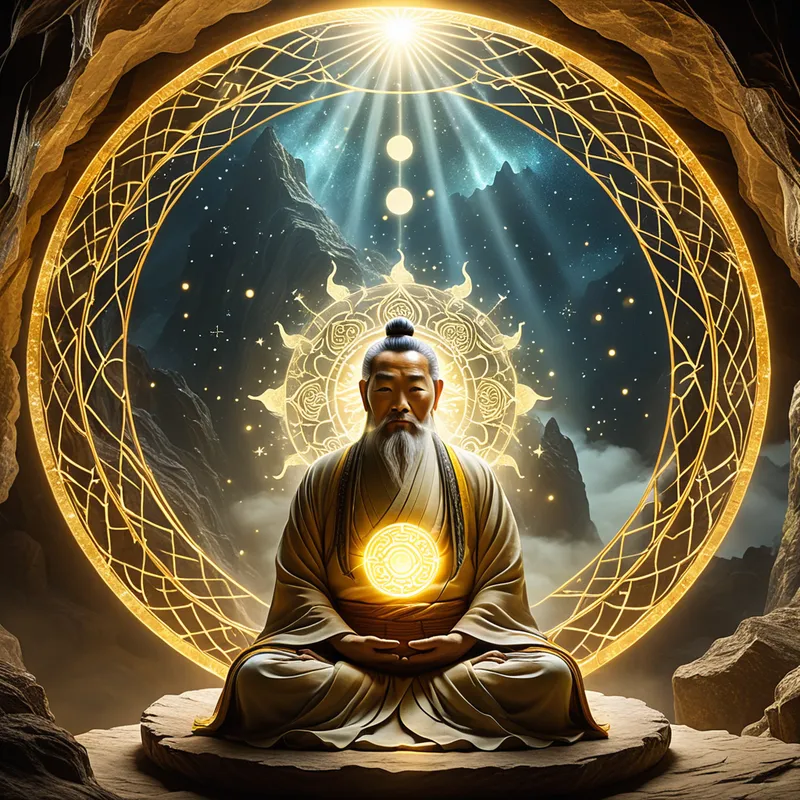
Nei Dan Myth Meaning & Symbolism
The myth of the inner elixir, where the body is a sacred crucible and immortality is found through the alchemical refinement of one's own essence.
The Tale of Nei Dan
Listen, and let the mists of Hua Shan part. This is not a story of distant gods, but of the universe within your own breath.
In the beginning, there was chaos—a swirling, formless potential the sages called Hundun. From this, the great polarities emerged: the bright, ascending force of Yang and the deep, receptive flow of Yin. They danced, and from their dance, the Ten Thousand Things were born—rivers, stones, tigers, and humankind. But within each human, a fragment of that original chaos remained, a precious yet turbulent inheritance: the unrefined Qi, the cloudy Jing, and the scattered Shen.
The first to see this inner landscape was the Yellow Emperor, Huang Di. He looked not to the stars for answers, but into the silent darkness behind his own eyes. He heard the conflict within: the fire of desire warring with the water of fear, the breath of ambition clashing with the bones of mortality. His kingdom was his own body, a realm in civil war. The conflict was the slow, relentless decay of the flesh, the dissipation of vitality with every thought and breath. The rising action was not a battle against demons, but a profound turning inward—a decision to stop seeking the elixir in distant lands and to become the alchemist of his own being.
He retired to a simple hut, not as an emperor, but as a furnace-tender. His crucible was the Cinnabar Field below his navel. His fire was the focused, gentle heat of mindful breath. His ingredients were not rare minerals, but the very substances of his life: the generative Jing, drawn upward from the kidneys; the animating Qi, gathered from the breath and blood; and the luminous Shen, descended from the heart and mind. For years, decades, he tended this inner flame. He learned to still the <abbr title="The rational, discursive mind; the "monkey mind"">Xin, the restless heart-mind, so the true Yuan Shen could preside.
And then, in the deepest stillness, the alchemy began. The coarse Jing was transmuted into subtle Qi. The refined Qi was sublimated into pure Shen. And the purified Shen returned to Wu Ji, the void. In that return, a condensation occurred—a pearl of light formed in the crucible. It was the Shengtai, the immortal embryo. It grew, nourished by silence, until one day, the emperor opened his eyes. He saw the same hut, the same mountains, but he was no longer merely within his body. He was the body, and the body was the cosmos. The resolution was not an escape from life, but a radiant embodiment of it. He had forged the Nei Dan, and in doing so, had dissolved the conflict between mortal and immortal, inner and outer, self and Tao.
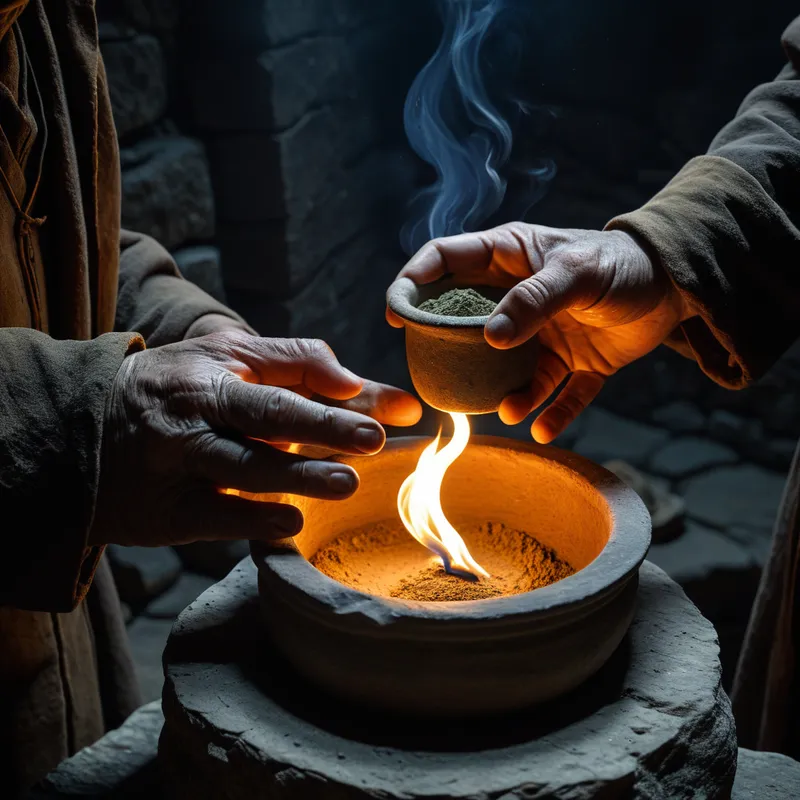
Cultural Origins & Context
The myth of Nei Dan is not a single narrative etched on temple walls, but a living, experiential doctrine that crystallized between the Han and Tang dynasties. It emerged from the confluence of earlier Taoist longevity practices, medical theories of Jingluo, and cosmological principles from the Yijing. Unlike the external alchemy (Wai Dan) that sought literal gold and elixirs, Nei Dan was a radical interiorization. It was primarily an oral tradition, passed from master to disciple in secluded mountain monasteries, often encoded in poetic and deliberately obscure language to protect its power from superficial understanding.
Its societal function was paradoxical. It was a path for the individual's ultimate liberation, yet it required profound discipline and often withdrawal from conventional social roles. It served as a metaphysical counterpart to the imperial order: just as the emperor harmonized the state, the adept harmonized the microcosm of the self. The myth provided a map for navigating the greatest human anxiety—mortality—not through afterlife promises, but through a tangible, if arduous, process of self-transformation. It was a science of the spirit, using the precise language of alchemy to describe the vagaries of consciousness.
Symbolic Architecture
At its core, the myth of Nei Dan is a grand metaphor for the process of psychological and spiritual integration. The body is not a prison, but the sacred laboratory.
The crucible is the present moment of awareness; the fire is the intensity of conscious attention.
The three treasures—Jing, Qi, Shen—represent the foundational layers of human existence: the physical and instinctual (Jing), the emotional and vital (Qi), and the mental and spiritual (Shen). The conflict is their disarray, our lived experience of being pulled apart by base desires, turbulent emotions, and scattered thoughts. The Shengtai is the symbol of the nascent, integrated Self—what Jung called the individuated personality. It is not a new thing added, but the latent wholeness revealed when the dross of the conditioned ego is burned away.
The entire process is a journey of return: refining spirit to return to emptiness, which in turn vivifies the entire being. It models the transformation of latent potential (Jing) into directed life force (Qi), and ultimately into conscious, luminous awareness (Shen). The final stage, where pure spirit returns to void, symbolizes the ego's surrender to the larger, transpersonal reality of the Tao.
The Dreamer's Resonance
When this myth stirs in the modern unconscious, it rarely appears as a Yellow Emperor. Instead, it manifests in dreams of profound inner architecture. One might dream of discovering a vast, intricate machine or a glowing furnace in the basement of their childhood home—the basement symbolizing the subconscious. There are dreams of tending a fragile, inner flame against howling winds, or of finding a radiant, warm stone or pearl in the center of one's chest after a long journey through dark, internal landscapes.
Somatically, the dreamer may be undergoing a process of consolidation. This is not the explosive drama of the hero's battle, but the slow, deep work of reclamation. Psychologically, it signals a movement from identification with thoughts and emotions (being the scattered Shen) to observation and regulation of them (tending the furnace). The dream ego is often in the role of the alchemist—patient, focused, and committed to a process whose full outcome is unseen. These dreams surface during life phases of integration: after a period of outward striving, during recovery from illness or burnout, or when consciously engaging in therapy or meditation. The body in the dream is the central symbol, often felt as a vessel being repaired, rewired, or filled with a new, potent substance.
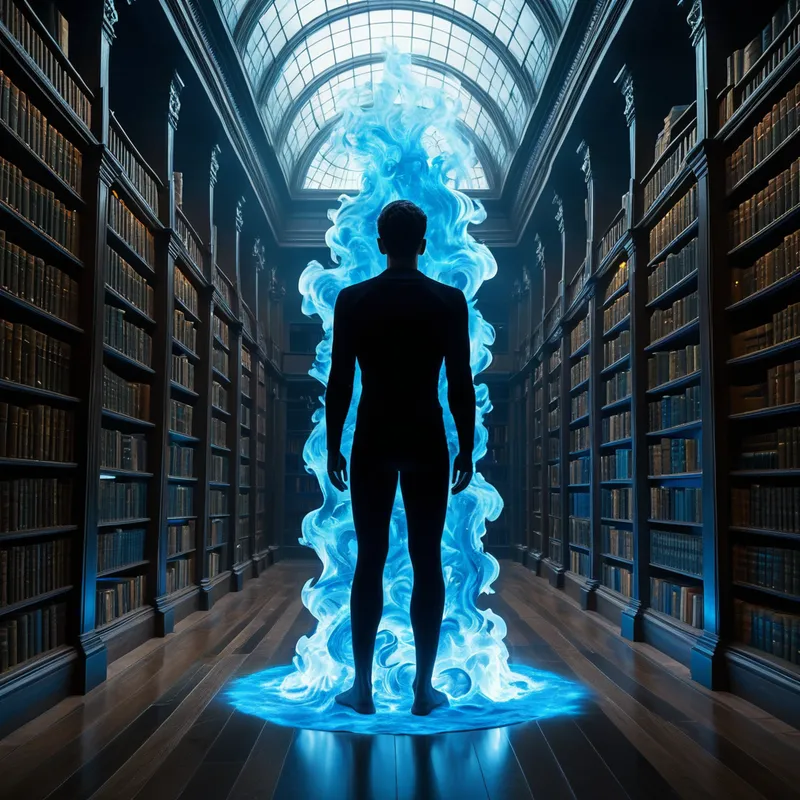
Alchemical Translation
For the modern individual, the myth of Nei Dan provides a non-theistic model of individuation. The "elixir" is not literal immortality, but the achieved state of inner unity, resilience, and authenticity.
Individuation is the internal alchemy where the lead of the persona is transmuted into the gold of the Self.
The first step is Gathering the Ingredients: confronting and accepting the raw materials of one's life—the instincts (Jing), the passions (Qi), and the complexes (Shen). This is shadow work. The Kindling of the Fire is the development of sustained self-awareness, often through practices like mindfulness or active imagination, which generates the heat of transformation.
The core alchemical operation is Circulation and Refinement: consciously processing emotional and psychic material instead of projecting it outward. Anger is not shouted, but felt in the body and understood—its energy (Qi) refined. A traumatic memory is not repressed, but revisited with compassionate witness—its essence (Jing) transmuted. The Sealing of the Crucible is the creation of a conscious container—a disciplined practice, a therapeutic relationship, a sacred space in one's routine—that prevents leakage of this precious energy.
The formation of the Shengtai is the emergence of a new, central organizing principle from the unconscious, one that aligns with the Tao of one's own nature. It feels like a quiet, unshakable knowing, a source of guidance distinct from the ego's wants. Finally, the Return to the Tao is the lived experience where this integrated self acts in the world not from need or strategy, but from spontaneous right action (Wu Wei). The struggle is the daily tending. The triumph is not a final state, but the realization that you are both the alchemist, the laboratory, and the ever-maturing elixir itself.
Associated Symbols
Explore related symbols from the CaleaDream lexicon: