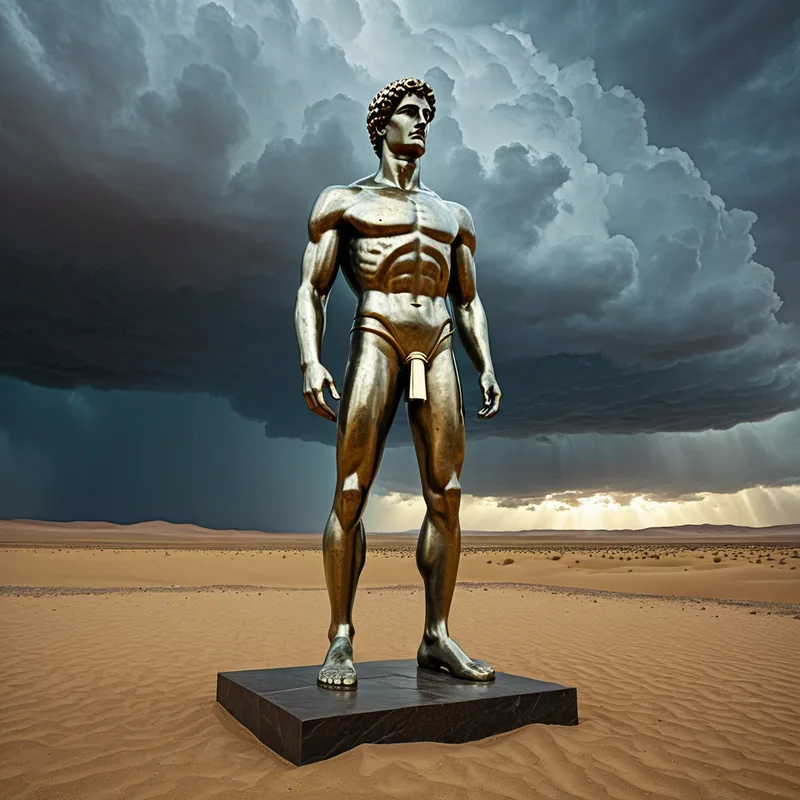
Nebuchadnezzar's Dream Statue Myth Meaning & Symbolism
A Babylonian king dreams of a magnificent, multi-metal statue shattered by a stone, revealing the fate of empires and the sovereignty of a higher order.
The Tale of Nebuchadnezzar's Dream Statue
The air in Babylon was thick with the incense of power and the silent dread of a king’s troubled sleep. Nebuchadnezzar, the ruler whose name shook the earth, lay in his palace of lapis and gold, but his spirit wandered in a land of shadows. A dream seized him—a vision so vivid, so monumental, that upon waking, its terror clung to his bones like frost, yet its form evaporated like mist in the dawn sun.
He summoned his court: the magicians, the enchanters, the sorcerers, and the Chaldeans. Their faces were pools of oil, reflecting the flickering torchlight. “I have dreamed a dream,” the king’s voice boomed, hollow with a fear they had never heard. “My spirit is troubled to know the dream.” They stammered, “O king, live forever! Tell your servants the dream, and we will show the interpretation.” But Nebuchadnezzar’s eyes were flint. “The thing is gone from me. If you do not make known to me the dream and its interpretation, you shall be torn limb from limb, and your houses shall be laid in ruins.”
A silence fell, deeper than any tomb. The wise men confessed their impotence; no man on earth could meet such a demand. The king’s decree of death hung over all the wise men of Babylon. Then, into this court of despair, stepped Daniel, a captive from Judah, whose God was not made of stone or metal. He asked for time, and with his companions, sought mercy from the God of heaven concerning this mystery.
That night, the mystery was revealed in a vision. Daniel stood before the king again, not with the flattery of courtiers, but with the clarity of one who has seen. “You, O king, saw, and behold, a great image. This image, mighty and of exceeding brightness, stood before you, and its appearance was frightening. The head of this image was of fine gold, its chest and arms of silver, its middle and thighs of bronze, its legs of iron, its feet partly of iron and partly of clay.”
The statue stood, a grotesque masterpiece of human empire, glittering in the dream-light. But as the king watched, a stone was cut out, not by human hands. It struck the image on its feet of iron and clay, and broke them in pieces. Then the iron, the clay, the bronze, the silver, and the gold all crumbled together, becoming like chaff on a summer threshing floor. The wind carried them away, leaving no trace. But the stone that struck the image became a great mountain and filled the whole earth.
Daniel’s voice was steady. “You are the head of gold.” The kingdoms that would follow, inferior and divided, were the other metals. But the stone uncut by hands—this was a kingdom established by the God of heaven, one that would never be destroyed, nor left to another people. It would break all these kingdoms in pieces and consume them, and it would stand forever.
The king’s terror melted into awe. He fell on his face before Daniel and made him ruler over the whole province of Babylon. The dream had been a window into the architecture of time, and for a moment, the most powerful man on earth glimpsed the foundation upon which his power—and all power—ultimately rested.
Cultural Origins & Context
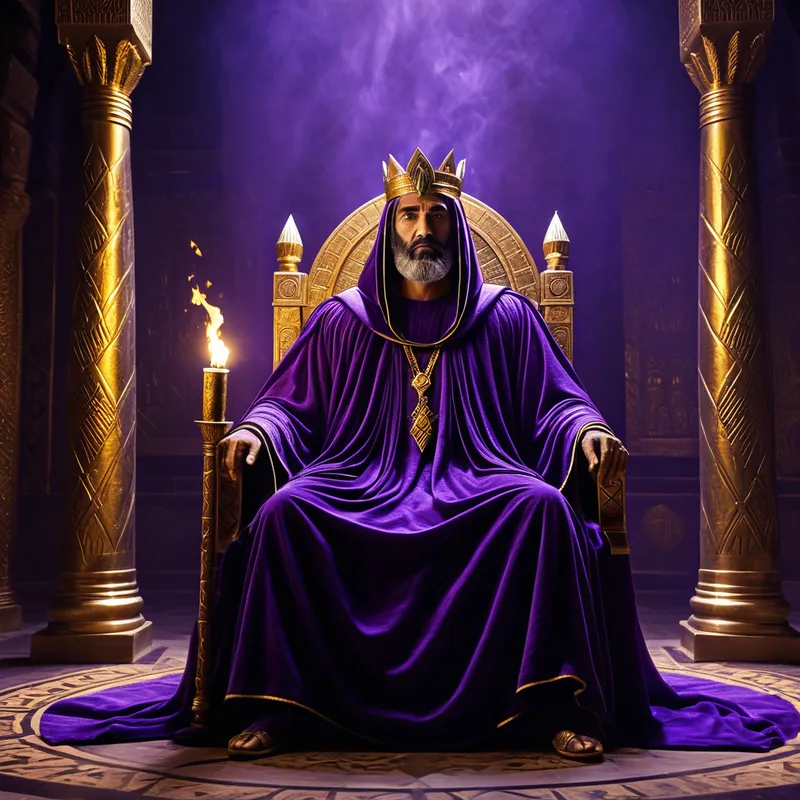
This narrative is embedded in the Book of Daniel, Chapter 2, a text composed during a period of profound crisis and resistance. While set in the 6th century BCE Babylonian exile, most scholars place its final composition in the 2nd century BCE, during the oppressive reign of the Seleucid king Antiochus IV Epiphanes. It is thus a text of diaspora wisdom and apocalyptic hope.
The story functioned as potent resistance literature for a subjugated people. It asserted that human empires, for all their glittering splendor, are transient, composite, and fundamentally fragile. Their succession—from Babylon (gold) to Medo-Persia (silver) to Greece (bronze) to Rome (iron)—is a process of degeneration, ending in the brittle mixture of iron and clay. The telling of this myth was an act of psychological and theological defiance. It transferred ultimate sovereignty from the palace-throne of a nervous king to the divine realm, offering a counternarrative to imperial propaganda. It was passed down not as mere history, but as a coded assurance: the present suffering under foreign rule was not the final word. The true, everlasting kingdom belonged to their God.
Symbolic Architecture
The statue is a perfect symbol of the ego in its most inflated, collective form: the empire of the self. Its composition tells a story of psychic entropy.
The statue is the psyche’s attempt to build a monument to its own permanence, layer by layer, from the most precious to the most base, only to discover its foundation is fatally flawed.
The head of gold represents the luminous, ruling consciousness—the brilliant idea, the founding vision, the peak of cultural achievement. It is pride and enlightenment. The silver and bronze signify the systems that follow: the administrative arms, the military might, the institutional structures that support the initial vision but are of lesser substance. The iron is raw, unyielding power—law without spirit, control without heart. Finally, the feet of iron mixed with clay are the fatal flaw: the point where the will to power (iron) cannot cohere with the mundane, earthly reality (clay). It is the instability born of inner contradiction, the point where grand ideology fails to connect with human fragility.
The stone uncut by hands is the symbol of the Self, the nucleus of the psyche that exists prior to and beyond ego-construction. It is not manufactured by human ambition or anxiety. It emerges from the unconscious, the “mountain” of the foundational earth itself. Its action is not reform but revolution; it does not repair the statue but shatters it, reducing the carefully constructed hierarchy to undifferentiated “chaff,” ready to be reintegrated into a new, organic, and whole form—the mountain that fills the earth.
The Dreamer's Resonance
When this myth pattern appears in modern dreams, the dreamer is often confronting a towering, imposing structure of their own making—a career, an identity, a belief system, a relationship—that feels magnificent but brittle. They may dream of skyscrapers with cracked foundations, prestigious awards that turn to dust, or a powerful, admired figure who is revealed to be hollow.
The somatic experience is one of awe mixed with dread, the feeling of being dwarfed by one’s own creation. The psychological process is the confrontation with psychic inflation and impending deflation. The dream is a compensatory message from the unconscious: the ego’s edifice, built on a mixture of strength (iron) and unexamined vulnerability (clay), is out of alignment with the deeper, more authentic Self. The dream signals that a process of necessary deconstruction is at hand. The “stone” might manifest as an unexpected insight, a sudden loss, a profound inner knowing, or an external event that disrupts the carefully maintained status quo, initiating a crisis that ultimately serves wholeness.
Alchemical Translation
The alchemical process modeled here is the solve et coagula—dissolve and coagulate—applied to the psyche. Nebuchadnezzar’s initial state is one of nigredo, the blackening: the terror of the unknown, the fragmentation of meaning, the despair of his wise men. The statue represents the false albedo, the whitening: an artificial, brilliant structure meant to symbolize order and permanence, but which is actually a complex of unintegrated metals (archetypes, complexes, cultural values).
The alchemical stone is not found; it is that which finds you, striking at the precise point where your conscious attitude is most rigidly mixed with unconscious weakness.
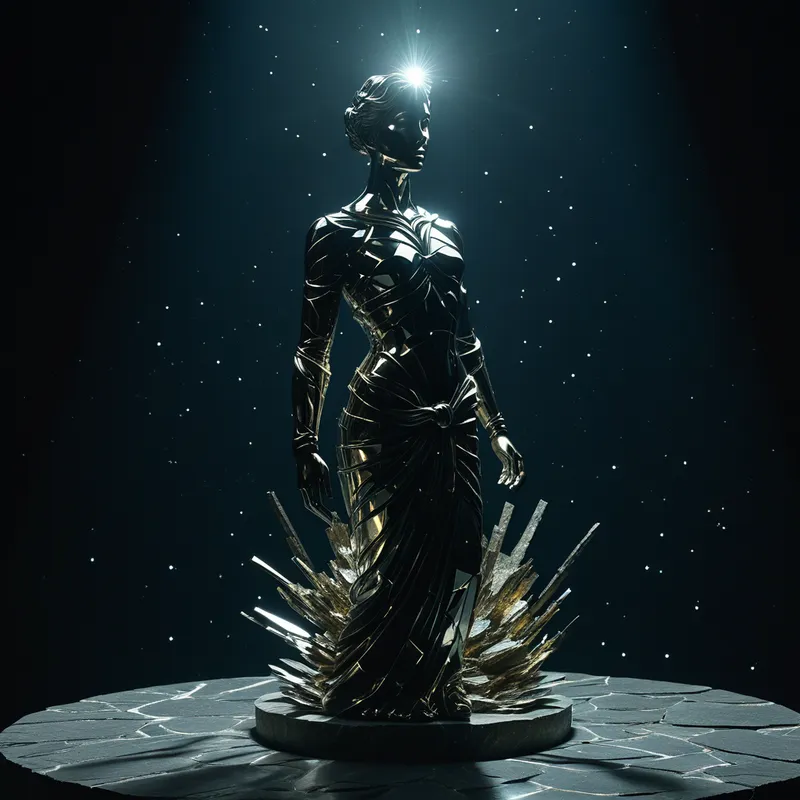
The stone’s strike is the moment of mortificatio, the death of the old, composite kingly ego. The reduction to chaff is the necessary dissolution. This is not annihilation, but the breaking apart of a false synthesis so that the essential elements can be freed. The wind that carries the chaff away is the separatio, the sorting of what is essential from what is not.
Finally, the stone becoming a mountain is the coagulatio, the rebirth into a new, grounded, and expansive form. It is the establishment of the inner kingdom of the Self. For the modern individual, this translates to the painful but liberating process of individuation. We must allow our inherited identities, our professional statues, our ideological certainties—all impressive but ultimately composite and unstable—to be challenged by the uncut stone of authentic experience and inner truth. The goal is not to build a better statue, but to become the mountain: rooted, vast, and capable of sustaining life, having integrated the metals of our experience into a living, whole earth.
Associated Symbols
Explore related symbols from the CaleaDream lexicon: