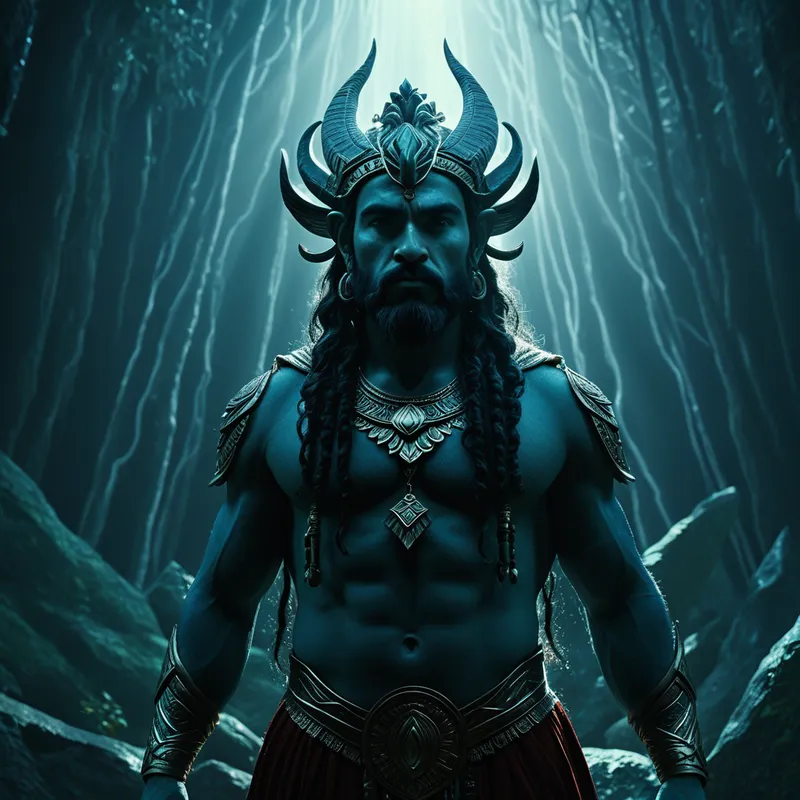
Nebuchadnezzar's Dream
The story of King Nebuchadnezzar's prophetic dream, interpreted by Daniel, revealing a divine vision of successive world empires and their ultimate fate.
The Tale of Nebuchadnezzar's Dream
In the second year of his reign, a profound disquiet settled upon the soul of Nebuchadnezzar, king of Babylon. His sleep, once the rest of conquerors, became a haunted field. Visions stalked him, a singular, terrifying image that would evaporate upon waking, leaving only the dregs of dread. His spirit was troubled, and his sleep fled from him. Summoning the entire cadre of his wise men—the magicians, enchanters, sorcerers, and Chaldeans—he issued a decree that was also a trap. He demanded not only the interpretation of the dream but the recounting of the dream itself. "Tell me my dream," he commanded, "and then its interpretation. If you cannot, you shall be torn limb from limb, and your houses shall be turned into rubble." The wise men were confounded; no art of divination could retrieve a dream the king refused to name. They stammered, "There is not a man on earth who can meet the king's demand." In his rage and despair, Nebuchadnezzar ordered the destruction of all the wise men of Babylon.
The decree reached Daniel, a young exile from Judah, a man in whom flowed the spirit of the holy gods. With prudent words and a request for time, he and his companions turned their faces toward the God of heaven in desperate prayer. That night, the mystery was revealed to Daniel in a vision. He stood before the furious king not with the tools of Babylonian omen-reading, but with a declaration of a God who reveals mysteries.
"Your dream, O king," Daniel began, his voice a channel for a truth vaster than empires, "was this: You saw a great statue, immense and exceedingly bright, standing before you. Its appearance was terrifying. The head of this statue was of fine gold, its chest and arms of silver, its middle and thighs of bronze, its legs of iron, its feet partly of iron and partly of clay. As you watched, a stone was cut out, not by human hands. It struck the statue on its feet of iron and clay, and shattered them. Then the iron, the clay, the bronze, the silver, and the gold were all broken into pieces, becoming like chaff on a summer threshing floor. The wind carried them away, leaving no trace. But the stone that struck the statue became a great mountain and filled the whole earth."
The court held its breath. Daniel had named the unnameable dream. Then he delivered its meaning: "You, O king, are the head of gold. After you shall arise another kingdom inferior to you, of silver. Then a third kingdom of bronze, which shall rule over all the earth. And there shall be a fourth kingdom, strong as iron, crushing and shattering all others. And as you saw the feet and toes partly of potter's clay and partly of iron, it shall be a divided kingdom; it will have something of the strength of iron, but mixed with clay, it will be partly strong and partly brittle. In the days of those kings, the God of heaven will set up a kingdom that shall never be destroyed. It shall break all these kingdoms and bring them to an end, and it shall stand forever. The great God has made known to the king what shall be hereafter. The dream is certain, and its interpretation sure."
Upon hearing this, King Nebuchadnezzar fell upon his face and paid homage to Daniel. "Truly," he proclaimed, "your God is God of gods and Lord of kings, and a revealer of mysteries." The terror of the dream was transfigured into awe, and the prophet of the exile was elevated to rule over the province of Babylon and to be chief prefect over all the wise men.
Cultural Origins & Context
The narrative is preserved in the Book of Daniel, a text of the Hebrew Bible set in the 6th century BCE during the Babylonian Exile, though its final composition likely occurred centuries later during the oppressive reign of the Seleucid king Antiochus IV Epiphanes (c. 165 BCE). This dual context is crucial. On one level, it is a story of Jewish wisdom triumphing in the very heart of the empire that had destroyed Jerusalem. Daniel, the exiled sage, demonstrates the superiority of his God’s revealed wisdom over the failed technical arts of the Babylonian diviners.
On a deeper level, the dream functions as a philosophy of history—a "metalistory"—from a divine perspective. The succession of metals (gold, silver, bronze, iron, iron-and-clay) was a recognized schema in the ancient Mediterranean and Near East, most famously in Hesiod’s Works and Days, which describes declining ages of man. Here, it is repurposed as a prophetic critique of imperial power. Babylon, the head of gold, is glorious but transient. Each subsequent empire is "inferior," not necessarily in territorial extent, but in moral and spiritual quality, culminating in a brittle, fragmented final state. The stone "not cut by human hands" represents the direct, disruptive intervention of the divine into human history, establishing an eternal kingdom that stands in stark contrast to the fragile, man-made empires. For a persecuted community under the "iron" heel of Hellenistic rule, this vision was not mere allegory; it was a potent theology of hope and ultimate divine judgment.
Symbolic Architecture
The statue is a masterpiece of symbolic condensation. It is the collective persona of history itself, a glittering idol of temporal order. Its composition maps the devolution of power: from the unitary, autocratic brilliance of gold (Nebuchadnezzar’s Babylon), to the dualistic arms of silver (traditionally Medo-Persia), to the widespread dominion of bronze (often seen as Greece), to the crushing, absolute strength of iron (Rome in later interpretation, or the Seleucid empire for the original audience). The feet of iron mixed with clay expose the fatal flaw in all human empire: the inherent instability of a power that seeks unity through force but is composed of incompatible elements—the strong and the brittle, the tyrannical and the democratic, the cohesive and the fragmented.
The stone uncut by hands is the archetypal symbol of the Self, the indestructible core of divine reality that exists outside the human ego’s manufacturing. It does not negotiate with the statue; it strikes at its point of greatest vulnerability—its foundation—and reduces the entire proud structure to insubstantial chaff.
The dream’s terror for Nebuchadnezzar is the terror of the ego confronted with its own destined dissolution. He is the head of gold, yet the vision shows his glorious identity as merely the first segment of a doomed entity. The interpretation transforms this terror by situating his kingdom within a divine narrative, granting even his reign a meaning, however provisional, within a cosmic story whose end is not chaos, but a kingdom of a different order.
The Dreamer's Resonance
Nebuchadnezzar is the quintessential powerful dreamer. His dream is not a personal neurosis but a collective, archetypal truth breaking into the royal psyche. He is a vessel for a message about the fate of civilizations. His initial reaction—furious demand, existential threat—is the ego’s attempt to control and weaponize the numinous content it cannot comprehend. He demands his wise men tell him his own dream, a profound psychological demand: "Know the contents of my unconscious, or be destroyed." It is the tyrannical ego’s ultimatum to the psyche itself.
Daniel, by contrast, operates from a state of receptivity and prayer. He does not "divine" the dream; he receives it as a revelation. He becomes the mediating function, the interpreter who can translate the symbolic language of the unconscious (the dream) into conscious understanding (the interpretation), thereby averting the king’s destructive rage and integrating the powerful message. The king’s final prostration is the necessary humiliation of the ego before the transpersonal truth. The dream forces a metanoia, a change of mind, in the ruler, shifting his identification from being the pinnacle of history to being a character within a divine drama.
Alchemical Translation
In the alchemy of the soul, Nebuchadnezzar’s dream represents the nigredo—the blackening, the terrifying confrontation with the shadow of one’s own grandiosity and impermanence. The glittering statue is the opus of the worldly ego, an alloyed construct of ambition, power, and cultural achievement. Its meticulous construction, from precious gold to base clay, mirrors the soul’s own journey from a pristine, golden state of potential into the complex, mixed, and compromised reality of lived existence in time.
The alchemical process requires the solve—the dissolution of this rigid, composite structure. The divine stone acts as the lapis philosophorum, the agent of transformation that strikes at the foundation, reducing the differentiated metals back to a homogeneous, primal state (chaff), ready to be reformed. The mountain that fills the earth is the coagula—the new, eternal, and holistic integration, the Self realized in the world.
The dream, therefore, is a recipe for spiritual revolution. It instructs that the path to the eternal (the mountain) necessarily passes through the shattering of the temporal idols we worship, including the idol of our own sovereign self-importance. The king must first be terrified by the fragility of his golden head before he can bow to the God who reveals mysteries.
Associated Symbols
Explore related symbols from the CaleaDream lexicon:
- Dream — The primary vessel for divine communication and unconscious truth, breaking into the conscious mind with disruptive, prophetic power.
- Statue — The composite idol of human civilization, order, and egoic achievement, magnificent yet inherently fragile and destined for dissolution.
- Stone — The symbol of the indestructible Self, of divine reality that originates beyond human effort and shatters temporal constructs.
- Mountain — The symbol of eternal, stable, and all-encompassing divine kingdom that emerges from the ruins of human empire.
- Gold — Representing the pinnacle of temporal power, brilliance, and value, yet also the first and most glorious stage of a decaying process.
- Clay — The symbol of human frailty, earthiness, and brittleness, whose mixture with iron creates fatal instability.
- Vision — A revelatory seeing that grants insight into the hidden architecture of history and the divine will.
- King — The archetype of sovereign power and ego consciousness, who must be humbled and educated by transpersonal wisdom.
- Sage — The interpreting function of the psyche, the wise one who can translate the language of symbols into conscious understanding.
- Wind — The agent of dispersion and erasure, carrying away the shattered remnants of the old order, leaving no trace for nostalgia.
- Temple — Implied in the contrast to the statue; the true, eternal dwelling of the divine versus the man-made idol of power.
- Destiny — The overarching fate of empires and souls, revealed through the dream as a narrative under divine authorship.